
This article is a continuation and further exploration of the central hypothesis presented in “What If Earth Was Created Not by God, but by Satan?”. Here, we examine one specific aspect of that idea: why sexual desire was made so extraordinarily powerful – and whether it could serve a deeper purpose within the system of material existence.
Why Was Sex Made So Irresistible?
There is one question that almost no one seems to ask:
Why does sex have to feel so good?
Not why reproduction exists.
That part is obvious.
But why turn reproduction into one of the most powerful pleasures available to a human being?
Why make sexual desire strong enough to override reason?
People lie because of sex.
They betray.
They destroy families.
They risk their reputation, money, health, and sometimes their entire lives.
The usual answer is simple:
Nature made sex pleasurable so that we would reproduce.
Fair enough.
But why did the mechanism have to be so powerful?
Could reproduction not have been driven by a simple biological instinct – without obsession, fantasies, jealousy, and the constant pull of desire?
If a human being is nothing more than a biological organism, perhaps that explanation is enough.
But if we assume that a human being is first and foremost a soul temporarily inhabiting a material body, the picture begins to look very different.
If you wanted to keep a soul attached to this world, suffering alone would not be enough.
Suffering can sometimes have the opposite effect.
Pain can make a person search for meaning.
For God.
For a way out.
So perhaps the soul must not only be made to suffer.
Perhaps it must also be seduced.
Given something it wants to return to again and again.
And sex is almost perfectly designed for that.
Desire.
Pursuit.
Pleasure.
Brief satisfaction.
And then, after some time, desire returns.
A person receives what they wanted but is never permanently freed from wanting it.
The system simply resets.
Again and again.
But there is something even more interesting.
Sex does not merely bind a person to the body.
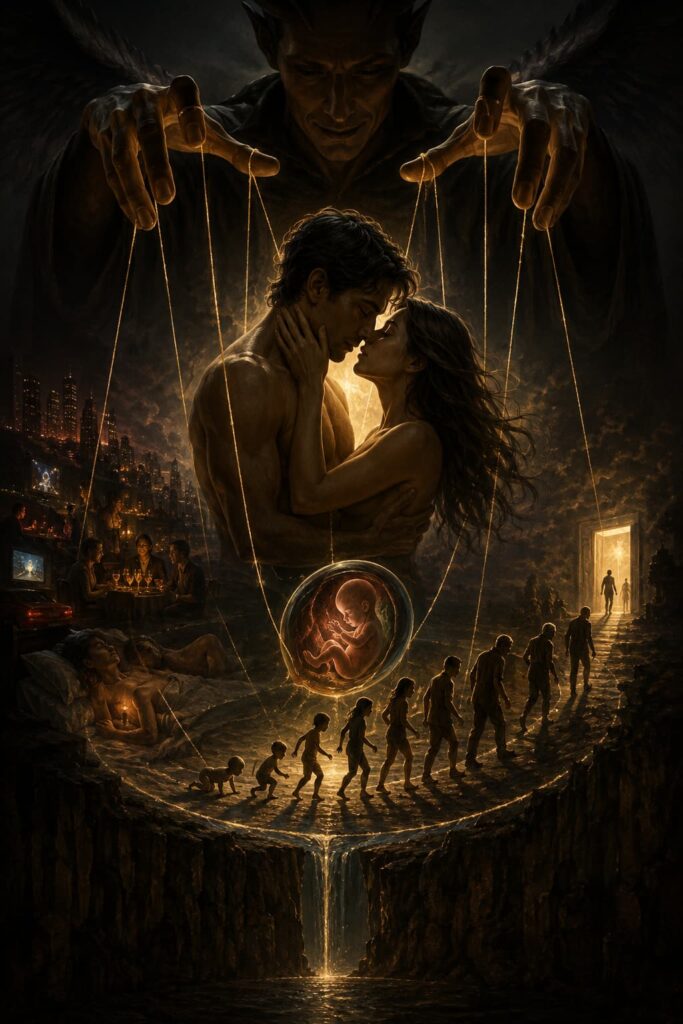
It creates new bodies.
If souls really do enter the material world again and again, then this world constantly requires new physical vessels.
And who produces them?
We do.
No one has to force us.
One of the strongest pleasures available to human beings is simply built into the mechanism.
Desire leads to sex.
A new body is created.
A soul enters it.
That person grows up, begins to desire, and creates more bodies.
The cycle continues.
The participants in the system reproduce the system themselves.
And this can be viewed as yet another argument for the hypothesis I explored earlier.
If God is absolute love, and the purpose of the soul is ultimately to return to God, why create such an extraordinarily powerful mechanism that repeatedly binds the soul to the body, desire, attachment, and further incarnations?
But if we consider another possibility – that Earth and the human body were created not by the highest God, but by another power interested in maintaining the circulation of souls within the material world – the design begins to make more sense.
Different religions and spiritual traditions have given different names and forms to such an opposing or binding force.
In Christianity, there is Satan.
In Islam, Iblis, closely associated with Shaytan.
In Zoroastrianism, Ahriman, or Angra Mainyu, the destructive adversarial spirit.
In some Gnostic traditions, the creator and ruler of the material world is the Demiurge, often identified as Yaldabaoth.
And in Sant Mat teachings, there is Kal – a power associated with time, death, karma, and the lower material realms.
These figures are not identical, and the traditions do not describe them in exactly the same way.
But it is striking that very different spiritual systems repeatedly speak of a power connected with material existence, desire, death, opposition to the divine, or the soul’s continued entanglement in the cycle of existence.
If, for simplicity, we call this force Negative Power, an intriguing possibility appears.
If Negative Power’s purpose is not to destroy the soul, but to make sure that it does not leave his world, then there is no reason to make earthly existence nothing but suffering.
Quite the opposite.
The world must be attractive enough for the soul to keep clinging to it.
It must contain beauty.
Music.
Taste.
Falling in love.
Sex.
Orgasm.
Children.
Dreams.
Because a prison made only of suffering is too obvious.
You want to escape from it.
A truly effective trap needs more than walls.
It needs bait.
And the more pleasurable the bait, the harder it becomes to notice the trap.
From this perspective, sexual desire may be more than just a biological mechanism.
It may be another clue supporting the possibility that Earth and the human body were created not by a God of absolute love, but by a power interested in keeping the cycle going.
So perhaps the deeper question is not:
“Why do religions call sex sinful?”
The more interesting question is:
Who made sex so irresistible – and who benefits if we, human beings, keep coming back here again and again?
This article is part of a broader exploration that began with “What If Earth Was Created Not by God, but by Satan?”. The question of sexual desire is only one piece of a much larger puzzle: who designed this world, how does it keep souls attached to it, and who benefits from the endless cycle of birth, desire, death, and return?
Sources and Further Reading
This essay presents a speculative philosophical argument rather than an established religious or historical conclusion. The following sources are provided to clarify the traditions, concepts, and texts discussed in the essay. Their inclusion does not imply that their authors or institutions endorse the essay’s central hypothesis.
Philosophy and the Problem of Evil
Stanford Encyclopedia of Philosophy — “The Problem of Evil”
A scholarly overview of the logical and evidential arguments arising from the apparent conflict between suffering and belief in an all-powerful, all-knowing, and perfectly good God.
https://plato.stanford.edu/entries/evil/
Stanford Encyclopedia of Philosophy — “Theodicies”
An examination of philosophical and theological attempts to reconcile divine goodness and justice with the existence of suffering and evil.
https://plato.stanford.edu/entries/theodicies/
Karma, Moral Causation, and Rebirth
Stanford Encyclopedia of Philosophy — “Naturalism in Classical Indian Philosophy”
Discusses karma as a foundational idea in Indian moral philosophy and examines differing Indian accounts of causation, moral order, and human existence.
https://plato.stanford.edu/entries/naturalism-india/
Internet Encyclopedia of Philosophy — “The Upanishads”
Explains the historical development of karma, rebirth, and liberation in early Indian philosophical thought.
https://iep.utm.edu/upanisad/
Oxford Bibliographies — “Karma”
An academic guide to the history and varied meanings of karma across Hindu religious, social, and philosophical traditions.
https://academic.oup.com/reference/62357/reference-article-abstract/554512552
Gnosticism, the Demiurge, and Yaldabaoth
Internet Encyclopedia of Philosophy — “Gnosticism”
A scholarly introduction to the diverse movements commonly described as Gnostic, including traditions in which the material cosmos is formed by an inferior or ignorant Demiurge, sometimes called Ialdabaoth or Yaldabaoth.
https://iep.utm.edu/gnostic/
Claremont Coptic Encyclopedia — “Apocryphon of John”
An academic introduction to one of the principal ancient texts associated with the Gnostic account of the material world, the archons, and the figure commonly known as Yaldabaoth.
https://ccdl.claremont.edu/digital/collection/cce/id/168/
The Apocryphon of John — Frederik Wisse Translation
An English translation of the ancient Gnostic text in which the distinction between the transcendent divine source and the lower creator of the material world is developed.
https://www.gnosis.org/naghamm/apocjn.html
Ahriman and the Zoroastrian Adversary
Encyclopaedia Iranica — “Ahriman”
An academic account of Ahriman, or Angra Mainyu, the destructive and opposing spirit in Zoroastrian tradition. This figure should not be treated as an exact equivalent of the Christian Satan or the Gnostic Demiurge.
https://www.iranicaonline.org/articles/ahriman/
Kāla, Kal, and the Sant Tradition
The Concise Oxford Dictionary of World Religions — “Kāla”
An overview of the Sanskrit concept of kāla, meaning time and, in some contexts, death or the destructive power of time. In wider Hindu traditions, Kāla is not simply another name for Satan.
https://www.encyclopedia.com/philosophy-and-religion/eastern-religions/hinduism/kala
Anurag Sagar — The Ocean of Love
A traditional text associated with the Dharamdasi branch of the Kabir tradition. It presents Kal, also called Niranjan or Dharam Rai, as a power connected with time, the lower creation, karma, death, and the cycle of rebirth. It is included here as a religious primary source, not as independently verified history or as a teaching accepted by all Indian religions.
https://archive.org/details/AnuragSagarOfKabir
Related Ideas in Christianity and Islam
The New Testament — Galatians 6:7–9
The Christian image of reaping what one has sown expresses a principle of moral consequence, although it is not identical to the Indian doctrines of karma and reincarnation.
https://www.biblegateway.com/passage/?search=Galatians%206%3A7-9&version=NRSVUE
The Qur’an — Al-Baqarah 2:286
A passage describing each soul as receiving the benefit of the good it has acquired and bearing the consequence of the wrong it has earned. This Islamic understanding of accountability should not be equated directly with karma or rebirth.
https://quran.com/2/286