Disclaimer: This essay is a philosophical exploration, not an criticism on any religion or belief. The concepts mentioned are used for reflection and are not presented as exact equivalents or established facts.
We are told that Earth was created by a loving God.
As proof, we are shown sunsets, oceans, stars, flowers, the birth of a child, and the human capacity to love.
But why do we not judge the Creator by the other side of creation?
Why are cancer, congenital diseases, parasites, earthquakes, hunger, aging, insanity, war, and death not treated as evidence too?
Why is beauty automatically attributed to God, while cruelty is dismissed as human error, a test, karma, a hidden plan, or something we are simply incapable of understanding?
Is that really honest reasoning?
If we judge an artist by his work, then we must look at the whole work.
And if we examine this world without fear, without religious conditioning, and without explanations prepared in advance, a terrifying question emerges:
What if the material world was created not by God, but by Satan?
Not necessarily Satan as the horned figure portrayed in religious imagery.
Perhaps Satan is simply the name we give to the force that created a system of suffering, death, guilt, and endless struggle.
Perhaps God exists.
But perhaps this world was not created by him.
Across different times and traditions, people have used different names for the highest divine principle and for the force opposed to it:
God, Yahweh, Allah, Brahman.
Satan, Iblis, Ahriman, the Demiurge, Yaldabaoth, Kal.
These figures are not entirely identical, but each reflects humanity’s attempt to understand the source of goodness and the nature of the force associated with evil, destruction, or imprisonment within the material world.
The World Is Built Not on Love, but on Destruction
The fundamental law of living nature is simple:
For one creature to live, another must die.
Animals devour one another. Parasites reproduce inside living bodies. Diseases use the human organism as an environment for their own survival. Plants crowd one another out. The strong take food from the weak. Old age slowly destroys the body. From the moment of birth, every living being moves toward death.F
We call this nature.
But why do we call nature good?
Imagine an architect who designs a city in which every building can exist only by destroying another building.
Imagine an engineer who creates a machine that functions only because its parts are constantly breaking and consuming one another.
Would we call that engineer loving?
Would we say that his design was perfect?
No.
We would conclude that he was either incapable of creating anything better, indifferent to the consequences, or deliberately constructing a system of torment.
Why, then, do we use a different kind of logic when we speak about the world?
The Cruelty of the World Cannot Be Explained by Humanity Alone
Believers often say that evil appeared because of free will.
Human beings were given the power to choose, and they chose violence, war, betrayal, and murder.
But humanity did not create cancer.
Humanity did not create genetic disease.
Humanity did not invent aging.
Humanity did not establish the law by which animals have been eating one another alive for millions of years.
Humanity did not create the parasite that lays its larvae inside another living creature.
Human beings do not cause earthquakes, tsunamis, or congenital disorders.
We can blame humanity for war.
But we cannot blame humanity for the basic design of biological life.
Suffering existed long before human civilization appeared.
Pain was built into nature before a human being ever committed the first sin.
The problem, then, goes deeper than human freedom.
The problem lies within the very architecture of the world.
A Benevolent God Is Also Only a Hypothesis
Whenever someone suggests that Earth may have been created by Satan, the immediate response is:
“There is no proof.”
But has it been proven that Earth was created by a loving God?
Where is the logical proof that the architect of this world is good?
We can see the result.
We can see how the system operates.
We can see that suffering is not a rare malfunction within it. It is one of its central mechanisms.
If an unknown creator builds a device that produces pain, fear, and death, it is more natural to assume that the creator is cruel, indifferent, or limited.
Yet we are asked to reach the opposite conclusion:
the more horrifying the result, the wiser the hidden plan.
The more meaningless the suffering appears, the deeper the mystery must be.
The less evidence of love we find, the more faith in that love is demanded.
That is no longer logic.
It is a justification accepted in advance.
The cruelty of the world cannot strictly prove the existence of Satan.
But the existence of this world certainly does not prove the existence of a loving architect either.
If we judge the creator only by the creation, then the hypothesis of a cruel or indifferent force appears no less logical.
Perhaps it appears even more logical.
Evil producing suffering is easy to understand.
Absolute love consciously creating a world filled with innocent suffering requires an endless chain of explanations.
Can Good Create Evil?
We are told that suffering is necessary.
It supposedly teaches us, purifies us, develops the soul, and allows us to understand goodness.
But an all-powerful God should be capable of teaching without cancer.
He should be capable of developing the soul without torture.
He should be capable of giving people wisdom without killing their children.
If God cannot create a path of growth without monstrous suffering, then he is not all-powerful.
If he can, but chooses not to, then his goodness becomes questionable.
If he knows every pain in advance, has the power to prevent it, and still consciously creates this exact system, why are we required to call him love?
The statement “we are not meant to understand” does not prove that the plan is good.
It merely ends the conversation.
But What, Then, Explains the Suffering of Children?
The strongest argument against the idea of a just world is simple:
why do children suffer?
Why is one person born with a devastating illness?
Why is one child born into safety and prosperity, while another is born into war, violence, and hunger?
If we assume that every life begins at birth, the answer becomes almost impossible to find.
But there is also the concept of karma.
(Not every spiritual tradition uses this word, yet many express a similar principle: actions carry consequences. Hinduism, Buddhism, and Jainism call it karma; Christianity speaks of reaping what one has sown; Judaism of measure for measure; and Islam of every soul receiving what it has earned. These teachings are not identical, but they share one central intuition: what we think, choose, and do does not simply disappear.)
According to the law of karma, the present life is not the beginning of the soul’s existence, but a continuation of its long journey.
A person may not remember previous lives, but the consequences of earlier actions remain.
A child whom we call innocent may be innocent within the limits of this present life, while the soul still carries causes created before it.
From this perspective, suffering is not random.
It is a consequence.
Not the punishment of a capricious God, but the operation of a law of cause and effect.
Karma explains why human destinies differ so dramatically.
Why one person is born healthy and another ill.
Why one child is surrounded by love while another endures severe trials from the beginning.
Why visible innocence does not always mean the complete absence of a cause.
We see only one page of the book and protest against what is happening because we do not know the chapters that came before.
But Who Created the Law of Karma?
Karma may explain suffering.
But it does not necessarily justify the creator of the material world.
Another question then arises:
who established this law?
Why is the soul born without remembering its past?
Why must a person suffer for something they cannot remember?
Why does learning take place through illness, loss, fear, and death?
If karma is a just law of existence, then it may stand above the personality of Earth’s creator.
Perhaps the architect of the material world did not create karma, but merely uses it.
Perhaps souls enter a system in which every mistake binds them to another birth.
A new birth creates new desires.
Desires lead to new actions.
Actions create new karma.
Karma leads to another birth.
And so the circle closes.
A person suffers, makes mistakes, becomes attached, loses, dies, and returns again.
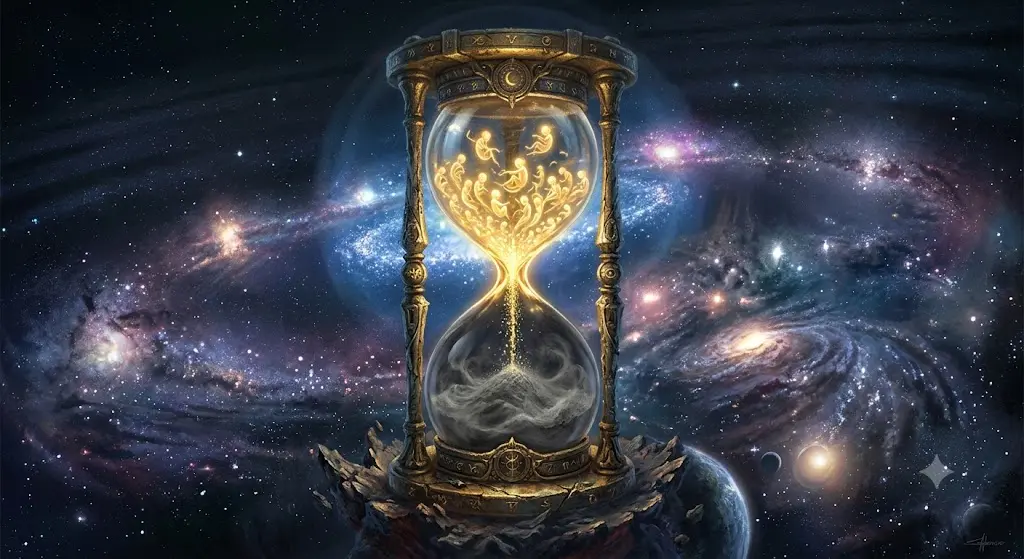
What if the material world is not God’s school, but a prison constructed by another force?
What if karma is an objective law, but the architect of Earth has transformed it into a mechanism for keeping souls trapped?
Then it becomes easier to understand why this world is both beautiful and tormenting.
A successful prison cannot be built from walls alone.
It must contain desires, pleasures, hopes, and attachments, so that the prisoner becomes afraid of freedom.
Beauty May Be Part of the Trap
We are told:
“Look at how beautiful the world is. Could Satan really have created such beauty?”
But why would a trap need to be ugly?
Quite the opposite.
The most effective trap is always attractive.
We love people whom we will inevitably lose.
We become attached to a body that will inevitably grow old.
We build homes that will one day decay.
We bring children into the world knowing that we can never protect them from every form of pain.
We are given happiness, but never a guarantee that it will remain.
We are given love together with the fear of loss.
We are given youth only for it to be slowly taken away.
We are given life, but death is made inevitable from the very beginning.
Does this not resemble a system built around attachment and eventual deprivation?
Constant pain might lead to complete emotional numbness.
But the alternation between happiness and suffering holds a person more securely.
They continue to hope.
They continue to cling.
They continue to return.
Perhaps the beauty of the world does not disprove the idea that it is a trap.
Perhaps beauty is precisely what makes the trap perfect.
If Satan Created the World, Where Did Goodness Come From?
This raises a fair question.
If the architect of the world is evil, where do love, mercy, compassion, self-sacrifice, and the longing for justice come from?
Why are human beings capable of recognizing cruelty as wrong?
Why do they not simply submit to the law of the strongest?
Perhaps because goodness does not belong to this world.
Perhaps our ability to love does not come from the architect of the material system.
Perhaps there is a fragment of another source within us.
Something higher.
Something divine.
In that case, God is not revealed through disease, earthquakes, or the food chain.
God is revealed through the doctor who fights disease.
Through the person who protects the weak.
Through the person who feeds the hungry.
Through the person who refuses to cause pain even when cruelty would be profitable.
Through the person who forgives.
Through the person who protects an animal.
Through the person who sees suffering and does not walk away.
Perhaps the evidence of God is not found in the cruelty of nature, but in humanity’s resistance to that cruelty.
And perhaps the structure of the material world speaks not of the love of its architect, but of his indifference or malicious intent.
Goodness as a Rebellion Against the Structure of the World
If nature was created by a loving God, why must humanity constantly correct it?
We build hospitals because nature kills.
We create medicine because the body breaks down.
We establish laws because the strong are capable of destroying the weak.
We build shelters because nature does not guarantee protection.
We feed the hungry because the world does not distribute food fairly.
We relieve the pain of the dying because death itself is not merciful.
Human civilization, at its best, is a struggle against the natural order.
We do not simply submit to nature.
We correct it.
We resist illness, cold, hunger, violence, aging, and death.
This creates a remarkable paradox:
human beings become more compassionate when they oppose the structure of the world.
If this world were a perfect expression of absolute love, why would it constantly need to be rescued from itself?
Perhaps goodness does not come from the rules of this system.
Perhaps goodness comes from somewhere beyond it.
And every act of compassion is a small rebellion of the soul against the architect of the material world.
Perhaps We Worship the Wrong Creator
The most dangerous thought is not that God does not exist.
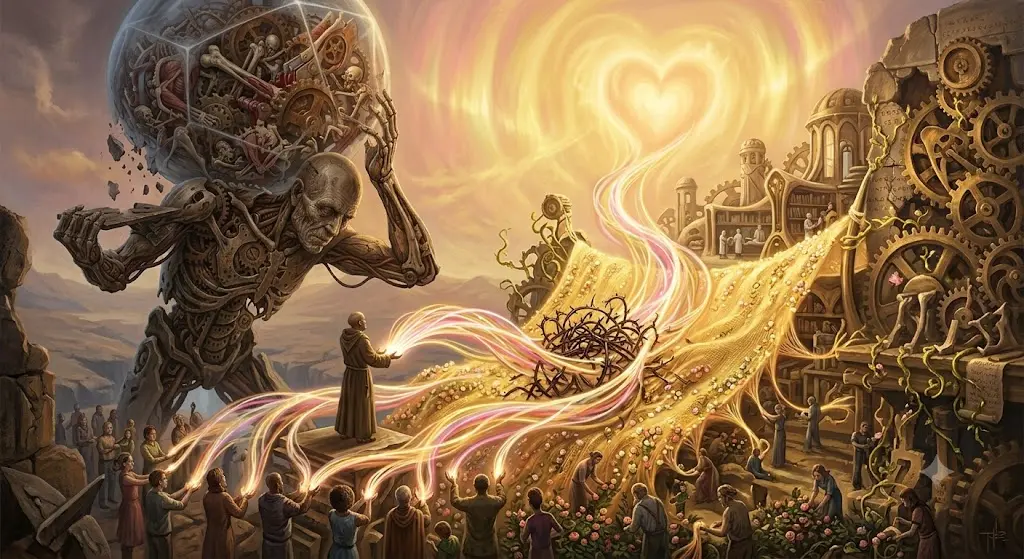
The most dangerous thought is that God does exist, but we have attributed someone else’s creation to him.
Perhaps the highest God did not create the world of suffering.
Perhaps the material world is the work of a lower power.
A power that demands worship.
A power that presents authority as love.
A power that punishes doubt.
A power that creates pain and then demands gratitude for brief moments of relief.
A power that convinces humanity that all suffering must be just, even when its purpose remains hidden.
What if the greatest religious deception is that the architect of this system called himself God?
What if the true God stands not with the one who created pain, but with the one who tries to stop it?
Then doubt ceases to be a sin.
Doubt becomes awakening.
Refusing to justify cruelty becomes a moral act.
And compassion becomes not merely a human emotion, but a trace of the true God within us.
Conclusion
I am not claiming that the existence of Satan has been proven.
But the existence of a loving creator of this world has not been proven either.
We cannot look at a flower and say, “God created this,” then look at a dying child and say, “We cannot understand his plan.”
Either creation tells us something about the creator, or it does not.
And if it does, then we must consider all of creation.
Not only beauty.
But fear.
Not only love.
But loss.
Not only birth.
But agonizing death.
The law of karma may explain why souls pass through different destinies.
But it does not prove that the architect of the material world is good.
Perhaps karma is a law through which the soul learns and eventually becomes free.
And perhaps the earthly world is a place that holds the soul through desire, forgetfulness, fear, and attachment.
Perhaps Earth truly was not created by God.
Perhaps God is revealed in the fact that human beings are capable of recognizing the evil of this world and refusing to submit to it.
Perhaps every time we reduce another being’s suffering, we act against the design of Earth’s architect.
And in favor of the God who did not create suffering, but left within us the power to resist it.
The central question, then, is no longer:
“Why did God create such a cruel world?”
The real question is:
“What made us assume that God created this world at all?”
Sources and Further Reading
This essay presents a speculative philosophical argument rather than an established religious or historical conclusion. The following sources are provided to clarify the traditions, concepts, and texts discussed in the essay. Their inclusion does not imply that their authors or institutions endorse the essay’s central hypothesis.
Philosophy and the Problem of Evil
Stanford Encyclopedia of Philosophy — “The Problem of Evil”
A scholarly overview of the logical and evidential arguments arising from the apparent conflict between suffering and belief in an all-powerful, all-knowing, and perfectly good God.
https://plato.stanford.edu/entries/evil/
Stanford Encyclopedia of Philosophy — “Theodicies”
An examination of philosophical and theological attempts to reconcile divine goodness and justice with the existence of suffering and evil.
https://plato.stanford.edu/entries/theodicies/
Karma, Moral Causation, and Rebirth
Stanford Encyclopedia of Philosophy — “Naturalism in Classical Indian Philosophy”
Discusses karma as a foundational idea in Indian moral philosophy and examines differing Indian accounts of causation, moral order, and human existence.
https://plato.stanford.edu/entries/naturalism-india/
Internet Encyclopedia of Philosophy — “The Upanishads”
Explains the historical development of karma, rebirth, and liberation in early Indian philosophical thought.
https://iep.utm.edu/upanisad/
Oxford Bibliographies — “Karma”
An academic guide to the history and varied meanings of karma across Hindu religious, social, and philosophical traditions.
https://academic.oup.com/reference/62357/reference-article-abstract/554512552
Gnosticism, the Demiurge, and Yaldabaoth
Internet Encyclopedia of Philosophy — “Gnosticism”
A scholarly introduction to the diverse movements commonly described as Gnostic, including traditions in which the material cosmos is formed by an inferior or ignorant Demiurge, sometimes called Ialdabaoth or Yaldabaoth.
https://iep.utm.edu/gnostic/
Claremont Coptic Encyclopedia — “Apocryphon of John”
An academic introduction to one of the principal ancient texts associated with the Gnostic account of the material world, the archons, and the figure commonly known as Yaldabaoth.
https://ccdl.claremont.edu/digital/collection/cce/id/168/
The Apocryphon of John — Frederik Wisse Translation
An English translation of the ancient Gnostic text in which the distinction between the transcendent divine source and the lower creator of the material world is developed.
https://www.gnosis.org/naghamm/apocjn.html
Ahriman and the Zoroastrian Adversary
Encyclopaedia Iranica — “Ahriman”
An academic account of Ahriman, or Angra Mainyu, the destructive and opposing spirit in Zoroastrian tradition. This figure should not be treated as an exact equivalent of the Christian Satan or the Gnostic Demiurge.
https://www.iranicaonline.org/articles/ahriman/
Kāla, Kal, and the Sant Tradition
The Concise Oxford Dictionary of World Religions — “Kāla”
An overview of the Sanskrit concept of kāla, meaning time and, in some contexts, death or the destructive power of time. In wider Hindu traditions, Kāla is not simply another name for Satan.
https://www.encyclopedia.com/philosophy-and-religion/eastern-religions/hinduism/kala
Anurag Sagar — The Ocean of Love
A traditional text associated with the Dharamdasi branch of the Kabir tradition. It presents Kal, also called Niranjan or Dharam Rai, as a power connected with time, the lower creation, karma, death, and the cycle of rebirth. It is included here as a religious primary source, not as independently verified history or as a teaching accepted by all Indian religions.
https://archive.org/details/AnuragSagarOfKabir
Related Ideas in Christianity and Islam
The New Testament — Galatians 6:7–9
The Christian image of reaping what one has sown expresses a principle of moral consequence, although it is not identical to the Indian doctrines of karma and reincarnation.
https://www.biblegateway.com/passage/?search=Galatians%206%3A7-9&version=NRSVUE
The Qur’an — Al-Baqarah 2:286
A passage describing each soul as receiving the benefit of the good it has acquired and bearing the consequence of the wrong it has earned. This Islamic understanding of accountability should not be equated directly with karma or rebirth.
https://quran.com/2/286