Perhaps life on Earth did not arise just once. Perhaps all the other attempts disappeared so long ago that we can no longer distinguish their traces from ordinary geology.
At first glance, the answer may seem obvious: life on our planet appeared once and then gradually began to evolve. From the first primitive organisms came bacteria, archaea, plants, animals, and eventually ourselves.
But in reality, the question in the title is far more complex.
We know for certain that life exists on Earth. We also know that it appeared very early in our planet’s history, likely more than 3.5 billion years ago. What we do not know is the deeper question: how many times did nature attempt to create life, and how many of those attempts failed?
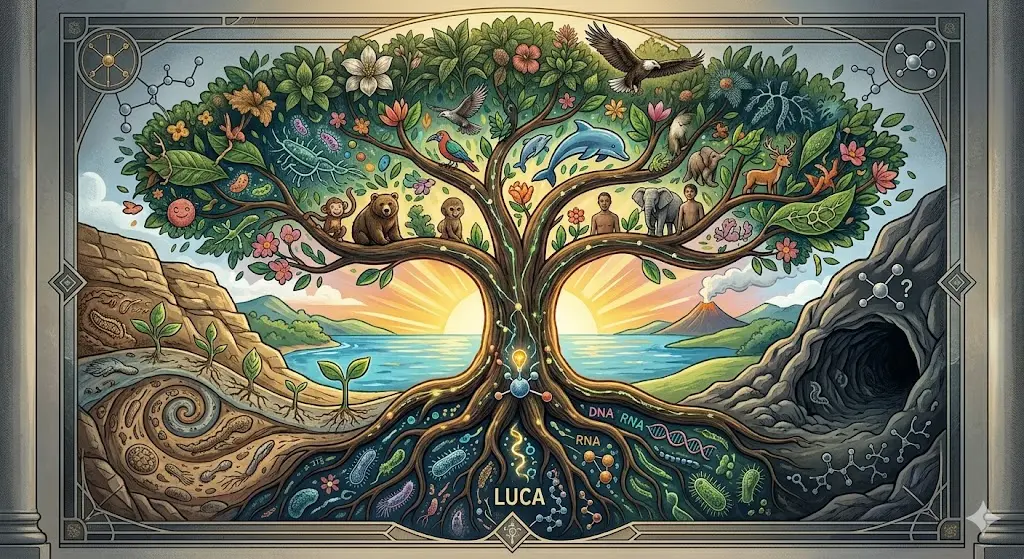
All living organisms are built in a surprisingly similar way. Bacteria, fungi, trees, whales, and humans use DNA and RNA to store and transmit information. Proteins are assembled from amino acids, and cells use ATP as a universal energy currency. What is especially striking is that the genetic code is also almost the same across all living beings.
And of course, this is not a coincidence. The diversity of life we see on Earth today traces back to a common root: the last universal common ancestor, known as LUCA. A 2024 study in Nature Ecology & Evolution describes LUCA as the point on the tree of life from which the fundamental prokaryotic domains, Archaea and Bacteria, diverged: The nature of the last universal common ancestor and its impact on the early Earth system.
It is important to be precise here: in a strict scientific sense, LUCA was not the first living organism on Earth. It was not “the first cell” and not the exact moment when non-living matter suddenly became alive. LUCA was rather the last common point from which all branches of modern cellular life descended. NASA Astrobiology also presents LUCA as an ancient common ancestor of present-day life, not necessarily as the very first life form: Looking for LUCA, the Last Universal Common Ancestor.
And this is where the story becomes especially interesting.
The fact that all modern life has a common ancestor does not prove that life arose only once. It only tells us that one successful lineage survived to the present day.
Early Earth had oceans, volcanic activity, a chemically rich environment, energy sources, organic molecules, and millions of years for experimentation. Under such conditions, different forms of proto-life may have appeared: simple chemical systems capable of growth, metabolism, and primitive inheritance.
But not every such system would necessarily have become full biological life.
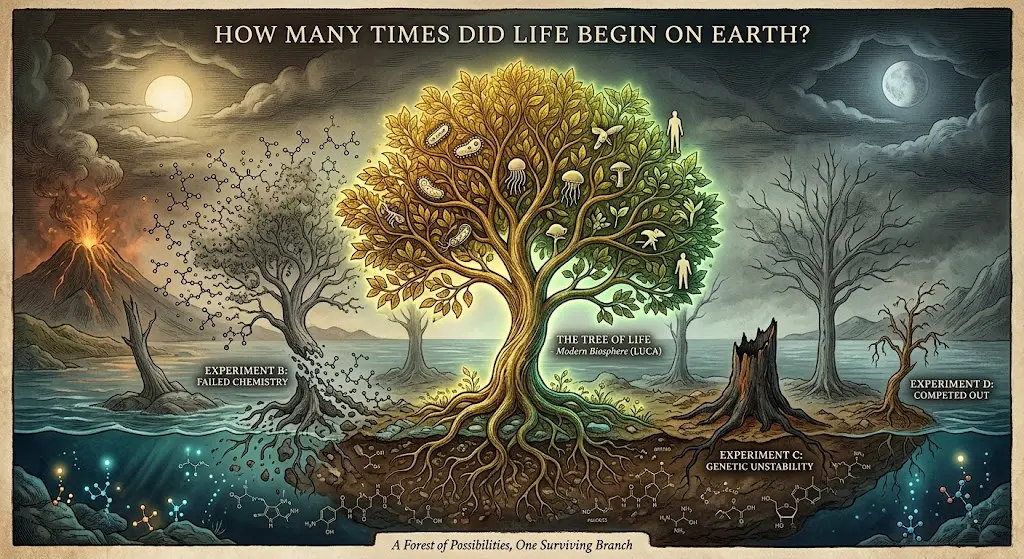
Some chemical structures may have been unstable and quickly broken apart. Others may have failed to pass information reliably from one generation to the next. Some may have existed for a while, but were eventually outcompeted by a more stable and efficient lineage.
Imagine not a single tree of life growing from one seed, but an entire forest of different trees. Some sprouts dried out almost immediately. Others grew for a time but could not survive environmental changes. Still others were displaced by stronger neighbors. After hundreds of millions of years, only one lineage remained: the one that gave rise to all modern biological evolution.
From that point onward, the surviving lineage gained a tremendous advantage. It no longer merely existed passively within its environment. It began to reshape that environment around itself. The first successful organisms used available molecules, occupied suitable ecological niches, and gradually consumed or transformed the chemical resources from which independent life might theoretically have arisen again.
This is why it is possible that life emerged more than once on early Earth, but all those experiments, except one, became evolutionary dead ends. Their traces may have vanished long ago: molecules broke down, rocks were transformed by geological processes, oceans and continents changed, and the most successful lineage of life eventually occupied the entire planet.
Scientists have proposed several scenarios for the origin of life, including the “primordial soup,” deep-sea hydrothermal vents, the RNA world, and other models. A clear overview of these hypotheses is given by the University of Chicago in its explainer: The origin of life on Earth, explained.
All these models try to answer not only the question “How did the first life appear?” but also a subtler one: why did one particular biochemical lineage become the ancestor of everything alive today?
Here it is useful to separate three things.
What we know: all modern life has a shared biochemical foundation.
What we do not know: whether that lineage was nature’s only attempt to create life.
What is possible: before LUCA, other forms of proto-life may have existed, but they left no descendants, or their traces were destroyed.
It is also worth mentioning one intriguing hypothesis: the possibility of a “shadow biosphere” on Earth. This would mean organisms with a different biochemistry from our own, perhaps using another set of molecules or an unusual form of metabolism. In simple terms, another lineage of life could, in theory, still be hiding somewhere on our planet.
However, at the moment, this remains only a hypothesis. There is no convincing evidence for it. Every organism discovered so far, no matter how strange or extreme it may seem, still belongs to the same tree of life as we do.
So the most honest answer is this: we do not know how many times life tried to arise on Earth. We only know that one attempt became so successful that it turned into our shared history.