
The Stories That Shaped Its Karma: USA
Sometimes a nation tells children stories not to comfort them, but to train them.
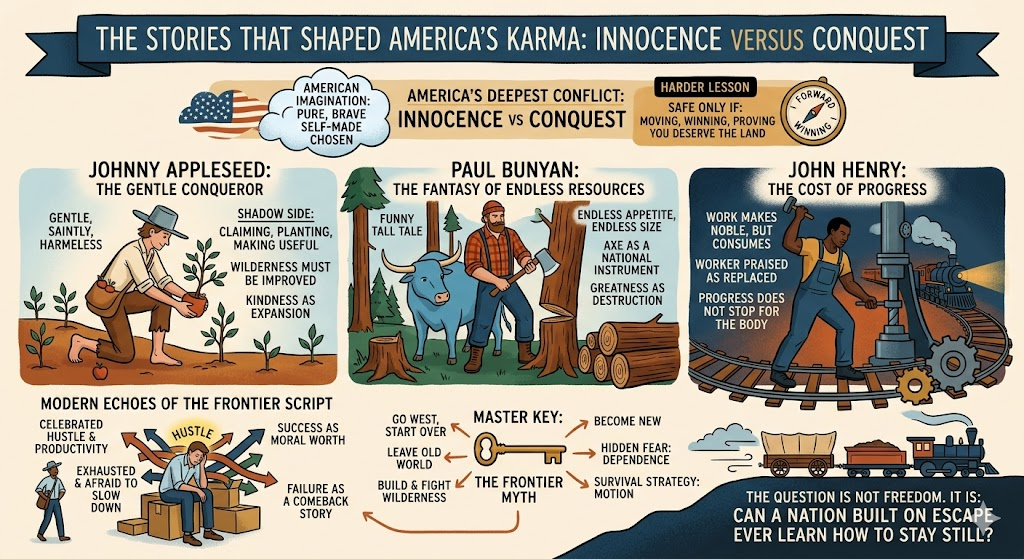
America’s deepest conflict is not freedom versus control. That is too clean. The real conflict is innocence versus conquest. The American imagination wants to believe it is pure, brave, self-made and chosen. But underneath many of its founding stories sits a harder lesson: you are safe only if you keep moving, keep winning, keep proving that you deserve the land beneath your feet.
- Take Johnny Appleseed. On the surface, he is gentle, barefoot, almost saintly. A man planting trees across the frontier. A harmless dreamer with seeds in his pocket. But the shadow side is sharper: nature becomes meaningful only when it is claimed, planted, named and made useful. The wilderness is not simply respected. It is improved. Even kindness becomes a form of expansion.
- Then there is Paul Bunyan, the giant lumberjack who cuts forests with superhuman ease. Children hear a funny tall tale. The adult mind hears something else: the fantasy of endless resources, endless size, endless appetite. The land is huge, so the hero must be huge. The axe becomes a national instrument. The uncomfortable truth is that American greatness often begins as a joke about destruction.
- And then, John Henry, the steel-driving man who races a machine and wins, only to die with his hammer in his hand. This is one of America’s most honest myths. It says: work will make you noble, but it may also consume you. The worker is praised most beautifully at the moment he is being replaced. The story honors human dignity while quietly admitting that progress does not stop for the body.
Sounds familiar, doesn’t it? The culture that celebrates hustle, reinvention, productivity and “making it” also leaves many people exhausted, replaceable and afraid to slow down. Success is not just desired. It becomes proof of moral worth. If you are struggling, the myth whispers: maybe you did not believe hard enough, work hard enough, move fast enough.
The master key may be the frontier myth. Not one story, but a national operating system. Go west. Start over. Leave the old world behind. Build a cabin. Fight the wilderness. Become someone new. Its hidden fear is dependence. Its survival strategy is motion. Do not wait to be saved. Move, claim, build, sell, expand.
Modern America still lives inside that script. Power is admired when it looks self-made. Money is treated as evidence of character. Work becomes identity. Failure is tolerated only if it can be repackaged as a comeback story.
The question is not whether America believes in freedom. It clearly does. The question is more unsettling: can a nation built on escape ever learn how to stay still?