

The Imperial Glitch: How the American Dream Became a Debt-Collection Notice
Welcome to the ultimate geopolitical therapy session. Today on the couch, we have the United States of America—a nation currently experiencing a massive identity crisis. In 2026, the global superpower looks less like a confident titan and more like a jittery tech executive who has drunk six espressos, hasn’t slept in three days, and is terrified that someone is about to find out they maxed out the company credit card.
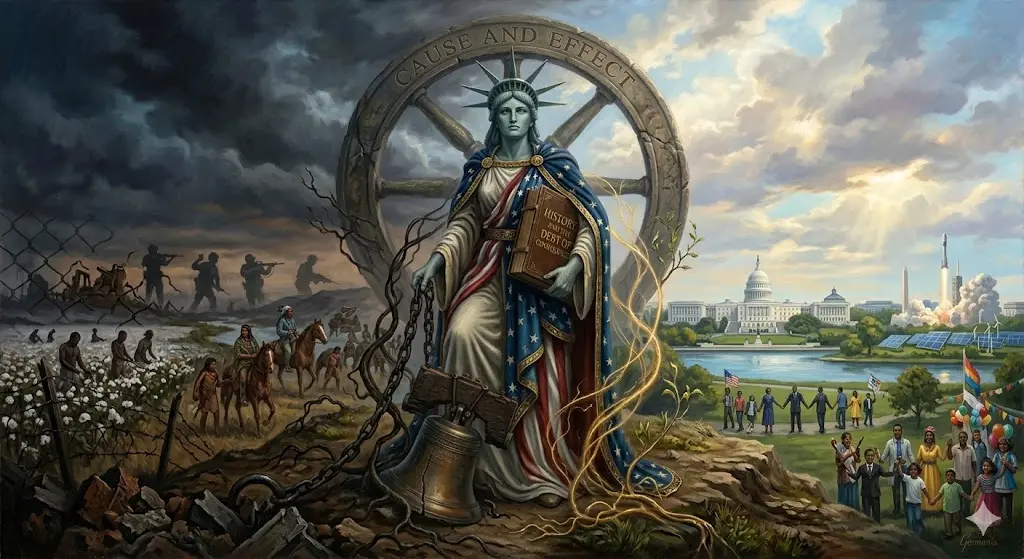
To understand why America is chewing its fingernails to the bone today, we have to look at its “karma”—not in a mystical, New Age sense, but as the cold, hard law of cause and effect. Every historical bypass, every buried atrocity, and every unpunished global intervention has a psychological price tag. And right now, the bill is coming due.
Introduction: The Transactional Soul of the Republic
Every nation is built on a foundational myth, a psychological contract between the citizen and the state. In some places, it’s about blood and soil; in others, it’s about collective security. In America, the contract is strictly transactional: “Give up your communal safety net, work yourself to the bone, and in exchange, we will grant you unlimited individual freedom and the chance to become filthy rich.”
This contract wasn’t signed in a vacuum. It was forged in the fires of three massive historical realities: the intoxicating blank canvas of a stolen continent ripe for exploitation, 250 years of free, forced labor that generated the nation’s initial capital, and the post-WWII golden age, where the US emerged as the last industrial empire standing.
Americans agreed to a society without a safety net because the jackpot seemed infinite. The state promised that you didn’t need a community or a government to protect you if you had a big enough bank account. But what happens when the frontier runs out, the jackpot shrinks, and all that’s left is a hyper-individualistic rat race built on a cracked, historical foundation? You get the modern American neurosis.
1. The Chief Internal Demon: The Trinity of Genocide, Slavery, and Overlordship
America likes to view itself as the world’s reluctant sheriff, stepping in to save the day with a lasso of democracy. But a cynical look at history reveals a pattern of behavior that looks less like peacekeeping and more like a global protection racket. When you build a nation on the total erasure of indigenous life, the literal ownership of millions of human beings, and maintain dominance through unprecedented mass destruction, that trauma eventually bleeds backward into the domestic psyche.
Here are five defining historical milestones and foundational crimes where the US acted as a brutal aggressor, creating the very ghosts that haunt its society today:
- The Century of Indigenous Genocide (19th Century): The blood-soaked bedrock of the nation. The systematic slaughter, forced displacement (like the 1838 Trail of Tears), and cultural erasure of Native American civilizations were deliberate state policies to clear land for capitalist expansion. This included breaking hundreds of treaties and the deliberate extermination of millions of American bisons to force starvation.
- The 250-Year Engine of Chattle Slavery (1619–1865): The institutionalized horror that built the American economic empire. For two and a half centuries, millions of Black human beings were legally classified as livestock—bought, sold, systematically tortured, and worked to death to power the southern cotton trade and enrich northern banks. Even after abolition, this was followed by another century of state-sanctioned apartheid (Jim Crow laws), lynchings, and redlining.
- The Atomic Vaporization of Hiroshima and Nagasaki (August 1945): The ultimate display of playing God. Under the guise of “saving lives,” the US became the only nation to use nuclear weapons on human populations. By instantly incinerating over 210,000 mostly civilian men, women, and children, this was a terrifying geopolitical flex to intimidate the Soviet Union at the dawn of the Cold War.
- The Vietnam Slaughter (1955–1975): A catastrophic intervention based on geopolitical paranoia. The US dropped more bombs on Indochina than were used in the entirety of WWII, unleashed millions of gallons of toxic Agent Orange, and caused the deaths of over 2 million civilians—all to prevent a small nation from choosing its own economic system.
- The Iraq Invasion (2003): A textbook war of aggression launched under manufactured pretenses (the non-existent Weapons of Mass Destruction). It destabilized an entire region, led to the deaths of hundreds of thousands of Iraqi civilians, birthed ISIS, and normalized state-sanctioned torture at Abu Ghraib.
The Karmic Feedback Loop
How do these foundational bloodstains manifest in 2026? Through an all-pervading cultural paranoia, domestic militarization, and deep racial trauma.
The original sin of taking a continent by force and enslaving generations has created a deeply rooted, subconscious fear: “If we did this to others for our profit, what stops someone from doing it to us? What happens if those we oppressed rise up?” This manifests as a manic obsession with walls, civilian arsenals, and the highest incarceration rate on the planet—a prison-industrial complex that heavily targets minorities and acts as a direct, legalized continuation of forced labor.
Today, that exported violence and historical cruelty has completely returned home. The domestic police force looks and acts like an occupying army, driving surplus military vehicles down suburban streets. Saturated with the very firearms used to secure its borders and empire, the culture has turned inward, turning neighbors into existential threats.
2. National Fixation in Everyday Life: Toxic Hyper-Individualism
The great American pride is “Independence.” The cowboy who needs nobody, the self-made billionaire, the rugged individualist. In the 21st century, however, this noble trait has been driven completely off the cliff into a bleak, dystopian absurdity.
Take a look at the modern American relationship with health, labor, and basic survival. In any other developed nation, if you get sick, you go to the hospital, get treated, and go home. In the US, a medical emergency is an existential threat to your class status.

The absolute peak of this absurdity is the normalization of GoFundMe as a legitimate pillar of the American healthcare infrastructure. It is considered “heartwarming” when a community raises money so a nine-year-old can afford cancer treatment by selling lemonade. In reality, it is a psychological horror show.
Because Americans are conditioned to believe that any collective social responsibility is “socialism,” they prefer to rely on algorithmic charity. The fixation on “not paying for anyone else” means everyone pays double through inflated insurance premiums and crippling debt. The individual is totally sovereign, completely free—and entirely alone in an icy void.
3. Anatomy of National Doublethink
The gap between what America says it is and what America actually does is wide enough to sail an aircraft carrier through. Here is the reality contrast of the mid-2020s:
| The Beautiful Myth / The Facetious Façade | The Gritty Reality in 2026 |
| “The Shining City on a Hill” The global beacon of human rights, democracy, and freedom of speech that lectures the rest of the world on morality. | Systemic Disenfranchisement & Oligarchy A political system entirely legalized by corporate lobbying (Citizens United), where gerrymandering, voter suppression, and billions of dark dollars mean policy reflects the desires of the top 1% rather than the electorate. |
| “All Men Are Created Equal” The core democratic promise written by the Founding Fathers in the Declaration of Independence. | The Slaveholder Paradox Thomas Jefferson wrote those words while owning over 600 human beings. In 2026, this manifests as generational wealth gaps, where the descendants of slaves own a fraction of the assets of white households due to centuries of systemic economic exclusion. |
| “The Land of Opportunity” The meritocratic paradise where anyone can make it if they just work hard enough. | The Hereditary Meritocracy Class mobility in the US is lower than in most of Western Europe. Shackle an entire generation with $1.6 trillion in student debt, soaring housing costs, and stagnant wages, and the American Dream becomes a mathematical impossibility. |
| “Leader of the Free World” The champion of international law, global treaties, and sovereign justice. | The Sovereignty Exception The US routinely refuses to ratify the International Criminal Court (ICC) treaties and reserves the right to invade The Hague if an American soldier or leader is ever put on trial for war crimes (The American Service-Members’ Protection Act). |
📊 POLL : The Price of a Clear Conscience
4. The Main Fear Paralysis System
What keeps the engine of this frantic machine running? Fear. But it’s not the fear of foreign dictators or terrorist cells; it’s the sheer terror of falling off the economic tightrope.
In America, there is no net. If you slip, you don’t just get bruised; you disappear into the underclass. This creates an intense, systemic risk-aversion disguised as corporate compliance. Employees, managers, and civil servants are trapped in a loop where true innovation or systemic critique is a fast track to ruin.
The Systemic Compliance Loop
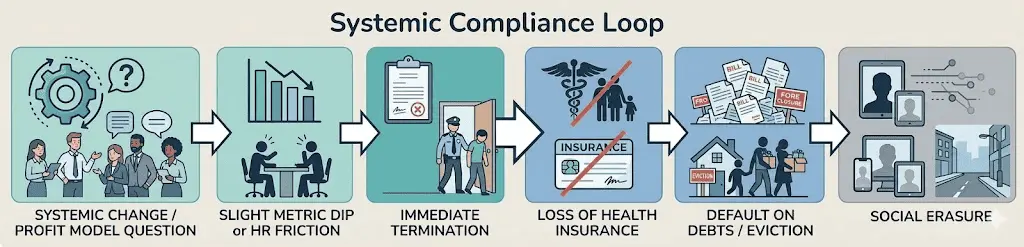
Because survival is directly tied to your employer, the American worker is profoundly unfree. This fear paralyzes the political system: any attempt to fix the structural rot (like introducing universal healthcare or reining in Wall Street) is instantly blocked by a wall of terrified resistance from people who worry that changing the rules will cause their fragile world to come crashing down.
5. The Trap of Past Laurels
America is currently trying to cruise on the momentum of a vehicle built in 1950. It relies heavily on three historical strokes of luck:
- The Petrodollar and the Reserve Currency: The fact that the entire world has to buy oil and settle trade in US dollars, allowing Washington to print money endlessly without facing immediate hyperinflation.
- Geographic Inviolability: Two massive oceans separating it from any real military rivals, meaning its infrastructure has never been devastated by modern war on its own soil (unlike the nations it has bombed).
- The Silicon Valley Monopolies: The legacy of 1990s tech dominance that created the digital infrastructure of the modern world (Google, Apple, Microsoft).
But this old toolkit is failing in the multipolar reality of the 2020s. You cannot fix crumbling 70-year-old bridges, a failing power grid, or a decaying public education system by printing more dollars or launching another social media app.
While rival nations spend decades building high-speed rail and dominant manufacturing ecosystems, America has financialized everything. It doesn’t build things anymore; it builds complex financial instruments to extract profit from things that already exist. The country is coasting on the cultural and economic capital of its grandparents, ignoring the fact that the engine is smoking.
6. Diagnosis: The Inertia of the Money Printer
Why doesn’t America collapse tomorrow, despite these glaring fractures? Because it possesses the ultimate get-out-of-jail-free card: The global financial system is co-dependent on its survival.
The rest of the world holds too much American debt and relies too heavily on American consumer markets to let the country simply sink. So, the world keeps funding the American stagnation, buying its treasury bonds and propping up its currency. It’s an economic Mexican standoff.
But this brings us to the heaviest, most stubborn karmic lesson that the United States refuses to learn: You cannot bomb, spend, or market your way out of structural domestic decay.
The ultimate lesson is that true greatness isn’t measured by how many aircraft carriers you have, or how high the S&P 500 can climb while your citizens are sleeping in tents under highway overpasses. Until America realizes that its greatest enemy isn’t external, but rather its own refusal to look into the mirror and account for the lives it has broken—built on stolen land, fueled by stolen labor, and maintained by global violence—it will remain trapped in this anxious cycle. It will continue to be a hyper-armed, hyper-stressed empire, staring out the window of a heavily fortified mansion, terrified of the very world it spent the last century trying to run.
How this analysis was written
This analysis was written as a cultural and psychological reading of the United States through its founding myths, imperial habits, economic dreams and national obsession with reinvention. It looks at America not only as a country, but as a powerful story: the promise that anyone can start again, rise higher, win bigger and escape the limits of the past.
The essay focuses on several recurring codes: the American Dream, frontier mentality, individual freedom, debt, competition, exceptionalism and the fear of weakness. It does not claim to describe every American individual. Instead, it reads the USA as a collective myth under pressure: a nation built on the idea of unlimited possibility, now forced to confront the costs of that promise.
Sources / Further Reading:
Alexis de Tocqueville, Democracy in America; Jill Lepore, These Truths; Howard Zinn, A People’s History of the United States; Richard Slotkin, Gunfighter Nation; David Graeber, Debt: The First 5,000 Years; Sarah Churchwell, Behold, America.
Wait, America really nuked Japan?
But honestly, it feels like Japan also did things that led to this. Still, America did something awful too. Damn, it’s a vicious circle.
America will get its karma too.