
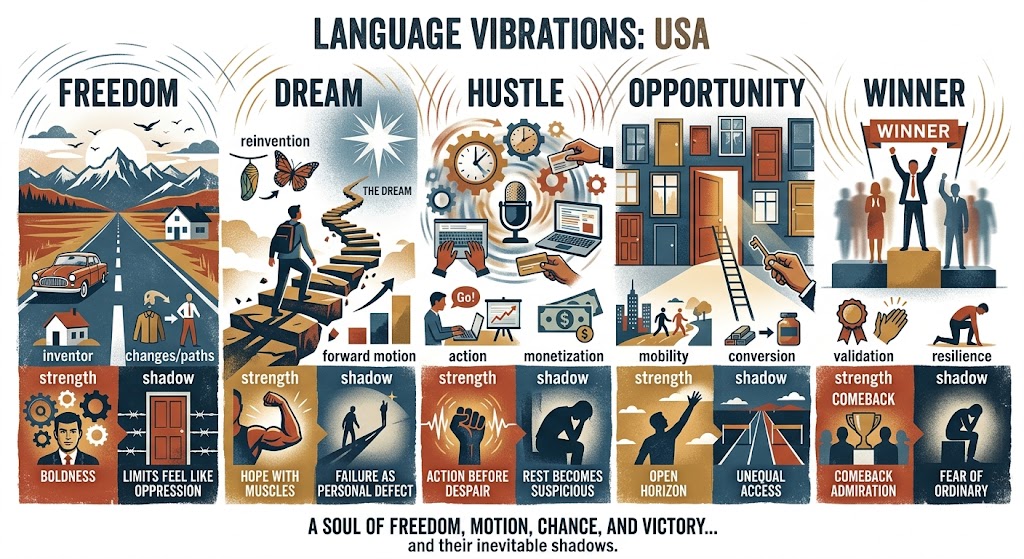
Freedom
Freedom in the United States is not just a political value. It is the sacred right to choose your own path and not ask permission.
Behind this word stands the central American nerve: my life, my choice, my risk, my responsibility. Freedom is not treated as a luxury. It is treated as proof of dignity.
It lives not only in elections and speeches. It lives in the car, the highway, the private house, the right to move states, change jobs, change partners, change religion, change your name, change your story.
Its strength is obvious. It creates boldness. It creates inventors, rebels, entrepreneurs, people who do not wait for permission from above.
But its shadow is just as powerful. When freedom becomes sacred, every limit can start to look like oppression. Even a rule. Even a tax. Even public responsibility. Even protection for someone weaker.
From this comes:
- the cult of personal choice
- suspicion toward government
- admiration for self-made people
- fear of being controlled
This is a language where freedom can become more important than fairness. America wants to be free, sometimes even from the consequences of its own freedom.
Dream
Dream in the United States is not just a private fantasy. It is a contract with destiny: work hard enough, and the door should open.
The American Dream is one of the country’s deepest emotional machines. It tells people that birth is not a final sentence. You can rise. You can escape. You can reinvent yourself. You can become more than anyone expected.
This word gives the nation its forward motion. Life should improve. The job should get better. The house should get bigger. The child should go further. The next version of you should outperform the previous one.
Its strength is hope with muscles. It keeps people moving after failure. It turns biography into a project.
But its shadow is cruel. If success is seen as available to everyone, failure starts to look like a personal defect. Not bad luck. Not a broken system. Not unequal access. Just you, not wanting it badly enough.
From this comes:
- belief in second chances
- the cult of ambition
- shame around poverty
- the endless chase for self-improvement
This is a language where even hope has to be productive. In America, the dream does not sleep, it works overtime.
Hustle
Hustle is the sound of life on high speed. Move, sell, pitch, build, monetize, survive.
Behind this word stands a nervous belief: as long as you are moving, you have not lost. Hustle turns time into capital, personality into brand, talent into product, exhaustion into proof of commitment.
Its strength is energy. Hustle pulls people out of passivity. It teaches action before despair. Send the email. Start the business. Knock on the door. Try again.
But the shadow is almost neurotic. If everything must become productive, rest becomes suspicious. Silence feels like failure. A hobby becomes a side hustle. A person becomes a business model.
From this comes:
- the cult of busyness
- admiration for aggressive effort
- fear of stopping
- monetization of almost everything
This is a language where a person does not simply live. They must constantly prove to the market that they are still useful.
Opportunity
Opportunity is not just a chance. It is a door that must be noticed, opened and converted into results.
In the American imagination, opportunity is almost a moral test. Did you see it? Did you take it? Did you move fast enough? Did you turn it into something?
This word feeds the myth of the open horizon. Somewhere there is another city, another job, another investor, another school, another version of your life. If the door is closed, find a window. If there is no window, build one and call it a startup.
Its strength is mobility. It keeps the culture flexible, restless and inventive.
But its shadow is denial. Opportunity can become a beautiful word used to hide unequal access. Some people begin with networks, schools and capital. Others begin with debt, fear and two jobs.
From this comes:
- belief in the open door
- geographic and social mobility
- entrepreneurial thinking
- discomfort with structural inequality
This is a language where opportunity looks available to everyone. But not everyone is handed the same map.
Winner
Winner in the United States is not simply someone who won. It is almost a moral identity.
To be a winner is to be validated by results. It means discipline, strength, intelligence, drive. It means you proved something. Not just to others, but to yourself.
Behind this word stands a hard psychological mechanism: outcome becomes a language of worth. Life is not only lived, it is measured. The story is not complete until it becomes a success story.
Its strength is resilience. The culture admires comeback because defeat can be forgiven if it becomes the first act of victory.
But its shadow is brutal. It becomes difficult to be ordinary, tired, slow, unsure or simply human. Even peace can feel like underachievement.
From this comes:
- the cult of success
- fear of losing
- admiration for strength
- hidden shame around ordinary life
This is a language where victory becomes proof of value. And that is why America fears losing even in places where nobody needed to compete.
What do these words reveal about the soul of this country?
The soul of the United States speaks in the language of freedom, motion, chance and victory.
It is a country that believes a person can rewrite fate. But the price of that belief is high: anxiety, loneliness, fear of failure and the silent suspicion that if you did not win, you simply did not try hard enough.