Language Vibrations: Words That Do Not Translate, But Shape a Nation’s Fate
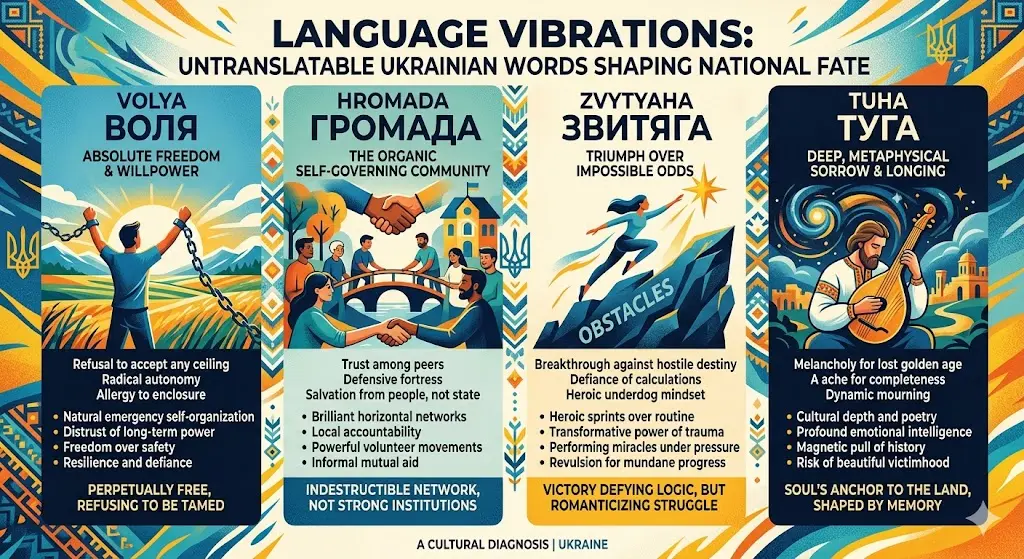
Воля – Volia
Pronunciation: VOH-lya
Volia is not simply freedom. It is freedom with a pulse, a will that refuses to kneel even when kneeling would be safer.
Behind this word stands one of the deepest Ukrainian nerves: dignity is not given by the state, by empire, by law or by permission. It is held inside the person, sometimes quietly, sometimes stubbornly, sometimes with terrifying patience.
Volia lives in the field, in the song, in the refusal, in the homemade strategy of survival. It is not elegant freedom. It is freedom with mud on its boots. It does not ask, “Am I allowed?” It asks, “How much will it cost me?”
This word creates a culture where submission may happen externally, but internally it is never fully accepted. A person can obey the rules and still keep a private kingdom inside. That private kingdom is dangerous to any power that wants full obedience.
The strength of volia is obvious: it produces endurance, courage and the ability to rise after being broken. Its shadow begins when freedom becomes allergic to structure. Then every rule starts to look like occupation, every compromise like betrayal, every institution like a cage.
From this comes:
- deep suspicion toward imposed authority
- admiration for courage under pressure
- emotional loyalty to independence
- difficulty trusting stable institutions
Volia gives Ukraine its fire. But fire can warm a house or burn down the furniture.
Громада – Hromada
Pronunciation: hro-MAH-da
Hromada is community, but not in the soft decorative sense. It is the instinct to gather, decide, help, repair and survive when official systems are too slow, too distant or too compromised.
Behind this word stands a practical psychology: if the center fails, the people nearby must become the center. Ukraine often thinks from below upward, from yard to village, from neighborhood to volunteer network, from kitchen table to public action.
Hromada is not just a group of people living near one another. It is a moral test. Are you useful? Do you contribute? Do you show up when something burns, breaks, floods, collapses or needs to be defended?
This word shapes daily life more than it may seem. It creates quick horizontal alliances, informal problem-solving and a talent for self-organization. It also explains why Ukrainians can distrust the state and still show astonishing civic energy.
The strength of hromada is solidarity without waiting for instructions. Its shadow begins when the circle becomes closed. Then “our people” get help, while strangers must first prove they deserve entry.
From this comes:
- strong local mutual aid
- quick volunteer mobilization
- respect for practical contribution
- suspicion toward distant bureaucracy
Hromada is Ukraine’s hidden infrastructure. Sometimes it works better than the official one, which is both a miracle and a warning.
Свої – Svoi
Pronunciation: svo-YI
Svoi means one’s own, one’s people, those who belong inside the circle. It is a small word with a very powerful gate.
Behind it stands the psychology of trust in a country where trust has often had to be selective. Not everyone is safe. Not every official is helpful. Not every polite smile means goodwill. So the culture develops an inner radar: who is svii, and who is not?
Svoi does not always mean family. It can mean a neighbor, a friend of a friend, a person from the same struggle, the same town, the same moral code. It is less about blood and more about recognition. You see something familiar in another person and lower your guard.
This word makes relationships warm, loyal and protective once the border is crossed. Inside the circle, there can be generosity, humor, food, help, emotional honesty and fierce defense. Outside the circle, there can be caution, irony and silence.
The strength of svoi is loyalty. The shadow begins when trust becomes tribal. Then rules matter less than connections, fairness bends toward insiders, and society quietly divides into “ours” and “not ours.”
From this comes:
- strong personal loyalty
- careful social testing
- warmth inside trusted circles
- risk of informal favoritism
Svoi is a beautiful word until it becomes a locked door. Then belonging turns from shelter into border control.
Хата – Khata
Pronunciation: KHA-ta
Khata is not just a house. It is the private republic of survival, the place where history may rage outside, but the stove, table and family order still claim reality.
Behind this word stands a Ukrainian instinct for rootedness. The world may be unstable, but the home must be made livable. Even if it is modest. Even if it is temporary. Even if tomorrow is uncertain.
Khata carries a deep psychological message: dignity begins in one’s own space. A whitewashed wall, a clean table, preserved food, a garden, a repaired fence, a towel, a corner for memory. These are not small domestic details. They are a defense against chaos.
This word influences the attitude toward property, land, family and privacy. The home is not just comfort. It is proof that life has not been defeated. To lose it is not only economic loss. It is a wound to identity.
The strength of khata is the ability to rebuild life from the smallest base. Its shadow begins when the private home becomes more trusted than the public world. Then people perfect the house while the street, the system and the common space remain neglected.
From this comes:
- deep attachment to home and land
- pride in domestic order
- resilience through practical rebuilding
- weak trust in public structures
Khata is Ukraine’s small fortress. The danger is that a nation cannot live only inside fortresses.
Доля – Dolia
Pronunciation: DOH-lya
Dolia means fate, but not cold fatalism. It is the sense that life gives each person a path, a burden, a share, a strange invisible script that must be met, negotiated or outwitted.
Behind this word stands a culture that knows life is not fully controllable. Weather, war, power, poverty, family history, geography, loss, luck. A person can work hard and still be struck by forces larger than effort.
But dolia is not passive. It does not simply say, “Nothing can be done.” It says, “This is what was given. Now what kind of person will you become inside it?”
This word creates emotional depth. It makes people sensitive to suffering, endurance and the moral weight of a life story. It also gives Ukrainian culture its melancholic intelligence: joy is real, but it is rarely naive.
The strength of dolia is acceptance without spiritual stupidity. Its shadow begins when pain becomes identity. Then suffering is romanticized, repetition is mistaken for destiny, and people endure what should be changed.
From this comes:
- emotional seriousness
- respect for endurance
- belief in meaningful suffering
- danger of accepting too much
Dolia gives Ukraine depth. But depth becomes dangerous when a nation starts treating wounds as proof of character.
What do these words reveal about the soul of this country?
These words reveal a country built around one sharp paradox: Ukraine wants freedom, but survives through belonging; it mistrusts power, but creates community; it loves the home, but is repeatedly forced to defend the road, the field, the border and the future.
The soul of Ukraine is not soft folklore. It is a stubborn argument with fate, spoken in the language of home, will, loyalty and fire.