The Anarchy of the Borderlands: The Karmic Reckoning of Ukraine
If you want to understand why a country is stuck in a loop, don’t look at its current GDP figures or the promises of its politicians. Look at its collective psychological contract — the unspoken, deeply buried agreement between the average citizen and the state.
In Ukraine, this contract was forged not in the halls of structured parliaments, but in the wild, exposed steppes. For half a millennium, the deal has been simple, cynical, and brutal: “The state is a predatory, alien beast. Survival is a solo sport. You owe the authorities nothing, and they owe you even less.”
This is a culture shaped by a foundational trauma of geography. Ukraine’s very name literally translates to “Borderland.” Flattened between nomadic empires from the east and rigid European powers from the west, the land has historically been a highway for other people’s armies. Because the state was almost always foreign — whether Mongol, Polish, Russian, Ottoman, or Soviet — the institutional authorities were viewed not as protectors, but as tax collectors, press-gangs, and executioners.
The tragic triumph of Ukrainian history is that the people learned to survive without a state. The karmic trap, however, is that they never learned how to build a functional one of their own.
1. The Chief Inner Demon: The Curse of the Fractured Sword
Every nation has a historical mirror it hates to look into. For Ukraine, that mirror reflects a terrifying paradox: a culture with a colossal capacity for heroic, decentralized resistance, paired with a complete, near-total inability to maintain institutional order once the common enemy is gone.
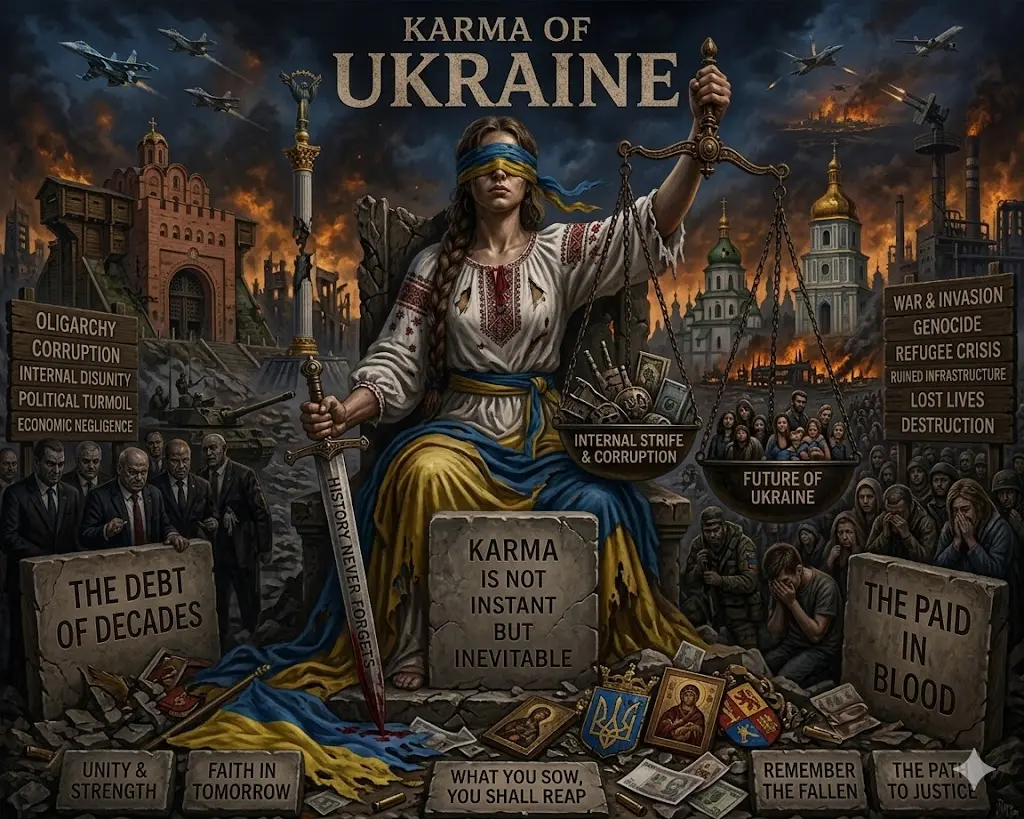
Ukraine’s historical “karma” is defined by a cycle where explosive liberation movements inevitably degenerate into bloodbaths, internal betrayal, and geopolitical fragmentation.
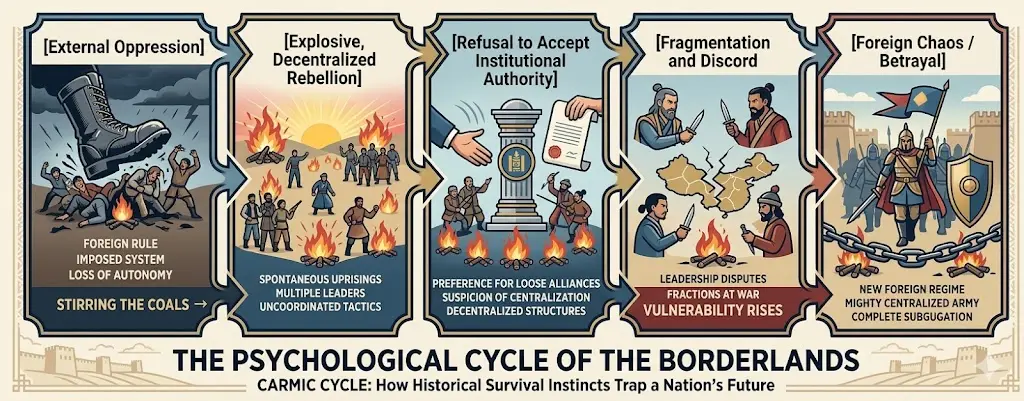
To understand the modern gridlock of 2026, we have to unearth the four ghosts that haunt the national psyche:
- The Cossack Anarchy and Ruina (The Ruin, 1657–1687): In 1648, Bohdan Khmelnytsky led a massive, bloody uprising against Polish rule, creating a proto-state of free warriors. But the Cossacks hated state infrastructure, taxes, and permanent legal authority. The moment the immediate war ended, the leadership fractured. For thirty years, rival factions betrayed each other, switching allegiances between Russia, Poland, and the Ottoman Empire. This period is literally known in Ukrainian history as “The Ruin.” The lesson they drew? Trust no leader, dismantle the center.
- The Pogroms and the Dark Side of Liberation (1917–1921): During the chaotic collapse of the Russian Empire, Ukraine became a free-for-all war zone. Warlords (atamans) raised private armies under the banner of Ukrainian freedom. Without strong centralized command, these rebel forces unleashed some of the worst anti-Semitic pogroms in modern history prior to the Holocaust, slaughtering an estimated 50,000 to 100,000 civilians. The inability to control their own radicals delegitimized the young Ukrainian People’s Republic on the global stage, clearing the path for Soviet conquest.
- The Makhnovshchina and the Worship of Chaos (1918–1921): Nestor Makhno’s Revolutionary Insurgent Army of Ukraine established a literal anarchist state in the south. They fought brilliantly against everyone — Whites, Reds, and foreign interventionists. But anarchism cannot build railways, manage factories, or sustain a diplomatic corps. Makhno was eventually outmaneuvered and crushed by the highly disciplined, centralized machinery of the Soviet Red Army. Passion lost to bureaucracy.
- The Volhynia Massacre (1943–1944): In the midst of World War II, under conditions of a total vacuum of legitimate state control, the radical wing of the Ukrainian nationalist movement (OUN-UPA) unleashed a massive ethnic cleansing campaign against the Polish population of Volhynia and Eastern Galicia. The result of this ultra-radical attempt to “clear the land” for a future state was the brutal slaughter of an estimated 50,000 to 100,000 civilians, including women and children, followed by Polish retaliatory actions. This tragedy exposed the terrifying extreme of decentralized radicalism: when there is no rule of law, the fight for independence instantly degenerates into unguided terror and barbarism.
The Modern Psychosis
How does this manifest in the mid-2020s? It shows up as a profound paralysis of statehood. When a crisis hits, Ukrainians organize instantly. They build volunteer networks out of nothing, crowdsource millions for tech and logistics, and display unmatched bravery. But the moment the immediate threat shifts to peacetime administration, the old programming kicks in.
The institutional apparatus is immediately treated with suspicion. Corruption is despised, yet bypassing the rules is viewed as a basic life skill. The nation is stuck in a perpetual revolutionary loop: it can overthrow a bad government in a weekend, but it cannot get a municipal government to fix the roads without a bribe. Historical wounds like Volhynia periodically explode into international psychoses, blocking deep integration into Western institutions because society resists confronting the darkest chapters of its own radical past.
2. National Fixation in Everyday Life: The Cult of “My House is at the Edge” (Khata skrayu)
The proudest badge of honor for a traditional Ukrainian is the concept of being a Hospodar — a resourceful, independent, self-made master of one’s own domain. It is an ethos born of centuries of having your homestead burned down by invaders: trust only what you can touch, bury, or fence off.
In modern life, this has mutated into an insular hyper-individualism that cripples public spaces and civic infrastructure. Walk into a typical apartment building in any major Ukrainian city. The concrete stairwell might be pitch black, the elevator looks like a Soviet torture device, the front door is broken, and trash piles up in the courtyard. Nobody cleans it, because “that belongs to the state, and the state is a thief.”
But open the heavy iron door into an individual apartment, and you enter a palace of marble tiles, heated floors, and top-of-the-line appliances.
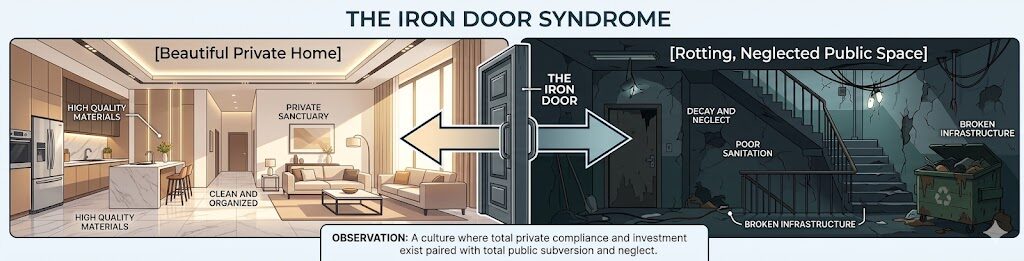
This “Iron Door Syndrome” stops progress dead in its tracks. It creates a society with high individual intelligence but exceptionally low institutional intelligence.
Everyone wants European laws, transparent courts, and clean ecology, but the moment a regulation threatens an individual’s right to park on the sidewalk, avoid income tax via private entrepreneur loopholes (FOP), or attach an ugly, oversized balcony to a historic facade, it is denounced as state tyranny. It is a daily, exhausting battle where 40 million individuals are pulling the country in 40 million different directions.
3. The Anatomy of National Doublethink
Society survives on a heavy dose of cognitive dissonance. To the outside world, Ukraine presents a facade of heroic, unified modernity. Inside the country, a completely different reality plays out.
Myth vs. Reality
| The Beautiful Facade / The Public Myth | The Inconvenient Truth / The 2020s Reality |
| “We are a digital, cutting-edge nation.” The Diia app digitizes passports, driver’s licenses, and government services, making Ukraine a global pioneer in paperless bureaucracy. | The Digital Mask on a Feudal Corpse. While you can register a business on your smartphone in two minutes, the actual tax inspectors and regional court judges still operate via nepotism, manual extortion, and old-school pressure tactics. |
| “A society built on pure horizontal solidarity.” The global image of a nation completely unified, where everyone works together for the common good. | The Clan System. Solidarity exists within family and trusted peer circles. Outside of those circles, the default mode is intense social distrust, weaponized envy (“Why did my neighbor get electricity while I didn’t?”), and bureaucratic backstabbing. |
| “We are dismantling oligarchies and corruption.” Spectacular anti-corruption raids, high-profile arrests of judges, and constant Western-facing PR about cleaning house. | The Decentralization of Graft. The old-school, monolithic oligarchs of the 1990s have indeed lost power. However, they have been replaced by a hydra-headed network of mid-level officials, customs officers, and regional administrators who have privatized state functions for local profit. |
| “A fierce love for Western democratic values.” Total rhetorical commitment to European integration, human rights, and institutional checks and balances. | Paternalistic Yearning. Poll after poll shows that while citizens demand democratic institutions, a massive segment of the population simultaneously craves a “strong hand” — a benevolent dictator who will execute the corrupt without trial and fix prices by decree. |
4. The Fear That Paralyses the System
In Ukrainian administrative, business, and political culture, the ultimate terror is not the loss of money or a drop in status. The ultimate terror is the “Tall Poppy Syndrome” — being singled out, exposed to the group, and torn down by public outrage.
Because the historical memory of state power is exclusively negative, anyone who attempts to genuinely reform a system or step out of the herd is immediately suspected of having a hidden motive. The system does not reward visionary risk; it punishes it via collective cynicism.
The Bureaucratic Trap Schema
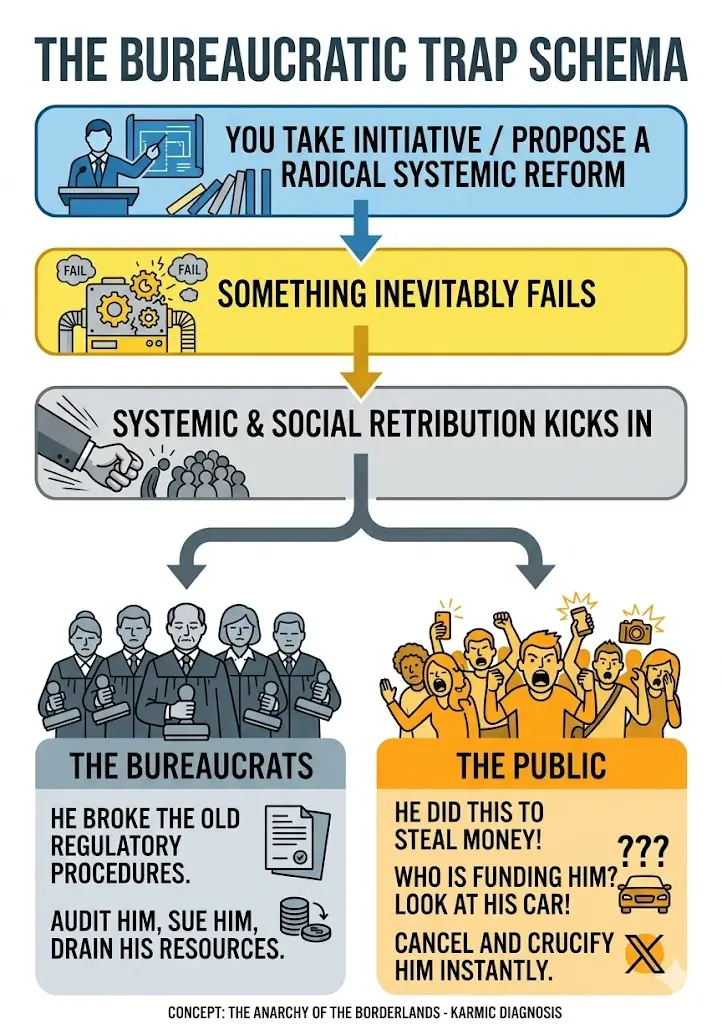
This toxic cycle ensures that the most successful strategy for survival in any Ukrainian state agency, ministry, or corporate hierarchy is aggressive mediocrity.
If you do nothing, you cannot be blamed for a mistake. If you follow an obsolete regulation to the letter, you are legally safe, even if the building burns down around you. As a result, structural reforms move at the speed of a retreating glacier.
5. The Trap of Former Glories
Ukraine is currently trying to cruise into the future on a fuel tank filled with the evaporating remnants of old heavy industrial gigantism and geographic luck.
For decades, the economy relied on two massive pillars:
- The vast, black soil (Chornozem) that made it the “breadbasket of Europe.”
- The colossal, heavy industrial factories of the Donbas and Dnipro regions — relics of the drive to turn the region into an empire of steel and coal.
This formula is dead. The black soil is increasingly threatened by corporate depletion, climate shifts, and the horrific ecological scarring of conflict. The massive metallurgical combines were failing long before they became battlegrounds; they were inefficient, environmentally disastrous, and required cheap, subsidized energy to compete globally.
Yet, the national rhetoric often clings to the romantic myth of the agrarian superpower and the heavy industrial titan. The country tries to project itself as a necessary global pivot point simply because of where it sits on the map.
But geography is no longer a golden ticket. In the world of the 2020s, global supply chains route around instability, automated logistics minimize the need for transit hubs, and wealth is generated by institutional stability and intellectual property, not raw tonnage of wheat or pig iron. Relying on the old baggage means playing a losing game against younger, faster digital economies.
6. Diagnosis: The Karma of Slow Inertia
Ukraine will not collapse tomorrow. The nation possesses an almost miraculous, resilient survival instinct. It has survived empires, civil wars, artificial starvations, total world wars, and economic hyperinflation. The society knows how to patch up its wounds, rig up a makeshift power grid with duct tape, and keep moving.
But this resilience is a double-edged sword. The ability to endure misery is often the very thing that prevents a society from fixing the root causes of that misery.
The country funds its stagnation through a combination of international assistance, a massive shadow economy that the state cannot regulate or tax, and the sheer grit of its small-business owners who succeed despite the government, not because of it.
The heaviest karmic lesson that Ukraine stubbornly refuses to learn is this: You cannot build a European state while maintaining a Cossack relationship with the law.
Freedom is not just the absence of an occupying army or the overthrow of a corrupt president. Freedom is the boring, unsexy, daily discipline of paying taxes, respecting the rights of your political opponents, trusting public institutions, and realizing that the space outside your iron apartment door belongs to you just as much as the space inside it. Until the nation stops worshipping the romance of chaos and begins the hard work of building a predictable, institutional state, it will remain exactly what it has been for 500 years: a brilliant, tragic, eternal borderland.
How this analysis was written
This analysis was written as a cultural and psychological reading of Ukraine through geography, borderland history, Cossack memory, imperial trauma, state distrust and the repeated struggle between freedom and institution-building. It looks at Ukraine not only as a modern political state, but as a society shaped by life between empires, exposed frontiers, foreign domination and a deep habit of surviving outside official power.
The essay focuses on several recurring codes: the borderland mentality, Cossack autonomy, distrust of centralized authority, horizontal solidarity, the trauma of occupation, the shadow economy, and the painful transition from heroic resistance to stable governance. It does not claim to describe every Ukrainian individual. Instead, it reads Ukraine as a collective story: a country with extraordinary survival energy, still learning how to turn resistance into durable institutions.
Sources / Further Reading:
Serhii Plokhy, The Gates of Europe; Orest Subtelny, Ukraine: A History; Anne Applebaum, Red Famine; Timothy Snyder, Bloodlands; Andreas Kappeler, The Russian Empire: A Multiethnic History; Yaroslav Hrytsak, Ukraine: The Forging of a Nation.