
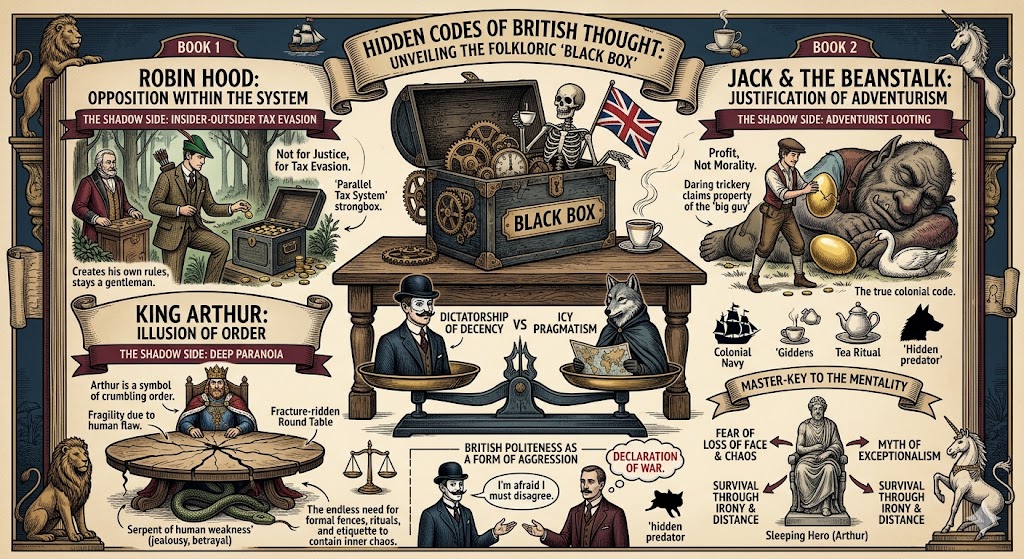
British bedtime stories aren’t meant to help children sleep; they are training manuals for surviving a system that was rigged long before you arrived.
The central psychological conflict of the British mind isn’t “Good vs. Evil.” It is The Rule vs. The Exception. It is the friction between an obsessive need for social order and a deep-seated urge to “get away with it” through a clever loophole. To be British is to live in a state of permanent apology for a crime you are currently committing.
The Scripts of Survival
- Robin Hood: On the surface, it’s a tale of charity. Deeper, it reveals a fundamental distrust of the Law, replaced by a cult of the “Good Outlaw.” It teaches that the system is inherently corrupt, so the only way to be moral is to work outside of it—while still maintaining a rigid hierarchy in the woods.
- Jack and the Beanstalk: This is the “chancer’s” manifesto. Jack doesn’t gain wealth through industry or merit; he gets it through a lucky trade, trespassing, and theft. The shadow truth? Upward mobility is a gamble, and success is something you steal from a “giant” who doesn’t understand your language.
- King Arthur: The myth of the “Once and Future King” is a psychological sedative. It’s the “Arthurian Sleep”—the belief that a savior will return to fix everything, which conveniently justifies doing absolutely nothing in the present.
The Recognition Moment
You see these patterns every day in the British “Queue.” It is not a display of politeness; it is a weaponized social contract. To cut a queue is to threaten the very fabric of reality. The British don’t follow rules because they love them; they follow them because they are terrified of the chaos that would erupt if they didn’t. This manifests as “Tall Poppy Syndrome”—a collective survival mechanism that ensures no one gets too big for their boots, lest they attract the Giant’s attention.
The Master Key: Sir Gawain
The primary myth is Sir Gawain and the Green Knight. Gawain is tasked with being perfect, fails by hiding a magic girdle to save his own life, and is then praised for being “mostly” honest. This is the British Master Key: The Cult of the Flawed Hero. Perfection is viewed with suspicion; “trying too hard” is the ultimate social sin.
In modern life, this translates to a workspace where power is exercised through understatement. The person with the loudest voice has the least power. True authority in the UK is silent, self-deprecating, and utterly ruthless behind a “Please” and a “Thank you.”
Is this the refined wisdom of an ancient civilization, or just the generational trauma of an island that has been holding its breath for a thousand years?
How does the British “apology” function as a tool of dominance in your own interactions?