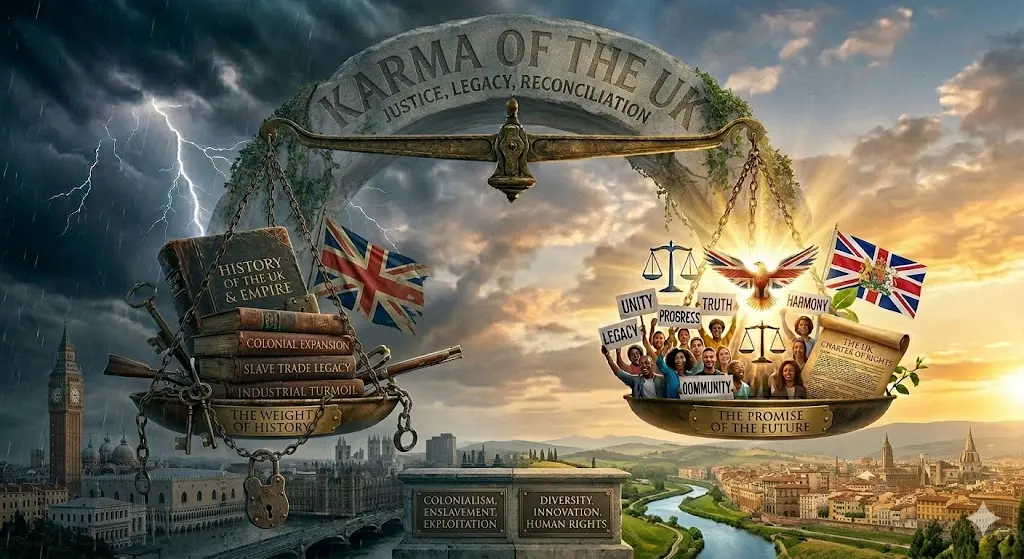
The Karma of the UK: A Nation Reckoning with its Own Echoes
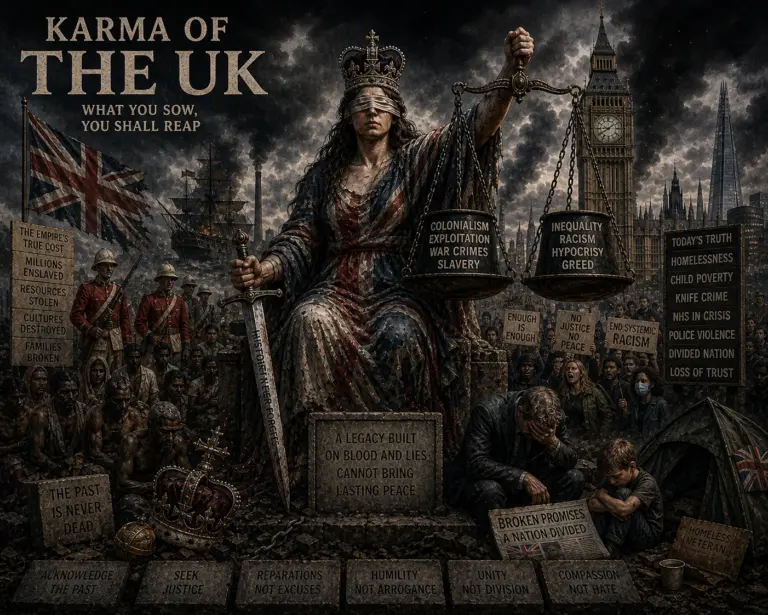
Every nation has a myth it tells itself to sleep at night. But when a country’s myth is separated from its reality by a widening chasm of decades, that myth hardens into a psychological trap. In 2026, the United Kingdom finds itself in the terminal stage of a centuries-long karmic feedback loop.
To understand Britain today, you have to stop looking at the postcard version of Buckingham Palace, afternoon tea, and eccentric Hugh Grant characters. You need to look at the collective subconscious of a society that once owned a quarter of the planet, successfully forgot how it got it, and is now deeply confused about why the plumbing in its own house no longer works.
This is the cultural diagnosis of a nation haunted by its own ghost.
The Invisible Contract: The Myth of Absolute Stability
At the heart of British society lies a deeply ingrained, unspoken psychological contract between the citizen and the state. It can be summed up in five words: “We endure, you guarantee continuity.”
This contract wasn’t born out of thin air; it was forged in the fires of unique historical triumphs and a deeply conditioned aversion to radical change. Unlike its continental neighbors, Britain didn’t experience a successful bloody revolution in its modern history (the 17th-century Civil War was quickly swept under the rug of the 1660 Restoration). The nation survived the existential horror of World War II without being occupied, cementing the belief that British institutions are fundamentally infallible, blessed, and built to last forever.
In exchange for this promised continuity, the British citizen signed away the right to be demanding. The public agreed to tolerate rigid class structures, crumbling infrastructure, and a stunningly indifferent ruling elite, all because of a comforting grand narrative: “Our system got us through the Blitz, it built the Empire, and it created the NHS. It is slow, but it works.”
The tragedy of 2026 is that the contract has expired, but the citizens are still paying the dues. The state can no longer guarantee stability, yet the public’s conditioned reflex—to quietly endure rather than riot—remains completely intact.
1. The Main Internal Demon: The Imperial Ghost and Historical Amnesia
The ultimate karmic law is simple: what you refuse to integrate into your shadow will eventually destroy your present. Britain’s greatest internal demon is its profound, institutionalized amnesia regarding the British Empire.
At its peak, the Empire governed a quarter of the world’s population. The psychological architecture of this massive enterprise required a fierce belief in a hierarchy of civilizations—a total conviction that London was the absolute center of the universe, and the colonies were just a distant, subservient periphery. But the brutal karma of empire-building is that the periphery eventually comes back to the center.
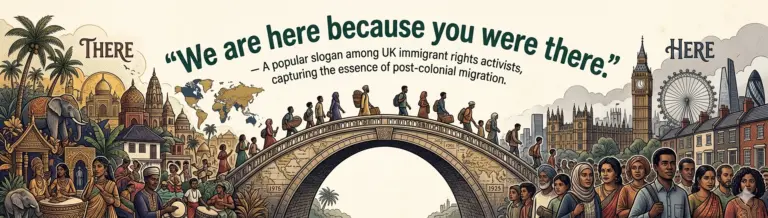
Following the devastation of World War II, a depleted, broke Britain had to invite citizens from the Commonwealth to help rebuild the mother country. The arrival of the ship HMT Empire Windrush in 1948 marked the beginning of a massive demographic and cultural transformation. It gave birth to a famous activist slogan that perfectly captures post-colonial migration: “We are here because you were there.”
Britain wanted the labor, but it wasn’t prepared for the historical bill. Because the UK selectively erased the memory of how the Empire was actually run, this historical blindness has left deep, bleeding scars that shape modern British reality:
The Bengal Famine (1943): While Britain rightly prides itself on defeating fascism, it conveniently forgets that wartime policies under Winston Churchill led to the starvation of roughly 3 million people in Bengal.
The Modern Karma: A complete inability to empathize with or understand the post-colonial grievances of the Global South. Britain genuinely wonders why former colonies aren’t enthusiastic about post-Brexit “Global Britain” trade deals, failing to realize that to the rest of the world, the Union Jack isn’t a symbol of cozy nostalgia, but of historical extraction.
The Partition of India and Ireland (1947 / 1921): The classic British imperial strategy was “divide and rule,” drawing arbitrary borders that triggered catastrophic sectarian violence—most notably splitting India and Pakistan, and carving up Ireland.
The Modern Karma: The borders Britain drew abroad have come home to roost. The unresolved legacy of Irish partition (exacerbated by Brexit) and the constant, bubbling threat of Scottish independence show that the UK is struggling to keep its own internal borders intact. The master of division is now terrified of being divided.
The Opium Wars (1839–1860): Britain literally acted as a state-sanctioned drug cartel, invading China twice to force open its markets for British-marketed opium, destroying millions of lives for corporate profit.
The Modern Karma: The shifting of global geopolitical tectonic plates. A resurgent, deeply nationalistic China remembers every single detail of its “Century of Humiliation.” Britain’s modern economic and political vulnerability to global superpowers is a direct consequence of a world order it helped brutalize.
The Mau Mau Uprising Suppression (1952–1960): In the twilight of empire, British forces in Kenya utilized systemic torture, forced labor camps, and extrajudicial killings to suppress independence fighters.
The Modern Karma: The institutional habit of cover-ups and hiding inconvenient truths. This psychological blueprint directly informs modern domestic scandals—from the decades-long cover-up of the Hillsborough disaster to the recent Post Office Horizon scandal. The state’s default reflex is still to protect the institution and gaslight the victim.
Because Britain never had a national moment of deep, painful reckoning with its past—unlike Germany’s post-WWII Vergangenheitsbewältigung—it remains trapped in a state of arrested development. It acts like an aging aristocrat who lost the estate generations ago but still expects the local shopkeepers to bow.
📊 POLL : The Blood for Perks Deal
2. National Fixation in Everyday Life: The Weaponized “Stiff Upper Lip”
If you ask a Brit what national trait they are most proud of, they will likely say resilience, often expressed through the cultural tropes of the “Stiff Upper Lip” or the wartime slogan “Keep Calm and Carry On.”
In the past, this trait was a genuine shield against catastrophe. Today, it has been driven to absolute, farcical absurdity. In 2026, the “Stiff Upper Lip” is no longer a sign of strength; it is a psychological coping mechanism used to tolerate systemic dysfunction. It has transformed into a toxic refusal to demand better.
Consider a mundane, everyday example: The British Rail System and Housing Market.
You are standing on a freezing, rain-slicked platform in a provincial town. The train—which costs a small fortune for a single ticket—is delayed by 45 minutes for the third time this week due to “leaves on the track” or ancient signaling equipment.
In France, commuters would be threatening a national strike. In Italy, there would be loud, passionate arguments at the ticket desk. In Britain? People look down at their shoes, emit a soft, collective sigh, and mutter, “Typical.” Someone might make a self-deprecating joke. Everyone quietly suffers in compliance.
This fixation manifests in the housing market too. Millions of Britons pay astronomical rents to live in damp, poorly insulated, Victorian-era properties with single-glazed windows and mold creeping up the walls. Instead of demanding sweeping regulatory overhauls or massive state building projects, the cultural response is to buy a dehumidifier, put on an extra jumper, and joke about the British weather.
By romanticizing discomfort and turning passive endurance into a virtue, the British public has actively disarmed itself. The ruling and corporate classes know exactly how much pressure they can apply to the population before they break—and because of the Stiff Upper Lip, that limit is nearly infinite.
📊 POLL: The Coward’s Way Out
3. Anatomy of National Duplicity
Britain is a master of soft power because it knows how to build a dazzling facade. However, the gap between what the UK projects to the world and how its society actually functions internally is massive.
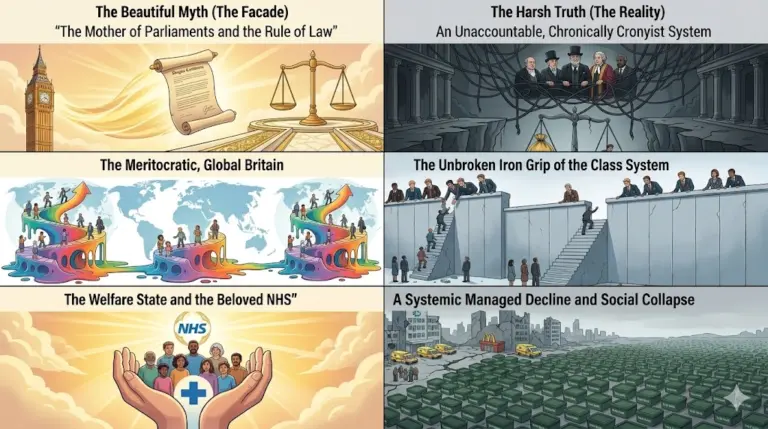
The Beautiful Myth (The Facade)
The Harsh Truth (The Reality)
“The Mother of Parliaments and the Rule of Law” Britain prides itself on being the global gold standard for democracy, fair play, incorruptible institutions, and unwritten, gentlemanly constitutional honor.
An Unaccountable, Chronically Cronyist System The country is governed by an unelected House of Lords packed with political donors, hereditary peers, and bishops. The “Rule of Law” frequently bends for the wealthy, as seen in London’s long-standing status as the premier money-laundering hub for global oligarchs (“Londongrad”).
“The Meritocratic, Global Britain” A modern, forward-thinking melting pot where talent rises to the top regardless of background, and anyone can make it.
The Unbroken Iron Grip of the Class System A tiny, nepotistic network of private school alumni (Eton, Harrow) and Oxbridge graduates still monopolizes politics, media, the judiciary, and high finance. Social mobility in the UK is among the lowest in the developed world.
“The Welfare State and the Beloved NHS” The National Health Service is treated as a secular religion—a shining beacon of collective care where health is a human right.
A Systemic Managed Decline and Social Collapse The NHS is starved of capital, with millions trapped on waiting lists and people literally dying in the backs of ambulances parked outside overwhelmed hospitals. The social safety net has been replaced by a sprawling network of food banks that outnumber McDonald’s franchises.
4. The Core Fear: The Terror of “Making a Scene”
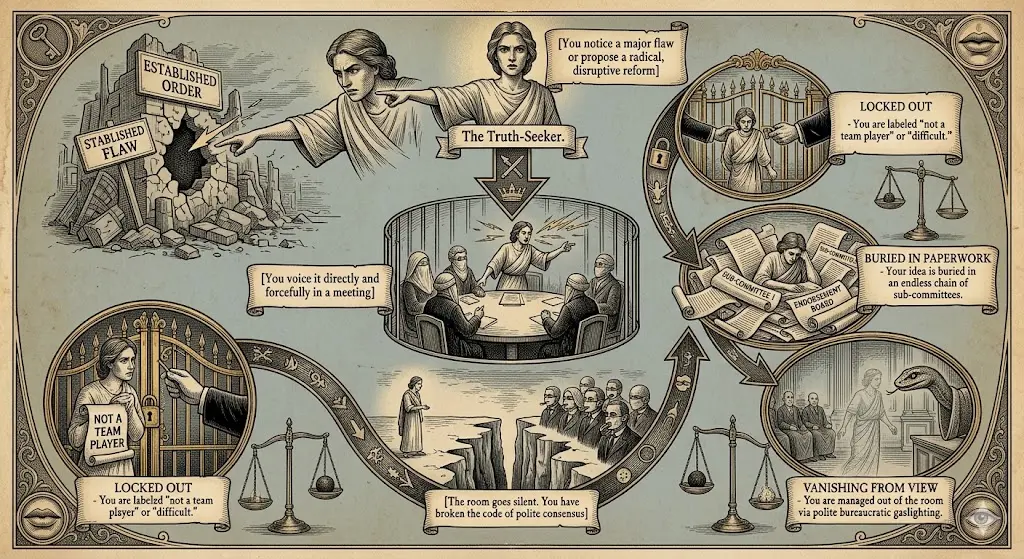
What is the ultimate horror for an individual within British culture? It isn’t poverty, and it isn’t injustice. It is social embarrassment. The entire society is policed by an invisible, suffocating dread of “making a scene,” being perceived as difficult, or breaking the unwritten rules of social etiquette.
This collective dread paralyses middle managers, civil servants, and corporate leaders alike, effectively blocking any real systemic reform or institutional innovation.
Because direct confrontation is viewed as a cardinal sin, problems are never solved; they are merely managed, smoothed over with polite euphemisms, and passed down to the next generation. The system rewards those who keep the water still, even if the boat is slowly sinking.
5. The Trap of Past Glories: The 1945 Nostalgia Engine
Britain’s economic and political strategy in the 2020s relies heavily on an exhausting intellectual grift: trying to monetize past glories while failing to invest in the present.
The ultimate high-water mark of British moral and geopolitical capital was 1945. The nation stood alone against tyranny and won. But this triumph became a narcotic. For eighty years, Britain has used the cultural capital of World War II, the prestige of the BBC, the royal family, Oxford and Cambridge, and the financial dominance of the City of London to maintain its seat at the top table of global affairs.
This formula has fundamentally broken down in the 2020s for several reasons:
The City of London is no longer the undisputed financial capital of the world; post-Brexit regulatory friction, economic stagnation, and the rise of rival financial hubs have chipped away at its dominance.
Soft power cannot heat homes or fix broken procurement systems. You cannot run a modern G7 economy on the cultural vibes of the Beatles, James Bond, and royal weddings while your regional cities lack basic, functional public transport networks.
The technology gap: While the US builds AI monopolies and Tech giants, and East Asia dominates advanced manufacturing and green tech, Britain’s primary economic strategy has long felt like inflating an enormous property bubble in the Southeast of England, pretending that buying and selling overpriced brick terrace houses to one another constitutes a real, productive economy.
6. Diagnosis: The Karma of Slow Inertia
The United Kingdom is not going to experience a sudden, dramatic collapse. It will not wake up tomorrow to a violent revolution or a cinematic apocalypse. Its karmic punishment is far more insidious: slow, comfortable, hyper-polite inertia.
Britain manages to fund its stagnation through the sheer weight of its historical accumulation. It still possesses massive institutional wealth, deep legal infrastructure, and an undeniable cultural cachet that draws foreign capital into London real estate. It is a wealthy country filled with increasingly poor people, managed by an elite that has mastered the art of managing decline while looking exceptionally dignified doing it.
The ultimate, heaviest karmic lesson that the British nation stubbornly refuses to learn is this: You cannot borrow glory from a past you refuse to honestly examine.
Until Britain stops looking at its history as a comforting bedtime story and starts looking at it as an unvarnished ledger of accounts, it will remain trapped in this loop. It will continue to walk backward into the future, wondering why it keeps tripping over the rubble of its own making, politely apologizing to the wall it just hit, and quietly carrying on.
How this analysis was written This analysis was written as a cultural and psychological reading of the United Kingdom through its imperial history, class system, public myths and everyday codes of restraint. It looks at Britain not only as a political state, but as a society shaped by empire, wartime memory, inherited hierarchy, institutional politeness and a deep fear of public rupture.
The essay focuses on several recurring patterns: the imperial ghost, historical amnesia, the “stiff upper lip,” class performance, nostalgia for 1945, and the habit of managing decline with dignity rather than confronting it directly. It does not claim to describe every British person. Instead, it reads the UK as a collective story: a country still trying to live inside the myth of stability while the structures behind that myth are visibly weakening.
Sources / Further Reading: David Olusoga, Black and British: A Forgotten History; Linda Colley, Britons: Forging the Nation 1707–1837; Sathnam Sanghera, Empireland; James Meek, Private Island; Tom Nairn, The Break-Up of Britain; Anthony Sampson, Anatomy of Britain.
British bedtime stories aren’t meant to help children sleep; they are training manuals for surviving a system that was rigged long before you arrived. The central psychological conflict…