
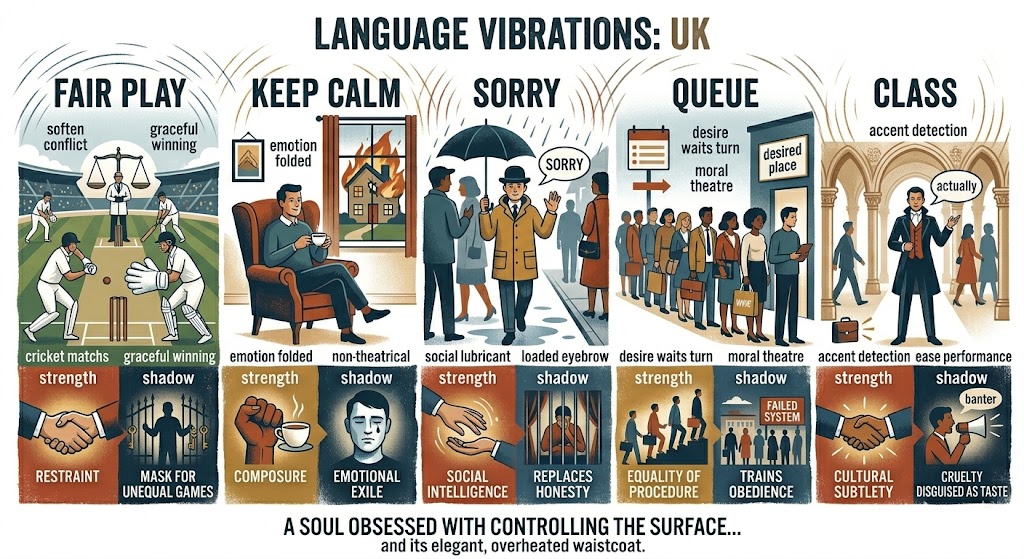
Fair Play
Fair play is not just a rule of sport. In the UK, it is the moral fantasy that power should wear gloves.
Behind this phrase stands a deep British mechanism: competition is acceptable, even admired, but it must not look nakedly brutal. You may want to win, but you should not look as if winning has made you spiritually hungry.
Fair play lives in sport, politics, schools, workplaces and public manners. It says: take your turn, do not cheat, do not push too openly, do not humiliate the loser, do not make ambition look vulgar. The game matters, but the way you play it tells people what class of person you are.
Its strength is restraint. It creates a society where rules can soften conflict, where disagreement does not always need to become war, where dignity is preserved even when someone loses.
But the shadow begins when fair play becomes a mask for unequal games. A system can look polite while quietly protecting old advantages. The rules may be “fair,” but who wrote them, who understands them, and who was trained from childhood to move inside them?
From this comes:
- respect for rules and procedure
- suspicion toward obvious aggression
- admiration for graceful winning
- blindness to hidden privilege
Fair play is Britain’s elegant conscience. But sometimes the cleanest game is played on a field where some people were never properly invited.
Keep Calm
Keep calm is not merely a slogan. It is the emotional discipline of a country that learned to treat panic as bad manners.
Behind this phrase stands a powerful psychological habit: do not collapse in public. Fear may exist, pain may exist, disaster may exist, but the face must remain arranged. The cup of tea is not a joke. It is a small ritual against chaos.
Keep calm appears in hospitals, train delays, family arguments, political crises and funerals. The emotion is not denied exactly, it is folded, pressed and placed somewhere less visible. The British self often survives by refusing to become theatrical.
Its strength is composure. This habit can produce courage, endurance, dry humour under pressure, and a remarkable ability to function while the roof is metaphorically on fire.
Its shadow begins when calm becomes emotional exile. A person may be so well trained in not making a fuss that they no longer know how to ask for help. A whole society can confuse silence with stability.
From this comes:
- emotional understatement
- humour during discomfort
- embarrassment around neediness
- quiet endurance that may hide deep distress
Keep calm is Britain’s stiff little altar to self-control. It saves the room from panic, but sometimes it also locks grief outside.
Sorry
Sorry in the UK is not only an apology. It is a social lubricant, a shield, a warning, a soft weapon and sometimes a tiny act of class warfare.
Behind this word stands the British fear of friction. Public life must move through narrow spaces: queues, trains, offices, pavements, pubs, families with old resentments. Sorry keeps bodies and egos from colliding too loudly.
The word can mean “I regret this,” but it can also mean “you are in my way,” “I disagree,” “you have just behaved badly,” or “I am about to become less polite.” It is a small word with a loaded eyebrow.
Its strength is social intelligence. It prevents unnecessary explosions. It allows people to correct, refuse, interrupt or complain without turning every interaction into open combat.
Its shadow begins when apology replaces honesty. People may say sorry when they are angry, sorry when they are right, sorry when they have been hurt, sorry when they want justice. The word can become a velvet prison where conflict never becomes clear enough to resolve.
From this comes:
- indirect communication
- fear of causing inconvenience
- politeness used as pressure
- difficulty saying what is actually meant
Sorry is Britain’s most innocent-looking weapon. It bows slightly, then quietly tells you exactly where the line is.
Queue
The queue is not just a line. It is Britain’s miniature constitution.
Behind this word stands a national belief that civilization begins when desire waits its turn. Everyone wants something: food, transport, service, attention, justice. The queue says: wanting is allowed, but pushing is suspicious.
The queue turns public space into moral theatre. A person reveals themselves not by what they claim to believe, but by how they behave when there are only three people in front of them and no official watching.
Its strength is equality of procedure. The queue gives ordinary people a sense that at least here, in this small ritual, rank should not scream too loudly. You wait, I wait, we all pretend the world is still governable.
Its shadow begins when procedure becomes a substitute for power. People may patiently wait in systems that are failing them, because anger feels less respectable than endurance. The queue can train fairness, but it can also train obedience.
From this comes:
- respect for turns and boundaries
- moral anger at queue-jumping
- patience as public virtue
- tendency to endure poor systems too politely
The queue is Britain’s quiet lesson in social order. It is noble, absurd and slightly tragic: a nation proving its dignity one slow line at a time.
Class
Class in the UK is not only money. It is accent, posture, school, taste, confidence, shame, irony, furniture, silence and the way someone says “actually.”
Behind this word stands the British talent for social reading. People may claim not to care about class, while detecting it in three seconds through a vowel, a joke, a coat, a university, a postcode or the absence of visible effort.
Class shapes ambition in a particularly sharp way. The dream is not only to rise, but to rise without looking desperate. Success must be managed carefully. Too much hunger looks crude. Too little confidence looks weak. The correct performance is ease.
Its strength is cultural subtlety. The UK understands nuance, tone, manners, codes, atmosphere. It knows that power is not always shouted. Often it is whispered, inherited, joked about and poured into institutions like milk into tea.
Its shadow is cruelty disguised as taste. Class can make inequality feel natural, even charming. It can turn exclusion into etiquette and humiliation into “banter.” The wound is not always economic. Sometimes it is the lifelong suspicion that you are speaking in the wrong voice.
From this comes:
- acute sensitivity to accent and manners
- ambition mixed with embarrassment
- humour as social defence
- inequality hidden behind style
Class is Britain’s invisible architecture. People may not mention it, but they keep walking through its doors.
What do these words reveal about the soul of this country?
These words reveal a country obsessed with controlling the surface so the depths do not flood the room: anger becomes irony, hierarchy becomes manners, conflict becomes procedure, pain becomes composure.
The UK is not cold. It is overheated beneath the waistcoat. Its genius is restraint, and its danger is the same: it can turn silence into civilization and then forget what it was trying not to say.