
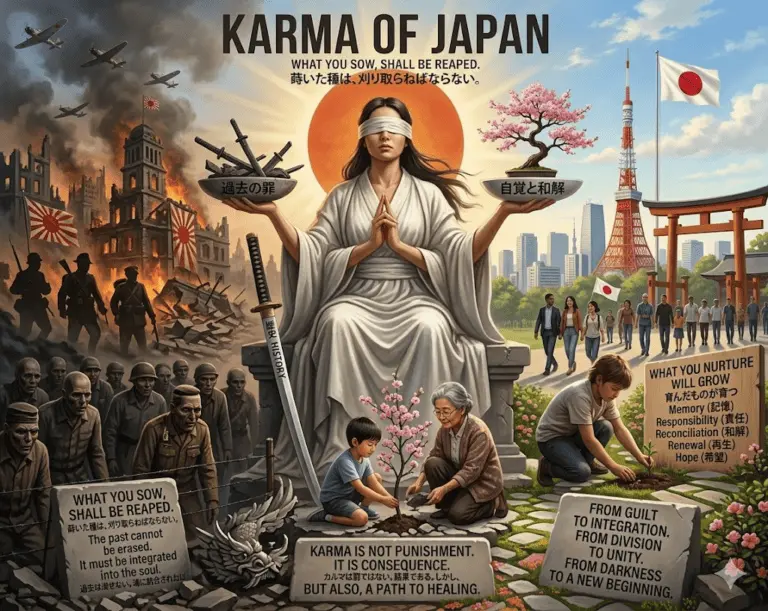
The Chrysanthemum and the Guillotine: How Japan Trapped Itself in its Own Historical Karma
If you look at Japan today, in 2026, it looks like a hyper-efficient, neon-lit paradise where trains run down to the second and crime practically doesn’t exist. But strip away the vending machines and the polite bowing, and you’ll find a society gripped by a quiet, suffocating paralysis. This isn’t an accident. It is the architectural blueprint of a national karmic contract—a deal signed in blood, trauma, and absolute exhaustion.
The unwritten psychological contract between the Japanese citizen and the state is simple: “Give up your individuality, your chaotic desires, and your voice. In exchange, we will give you safety, predictability, and a lifetime seat in a smoothly running machine.”
This contract wasn’t born out of thin air. It was forged in the ashes of 1945, when a nation that had been whipped into a fascistic, emperor-worshipping frenzy was violently broken by two atomic bombs and a crushing military defeat. To survive the ultimate shame of total destruction, the collective consciousness of Japan made a choice: Never again will we think for ourselves. We will become the ultimate collective. We will out-work, out-build, and out-discipline the world, because inside the group, we are safe from the horrors of the past.
But karma is an accountant that never loses a receipt. The very mechanisms that rebuilt Japan into a 20th-century economic titan have become the psychological prison of the 21st century.
1. The Chief Internal Demon: The Blood on the Rising Sun
Japan likes to present itself to the world as history’s ultimate victim—the only nation to ever taste nuclear fire. But this victim complex is a massive psychological defense mechanism designed to bury a much darker truth: before Japan was the victim, it was one of the most ruthless, psychopathic military aggressors the world has ever seen.
The modern Japanese collective psyche is haunted by five massive, unexpiated historical crimes and traumas:
- The Colonization and Cultural Erasure of Korea (1910–1945): For thirty-five years, Japan didn’t just occupy Korea; it tried to systematically delete it. The Japanese empire banned the Korean language, forced citizens to take Japanese names, and plundered the peninsula’s resources, operating under a deeply ingrained ideology of racial supremacy.
- The Rape of Nanking (December 1937): Upon capturing the Chinese capital, the Imperial Japanese Army engaged in a six-week orgy of slaughter, rape, and looting. Estimates place the death toll between 200,000 and 300,000 civilians and disarmed soldiers. It remains one of the most concentrated bursts of pure barbaric sadism in human history.
- Unit 731 and Human Experimentation: In the plains of Manchuria, Japan ran a covert biological and chemical warfare research lethal factory. Thousands of Chinese, Russian, and Allied prisoners—referred to as maruta (logs)—were subjected to vivisections without anesthesia, infected with the bubonic plague, frozen alive, and blasted with lethal doses of radiation just to see how much the human body could take.
- The “Comfort Women” System: The military institutionalized sexual slavery, forcibly abducting or tricking up to 200,000 women—primarily from Korea, China, and the Philippines—into a network of military brothels, treating human beings as disposable wartime logistical supplies.
- The Atomic Trauma and Self-Inflicted Extinction (1945): The horrific destruction of Hiroshima and Nagasaki, combined with firebombings that turned Tokyo into a literal sea of boiling asphalt, created a profound existential terror. The population realized their leaders had marched them into a meat grinder for a delusional myth of divine imperial exception.
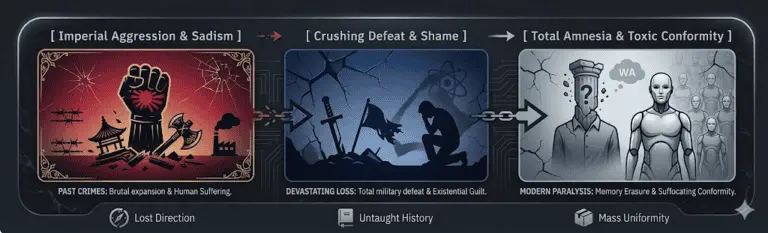
The Modern Psychosis
How does this bloody karma manifest today? Through historical amnesia and a total paralysis of moral will.
Unlike Germany, which looked its demons in the eye and dragged them into the light, Japan chose to bury its crimes in bureaucratic euphemisms and textbooks that gloss over atrocities. Because the state never truly repented or integrated this shadow, the society developed a profound, subconscious fear of looking beneath the surface.
To question authority or to stand out is viewed as dangerous—after all, the last time Japan let its collective passion run wild, the world ended in atomic fire. Therefore, the modern psychosis is a profound, lobotomized passivity. The youth are apolitical, the politicians are geriatric dynasties, and the national consciousness is trapped in a permanent, defensive crouch, unable to lead geopolitically or adapt culturally.
2. National Fixation in Everyday Life: The Absurdity of “Omotenashi” and “Ganbaru”
The world marvels at Japanese Omotenashi (ultra-politeness/hospitality) and Ganbaru (persisting through hardship against all odds). We see videos of pristine streets, train conductors apologizing for a 20-second delay, and workers pulling 14-hour days with a smile.
In reality, this is a beautifully lacquered torture device.
The fixation on extreme conformity and performance art has been driven to a point of pure, systemic absurdity. Take modern corporate life: the concept of Karoshi—literally dying from overwork—is so common that the government has to track its statistics. People do not stay late at the office because they are productive; they stay late because leaving before the boss is a catastrophic social sin. It is empty, performative endurance.

This obsession with surface-level perfection completely cripples modern progress. In 2026, Japan’s administrative backbone is still heavily reliant on Hanko (physical ink stamps) and fax machines. Why? Because changing to digital signatures requires an individual to take responsibility for altering a traditional process. Since the culture dictates that the process is holy and the individual is nothing, people choose to waste millions of hours stamping paper rather than risking the social friction of innovation.
Politeness has mutated into a tool of absolute social control, where “reading the air” (Kuuki wo yomu) matters more than speaking the truth.
3. Anatomy of National Duplicity: The Facade vs. The Truth
Japan operates entirely on two concepts: Tatemae (the public facade built for harmony) and Honne (a person’s true, hidden feelings). This systemic double-think has created a deeply hypocritical society that sells a utopian dream while living an increasingly dystopian reality.
| The Beautiful Myth / The Facade | The Harsh Reality of the 2020s |
| “We are a peaceful, hyper-technological utopia of the future.” | Japan’s IT infrastructure is notoriously archaic. Cash is still king, government offices are drowning in paperwork, and software engineering salaries are shockingly low compared to global standards. |
| “We possess a harmonious, caring society built on profound mutual respect.” | An epidemic of extreme isolation. The country is plagued by millions of Hikikomori (shut-ins who lock themselves in rooms for years) and Kodokushi (lonely deaths, where elderly people rot in apartments for weeks before anyone notices). |
| “We are global champions of human rights, pacifism, and clean living.” | Japan has an abysmal record on refugees (accepting a minuscule fraction of applicants) and institutionalized xenophobia, alongside a criminal justice system with a 99% conviction rate driven by forced, psychological confessions. |
| “Our corporate culture produces the highest quality and absolute dedication.” | Zombie companies kept alive by government subsidies, stagnant wages that haven’t significantly risen since the 1990s, and a complete lack of global competitiveness in the modern digital economy. |
4. The Main Fear Paralysing the System
The absolute engine of Japanese society isn’t ambition, Zen philosophy, or a desire for wealth. It is the terror of public shame and social excommunication (Mura Hachibu).
In a tribal culture squeezed onto a volatile, earthquake-prone island chain, being cast out of the group historically meant literal death. Today, it means psychological and professional execution. This fear completely chokes out any attempt at reform, creating a loop of multi-generational stagnation.
The Innovation Elimination Loop
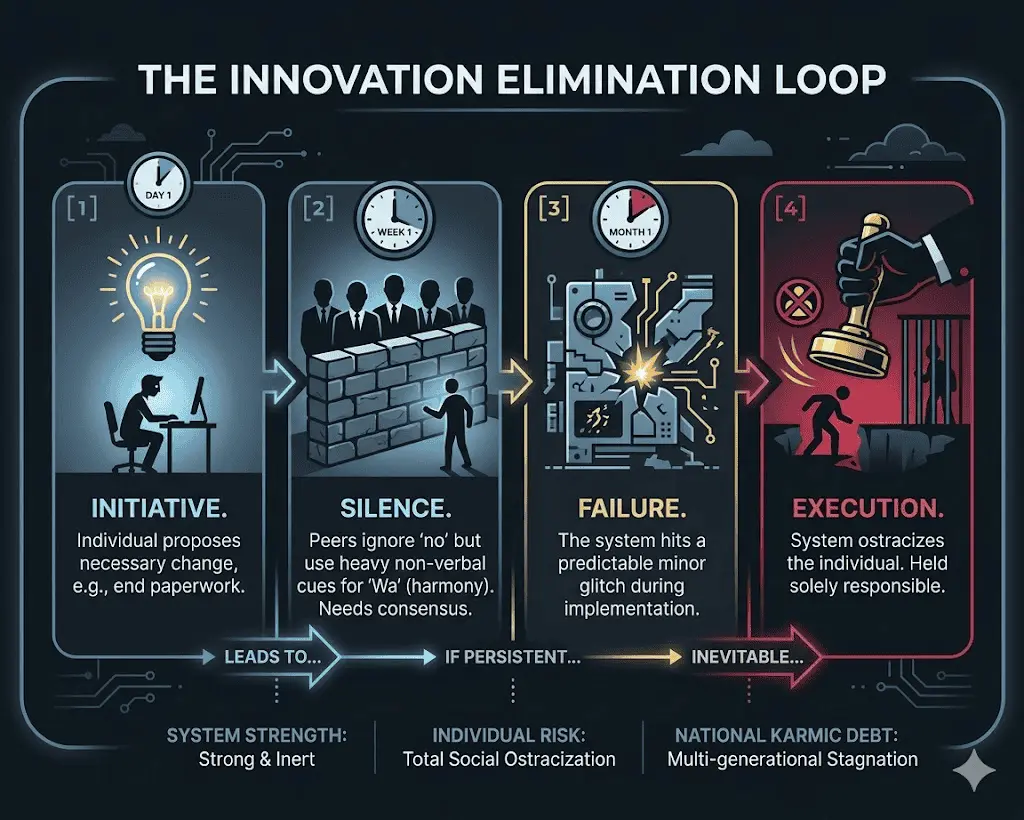
1.The Individual Sparks Initiative:
Day 1.
An employee or minor official proposes a radical, necessary change to a broken, decades-old system (e.g., abolishing useless bureaucratic paperwork or updating software).
2.The Wall of Silent Disapproval:
Week 1.
Superiors and peers do not say “no.” Instead, they use non-verbal cues, heavy silence, and bureaucratic delays to signal that the individual is disrupting the Wa (harmony). They are told it needs “consensus.”
3.The Minor Deviation/Failure:
Month 1.
The initiator pushes forward anyway, and the new system hits a predictable, minor teething glitch.
4.Systemic Execution & Ostracization:
The Aftermath.
The system reacts violently. The individual is held solely responsible for the disruption. They are stripped of responsibilities, moved to a desk facing the window (Madogiwazoku), ignored by colleagues, and forced into public, soul-crushing apologies.
The Lesson: The system teaches you that it is infinitely better to fail predictably by following old rules than to succeed unpredictably by inventing new ones.
5. The Trap of Past Glories: Riding a 1980s Ghost
Japan is currently trying to survive on the cultural and industrial fumes of an era that ended nearly forty years ago.
During the 1970s and 80s, Japan’s manufacturing model—characterized by lifetime employment, seniority-based promotions, and iterative hardware engineering (think Toyota, Sony, Panasonic)—conquered the planet. The country convinced itself that this specific, hyper-disciplined corporate structure was flawless.
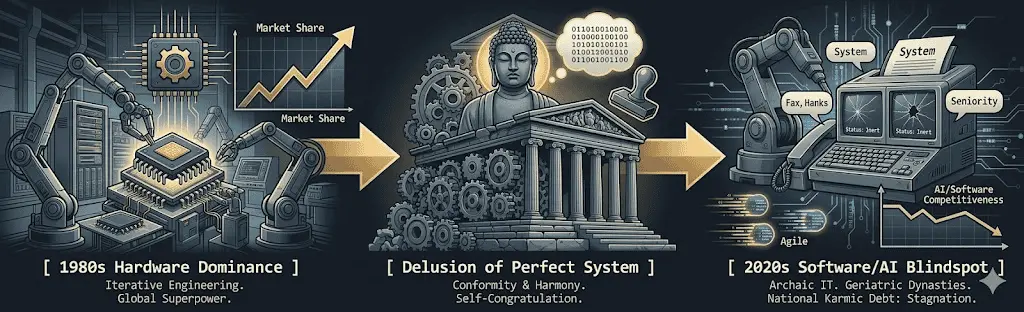
But the world changed. The global economy shifted from physical hardware iteration to agile software deployment, cloud computing, and AI disruption. Japan’s rigid hierarchy, where a 65-year-old manager who barely understands Excel has veto power over a brilliant 25-year-old coder, completely struck out in this new landscape.
The country is trapped in the myth of its own industrial perfection. It keeps throwing money at saving its aging automotive giants and trying to build physical microchip plants, completely failing to realize that its true bottleneck is not engineering capacity—it is a cultural operating system that treats young talent like disposable, obedient cogs.
6. Diagnosis: The Karma of Slow Inertia
Japan will not suffer a spectacular, cinematic collapse. It is far too wealthy, too cohesive, and too comfortable for a violent revolution or sudden economic bankruptcy. Instead, its karmic punishment is much more agonizing: a slow, polite, beautifully organized fade into irrelevance.
The country finances its economic stasis by printing endless amounts of money and borrowing from its own citizens’ massive savings pools. It is a closed financial loop that allows the elderly political elite to maintain the illusion of a functioning superpower while the country’s population shrinks by nearly a million people every single year.
The ultimate karmic lesson that Japan absolutely refuses to learn is this: You cannot build a sustainable future out of pure fear and historical denial.
By refusing to confront the dark, authoritarian roots of its past, Japan has carried that same authoritarianism into its modern offices, schools, and living rooms. It traded the literal tyranny of the wartime military state for a psychological tyranny of social conformity. Until the nation finds the courage to allow its individuals to stand out, to fail openly, to speak honestly, and to shatter the false harmony of the group, Japan will remain the world’s most luxurious, impeccably polite, and deeply tragic twilight zone.
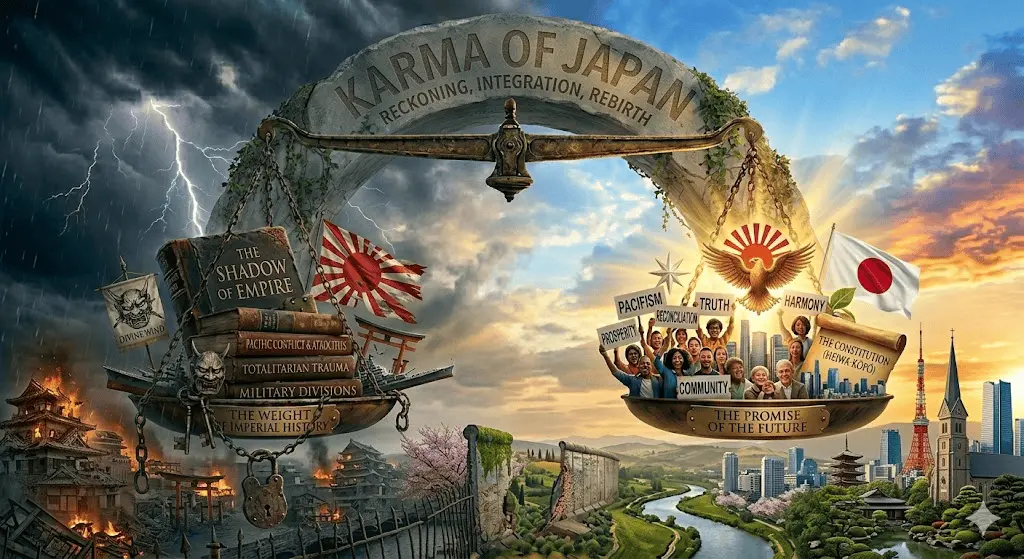
How this analysis was written
This analysis was written as a cultural and psychological reading of Japan through its history, social codes, postwar trauma and everyday rituals of conformity. It looks at Japan not only as a highly organized modern state, but as a society shaped by shame, collective discipline, historical silence and the fear of disrupting harmony.
The essay focuses on several recurring patterns: wa as social harmony, honne and tatemae as the split between private truth and public face, gaman as dignified endurance, and postwar reconstruction as both a miracle and a psychological cage. It does not claim to describe every Japanese person. Instead, it reads Japan as a collective story: a country that turned discipline into beauty, but may now be trapped by the same perfection that once saved it.
Sources / Further Reading:
Ruth Benedict, The Chrysanthemum and the Sword; Ezra F. Vogel, Japan as Number One; John W. Dower, Embracing Defeat; Takeo Doi, The Anatomy of Dependence; Haruki Murakami, Underground; Ian Buruma, The Wages of Guilt.