
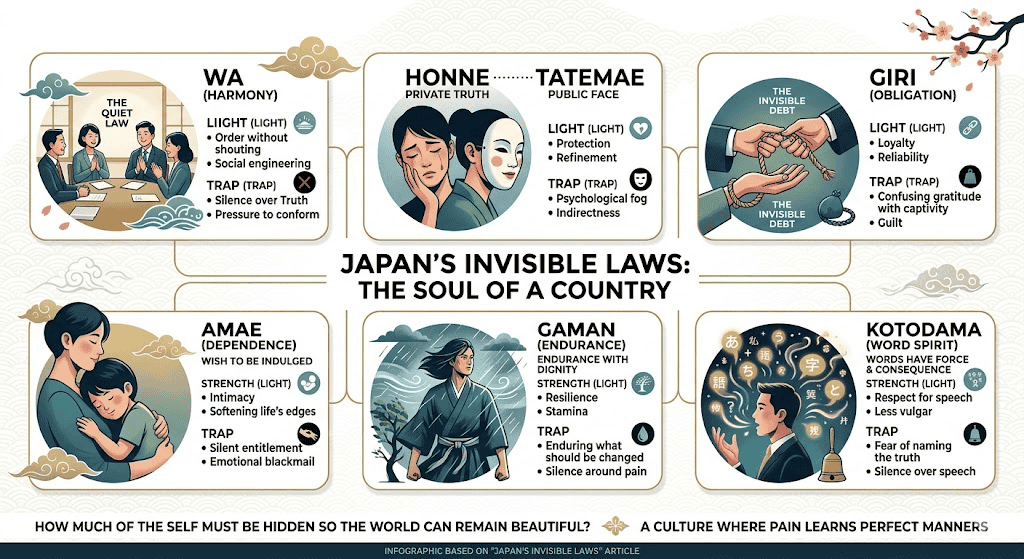
Language Vibrations: Words That Do Not Translate, But Shape a Nation’s Fate
Wa
Wa is not just harmony. It is the quiet law that says: the group must not crack because of your personal truth.
Behind this word stands one of Japan’s deepest social instincts: keep the atmosphere intact. Do not poison the room with your ego. Do not make your discomfort everyone else’s problem.
Wa lives in meetings where disagreement is softened, in families where conflict is swallowed, in offices where a person reads the air before speaking. It is not cowardice. It is social engineering. A whole society learns to reduce friction before friction becomes fire.
Its strength is obvious: Japan can create order without constant shouting. People cooperate. Public spaces feel civilized. The individual learns that freedom without sensitivity is just noise.
But the shadow begins when harmony becomes a soft form of control. If peace is always more important than truth, then the honest person becomes the “difficult” person. The system does not need to punish rebellion loudly. It only needs to make the rebel feel rude.
From this comes:
- the art of reading the room
- emotional discipline in public
- fear of disturbing the group
- pressure to hide conflict under politeness
Wa gives Japan its elegance. It also teaches people to suffer beautifully, without leaving fingerprints on the social surface.
Honne / Tatemae
Honne is the private truth. Tatemae is the public face. Japan did not invent hypocrisy, but it gave the split a vocabulary.
The psychological mechanism here is not simple lying. It is social survival. Honne says: this is what I really feel. Tatemae says: this is what the situation can safely hear.
In daily life, this creates a culture of layered speech. A “yes” may mean agreement, politeness, hesitation or simply “I hear you.” A smile may cover irritation. Silence may carry more meaning than a direct answer.
The strength of this system is refinement. It protects people from unnecessary cruelty. It allows relationships to continue even when emotions are inconvenient. It teaches that not every truth deserves to be thrown on the table like a weapon.
But the trap is psychological fog. When public face becomes too polished, people lose the habit of direct emotional contact. Everyone behaves correctly, while nobody knows what anyone really wants.
From this comes:
- indirect communication
- high emotional intelligence
- fear of open confrontation
- loneliness hidden behind perfect manners
Honne and tatemae reveal a culture where truth is not denied. It is simply stored in a private room, and not everyone receives the key.
Giri
Giri is obligation with a memory. It is the invisible debt that keeps relationships morally alive.
Behind giri stands the idea that a person is not a separate island of desire. You are tied to favors, roles, gratitude, parents, teachers, bosses, colleagues, ancestors. You owe something because you have received something.
This word shapes work, family and social life. It explains why duty may continue long after emotion has died. It explains why people keep showing up, keep bowing, keep fulfilling roles they may no longer love.
The strength of giri is loyalty. It creates reliability. It makes people remember who helped them, who trusted them, who gave them a place. In a world of disposable relationships, giri says: no, bonds have weight.
But its shadow is heavy. Giri can turn life into a contract nobody signed consciously. A person may confuse gratitude with captivity. They may stay in a job, marriage or family pattern not because it is alive, but because leaving would feel morally dirty.
From this comes:
- loyalty to roles and institutions
- deep respect for obligation
- difficulty saying no
- guilt when personal desire conflicts with duty
Giri is Japan’s moral glue. But glue can also trap the wings of a person who was meant to move.
Amae
Amae is the wish to be indulged without having to explain yourself. It is dependence made tender, almost sweet.
This concept touches something very deep: the desire to be accepted before you become useful, impressive or perfect. It is the emotional fantasy of being understood without negotiation.
In Japan, amae can live in family life, close friendships, romance and sometimes hierarchy. It appears when someone relies on another person’s kindness, patience or protection, expecting the bond itself to carry the request.
Its strength is intimacy. Amae softens the hard edges of social life. It allows adults to be vulnerable without turning every need into a formal demand. It says: closeness means I do not always have to stand alone.
But the trap begins when dependence becomes silent entitlement. If needs are not spoken clearly, they become tests. “If you really care, you will understand.” This can turn tenderness into emotional blackmail with beautiful manners.
From this comes:
- subtle emotional dependence
- warmth inside close relationships
- expectation of being understood without words
- resentment when care is not offered automatically
Amae shows that Japan is not only disciplined and restrained. Under the surface, it carries a profound hunger to be held without having to ask.
Gaman
Gaman is endurance with dignity. It is the command: bear it, but do not make suffering ugly.
The mechanism behind gaman is emotional containment. Pain exists, but it should not spill everywhere. Frustration exists, but it should not destroy the shared atmosphere.
This word can be noble. It helps people survive disaster, pressure, long work, illness, loss and humiliation without collapsing into chaos. It creates stamina. It turns self-control into a form of pride.
But gaman has a darker side. It can make people endure what should be changed. It can make exhaustion look like maturity. It can make asking for help feel like weakness.
A society that admires endurance may become suspicious of complaint, even when complaint is the beginning of justice. Sometimes the person who says “I cannot bear this anymore” is not weak. They are the first honest person in the room.
From this comes:
- resilience under pressure
- dignity in hardship
- silence around emotional pain
- delayed rebellion after long suppression
Gaman is beautiful when it protects the soul from panic. It becomes dangerous when it teaches the soul to disappear politely.
Kotodama
Kotodama is the belief that words have spirit, force and consequence. Speech is not just sound. Speech can disturb reality.
This concept reveals a culture that treats language with ritual seriousness. Words are not cheap objects. They can bless, shame, pollute, bind, invite fortune or call disaster closer.
You see its shadow in the carefulness around naming, phrasing and public statements. What is said aloud becomes socially real. A wrong word is not only inaccurate. It can damage the atmosphere.
The strength of kotodama is respect for speech. It makes language less vulgar, less careless, less disposable. It reminds people that words do not vanish after they are spoken. They remain in the room.
But the trap is fear of naming the truth. If words have power, then some truths become dangerous to say. People may avoid direct language not because they are confused, but because naming the problem feels like feeding it.
From this comes:
- careful speech
- respect for ritual language
- fear of verbal pollution
- avoidance of harsh direct naming
Kotodama gives Japanese language its sacred caution. It also shows why silence can feel safer than a sentence.
What do these words reveal about the soul of this country?
Japan’s linguistic soul is built around one dangerous question: how much of the self must be hidden so the world can remain beautiful?
These words reveal a culture of astonishing refinement, but also a culture where pain often learns perfect manners. Japan does not always silence the individual by force. Sometimes it teaches the individual to silence themselves, elegantly.