
Sometimes fairy tales are not for children. Sometimes they are a nation’s private instruction manual, disguised as bedtime comfort.
Japan’s old stories are rarely about loud victory. They are about restraint, obedience, disappearance, shame, duty and the terrifying price of disturbing harmony. The central conflict is clear: individual desire versus social order. The hero may dream, love, fight or escape, but the story almost always asks the same cold question: Can you survive without breaking the form?
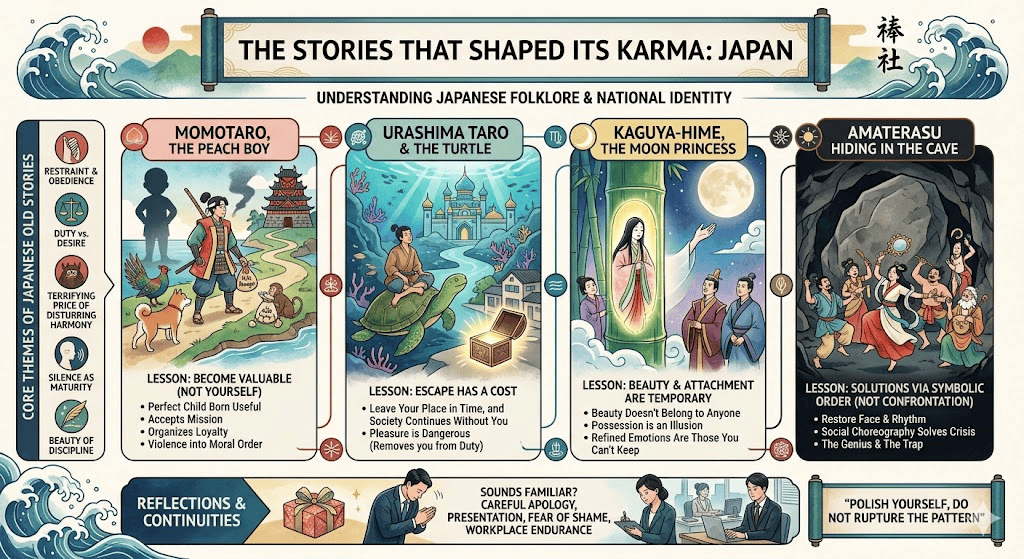
Take Momotaro, the Peach Boy, one of Japan’s most famous folk heroes. On the surface, it is a cheerful tale about courage, teamwork and defeating demons. Momotaro gathers animal companions, marches to the demons’ island and returns with treasure. Simple? Not quite. The shadow side is sharper: the perfect child is born already useful. He does not ask who he is. He accepts the mission, organizes loyalty and turns violence into moral order. The lesson is not “be yourself.” It is “become valuable.”
Then there is Urashima Taro, the fisherman who saves a turtle and is taken to a magical palace beneath the sea. He returns home only to discover that centuries have passed. The beautiful reward becomes punishment. The uncomfortable truth? Escape has a cost. Leave your place in time, and society may continue without you. Japan’s old imagination seems to whisper: pleasure is dangerous when it removes you from duty.
Kaguya-hime, the Moon Princess, is even more haunting. Found inside bamboo, raised on earth, desired by powerful men, she finally returns to the moon. The shadow lesson is brutal: beauty does not belong to anyone, not even to the people who love it. Attachment is temporary. Possession is an illusion. The most refined emotion is often the one you never get to keep.
But the master key may be Amaterasu hiding in the cave. The sun goddess withdraws after chaos and insult, plunging the world into darkness. The gods do not drag her out by force. They stage a ritual, a performance, a mirror, laughter, social choreography. This is Japan’s psychological genius and its trap: crisis is solved not by confrontation, but by restoring face, rhythm and symbolic order.
Sounds familiar, doesn’t it? The careful apology. The obsession with presentation. The fear of shame. The beauty of discipline. The workplace where endurance can look like virtue and silence can look like maturity.
Japan’s old stories do not say: conquer the world. They say: contain yourself, polish yourself, do not rupture the pattern.
And the haunting question remains: is this elegance, or is it pain trained to behave beautifully?