
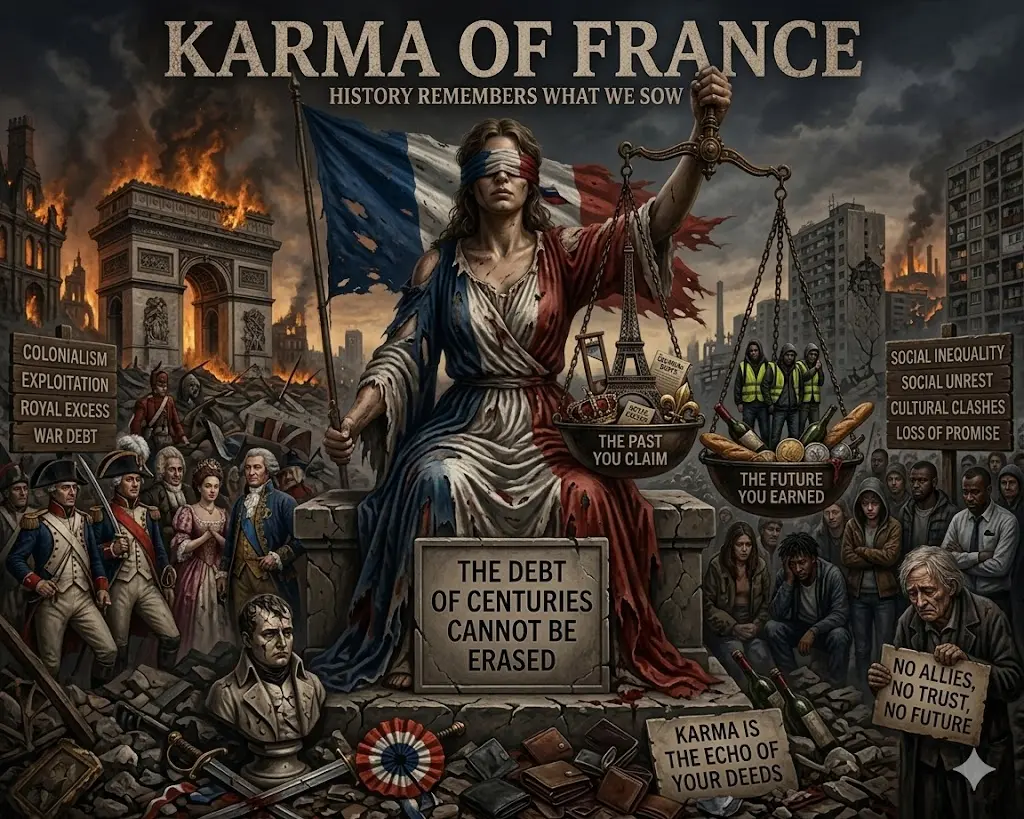
The Cultural Diagnosis: The Paradox of the Republic
To understand France, you have to look past the postcard aesthetics of outdoor cafes, wicker chairs, and Breton stripes. You have to look at its psychological architecture. France is a nation permanently trapped in a brilliant, self-made cage. Its “karma”—if we define karma not as mystical retribution, but as the inevitable psychological consequences of historical choices—is a unique blend of grand ideals and crippling rigidity.
France’s greatest strength is its greatest curse: it is a country built on an abstraction.
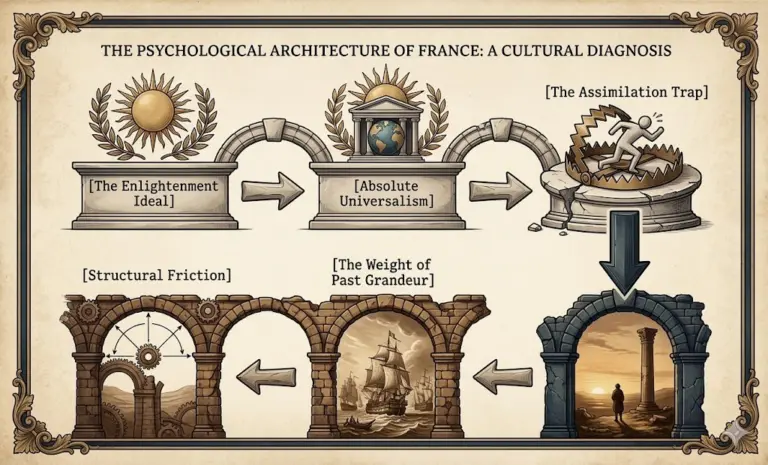
Unlike nations that evolved organically through shared tribal history or pragmatism, France invented itself in a laboratory of pure intellect. It is a country engineered by philosophers, lawyers, and mathematicians. And when you try to force messy, human reality into a perfect mathematical equation, reality eventually pushes back.
1. The Trap of Universalism
In 1789, France didn’t just stage a revolution; it invented a brand new operating system for humanity. The concept of La République is beautiful on paper. It claims that once you enter the public sphere, your ethnicity, religion, and social origins melt away. You are simply, purely, a French citizen.
But this beautiful idea hides a sharper edge. Because the Republic assumes everyone is already equal, it treats noticing differences as a kind of heresy.
- The Data Void: Because the state refuses to collect statistics on race or religion, it can pretend systemic discrimination doesn’t exist.
- The Zero-Sum Identity: By insisting that everyone must integrate into a single, static template of “French-ness,” it turns cultural diversity into a threat to national security.
The result is a strange, quiet friction. The state demands total assimilation but struggles to offer total acceptance in return. By refusing to see color, the system often becomes blind to its own internal fractures. The karma here is obvious: a philosophy designed to liberate people ends up making them feel invisible, creating a simmering resentment in the banlieues (suburbs) that the state’s intellectual frameworks are fundamentally unequipped to fix.
2. The Weight of Yesterday
Walk through Paris, and you are walking through a beautifully preserved museum of a fallen superpower. Every monument is a reminder of a time when French tastes, the French language, and French armies dominated the Western world.
There is a distinct melancholy that hangs over modern French culture—a feeling the French call la morosité. It comes from a hyper-awareness of past grandeur contrasted with a messy, globalized present.
France is a country that feels it has already peak-performed.
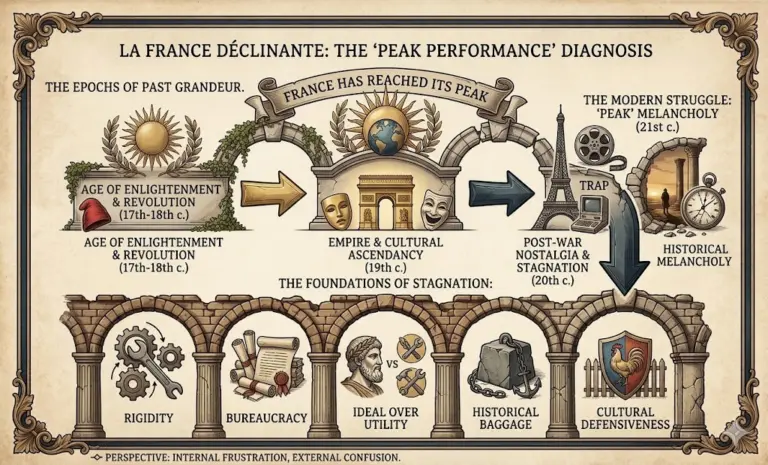
When a society believes its golden age is in the rearview mirror, its modern politics and culture become defensive. Innovation is treated with suspicion; preservation becomes the highest virtue. The country protects its language, its cinema, and its cheese with a ferocity that looks like pride, but often functions as fear.
The fear is simple: if France adapts too much to the modern, English-speaking, hyper-capitalist world, it will lose the very essence of what makes it special. Therefore, it chooses to be elegantly stagnant rather than vulgarly successful.
3. The Romance of Rebellion
No one revolts quite like the French. In most democracies, a strike or a protest is a breakdown of the system. In France, it is the system. It is a highly choreographed ritual of citizenship.

This stems from a deep, historical contradiction. The French state is highly centralized and top-down—a direct legacy of both Louis XIV and Napoleon. To balance this heavy, paternalistic authority, the culture developed an equally intense instinct for rebellion. The French citizen simultaneously expects the state to take care of everything, and hates the state for telling them what to do.
The ultimate paradox is that this constant state of revolt actually keeps things from changing. The street protests and burning tires rarely spark a new future; instead, they are usually fought to protect existing privileges, early retirements, and labor protections. It is a deeply conservative impulse dressed up in radical, revolutionary clothing. The country craves progress but hates change, leading to a perpetual, elegant stalemate.
4. The Intellectual Tyranny of Le Débat
In Anglo-American culture, an idea is judged by whether it works. In France, an idea is judged by whether it is beautiful, coherent, and elegantly argued. The French education system, specifically the grueling focus on philosophy in the Baccalauréat, trains an entire population to prioritize abstract rhetoric over practical execution.
This creates a society of brilliant critics. It is a culture that excels at diagnosing problems but despises the messy compromise required to solve them. To compromise is to pollute the purity of your intellectual position.
Therefore, French public life becomes an endless theater of grand speeches and ideological warfare. Leaders are expected to be literary figures—men and women who write books and quote classical poetry—even if they struggle to fix the local train network. It is a culture that prefers a magnificent failure to a boring, bureaucratic success.
The Diagnosis
France’s karma is to be perpetually haunted by its own brilliant standards. It is a society that values intellect over utility, beauty over efficiency, and state-guaranteed security over chaotic opportunity.
It remains one of the world’s most fascinating experiments—a culture stubbornly refusing to fully surrender to global homogenization, even as it pays the price in economic friction and social tension. France is not collapsing; it is simply doing what it has always done: fiercely debating its own identity while the rest of the world watches, slightly envious of their lifestyle, and thoroughly confused by their choices.

How this analysis was written
This analysis was written as a cultural and psychological reading of France through its republican ideals, intellectual traditions, centralized state and long memory of grandeur. It looks at France not only as a political nation, but as a country shaped by abstraction: the belief that reason, citizenship and universal principles can organize messy human life.
The essay focuses on several recurring codes: the Republic as a secular ideal, universalism as both liberation and blindness, protest as a ritual of citizenship, la morosité as nostalgia for lost grandeur, and le débat as a national habit of turning conflict into intellectual performance. It does not claim to describe every French individual. Instead, it reads France as a collective story: a nation trying to preserve beauty, dignity and universal ideals while struggling with the realities those ideals cannot fully contain.
Sources / Further Reading:
Alexis de Tocqueville, The Old Regime and the Revolution; Eugen Weber, Peasants into Frenchmen; Sudhir Hazareesingh, How the French Think; Pierre Bourdieu, Distinction; Tony Judt, Postwar; Mona Ozouf, L’École, l’Église et la République.