
Laïcité
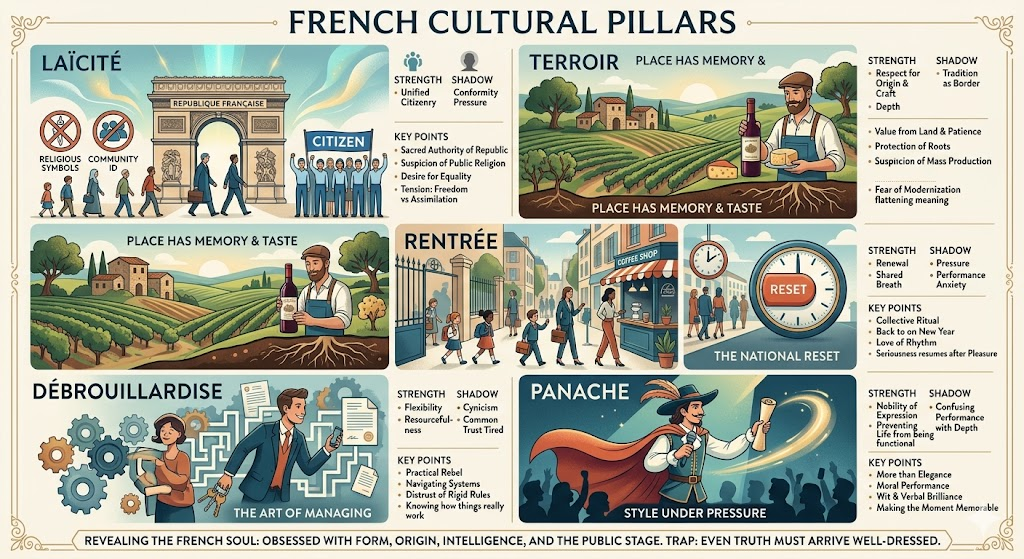
Laïcité is not just secularism. In France, it is the dream that the public space can be purified from private gods.
Behind this word stands one of the deepest French instincts: the state must be stronger than the tribe. Religion, family origin, community loyalty, private identity, all of them may exist, but they must not rule the common stage.
This is why laïcité is more than a legal principle. It is a psychological architecture. France does not simply ask people to live together. It asks them to enter the Republic almost ceremonially, leaving certain parts of themselves at the door.
Its strength is obvious. It creates a fierce idea of citizenship. You are not only someone’s child, believer, ethnic descendant or local creature. You are a citizen under the same abstract sky as everyone else.
But the shadow begins when abstraction becomes cold. When the Republic says, “Be universal,” some people hear, “Become invisible.” Laïcité can protect freedom from domination, but it can also become a very elegant machine for discomfort.
From this comes:
- the sacred authority of the Republic
- suspicion toward public religious display
- the desire to turn citizens into equals before they are individuals
- the constant tension between freedom and assimilation
Laïcité reveals a France that wants harmony, but prefers to achieve it through rules, symbols and intellectual discipline. Even equality must pass an exam.
Terroir
Terroir is the belief that place is not background. Place has memory, authority and taste.
In France, terroir is not only about wine, cheese or soil. It is a worldview. It says that value is not invented in a marketing department. Value grows slowly, from land, climate, gesture, patience, inheritance and stubborn local pride.
Behind this word stands a quiet resistance to the disposable world. France does not fully trust what can be made anywhere. It trusts what belongs somewhere.
This shapes more than food. It shapes identity. A product, a village, an accent, a recipe, a profession, even a way of arguing can carry the dignity of origin. The local is not provincial. It is proof.
The strength of terroir lies in its protection of depth. It teaches that things need roots to have character. The shadow begins when roots become a museum, when authenticity becomes a border, when tradition starts guarding the door like an old aristocrat with excellent taste and poor flexibility.
From this comes:
- respect for origin and craft
- suspicion toward mass production
- pride in regional identity
- fear that modernity will flatten everything meaningful
Terroir reveals a France that does not want merely to consume life. It wants life to have an address.
Rentrée
La rentrée is not just the return after summer. It is France pressing the reset button on the national nervous system.
Every year, the country performs a small collective ritual: back to school, back to work, back to politics, back to seriousness. The beach ends. The notebooks open. The nation remembers its posture.
Behind this word stands the French love of rhythm. Life must have seasons, pauses, returns, structures. Even freedom needs a calendar.
La rentrée is psychologically powerful because it gives people a second New Year without fireworks. It says: now we begin again, but properly. New plans, new books, new reforms, new anxieties, new arguments about everything.
Its strength is renewal. It gives society a shared breath. Its shadow is pressure. The return is not innocent. It carries the moral weight of performance: be organized, be informed, be serious, be ready to re-enter the system.
From this comes:
- the national drama of returning to routine
- the idea that seriousness resumes after pleasure
- social pressure to restart well
- a cultural rhythm where private life and public life move together
La rentrée reveals a France that can disappear into leisure, then return with a briefcase, a philosophy and a complaint.
Débrouillardise
Débrouillardise is the art of managing when the official path is too slow, too rigid or too absurd.
This word carries a very French intelligence: life is full of systems, but survival belongs to those who know how to move inside them without becoming their victim.
Behind it stands a practical rebel. Not the heroic revolutionary in the square, but the person who knows whom to call, which paper matters, which rule bends, which silence helps, which shortcut saves the day.
In daily life, débrouillardise is admired because it proves alertness. You are not naïve. You can read reality. You can handle bureaucracy, scarcity, inconvenience, contradiction. You can make life work even when the machine does not.
Its strength is flexibility. Its shadow is cynicism. When everyone must learn to “manage,” people stop expecting systems to function cleanly. The clever citizen survives, but the common trust becomes tired.
From this comes:
- admiration for resourcefulness
- creative negotiation with rules
- distrust of rigid procedures
- the quiet belief that intelligence means knowing how things really work
Débrouillardise reveals a France that loves structure, but secretly respects the person who knows how to escape it.
Panache
Panache is style under pressure. It is the refusal to be merely efficient when one can be memorable.
In France, panache is not simple elegance. It is a moral performance. It says: even defeat should have form, even courage should have language, even rebellion should know how to dress itself.
Behind this word stands the French hunger for gesture. Action alone is not enough. One must act with brilliance, wit, timing, dignity, theatrical nerve. The act must leave a trace.
This is why French culture often admires the figure who speaks sharply, falls beautifully, resists dramatically or wins with flair. The result matters, yes. But the manner matters almost as much.
Its strength is nobility of expression. It prevents life from becoming purely functional. Its shadow begins when style becomes more seductive than substance, when the phrase is sharper than the solution, when the pose survives after the courage has gone home.
From this comes:
- admiration for wit and verbal brilliance
- the theatrical side of politics and public life
- respect for elegance even in conflict
- the danger of confusing performance with depth
Panache reveals a France that does not only ask, “Did you win?” It asks, “Did you make the moment worthy of being remembered?”
What do these words reveal about the soul of France?
These words reveal a country obsessed with form, origin, intelligence and the public stage. France wants life to be universal, rooted, clever, renewed and beautifully expressed.
Its genius is that it turns ordinary existence into culture. Its trap is that even truth may be asked to arrive well dressed.