
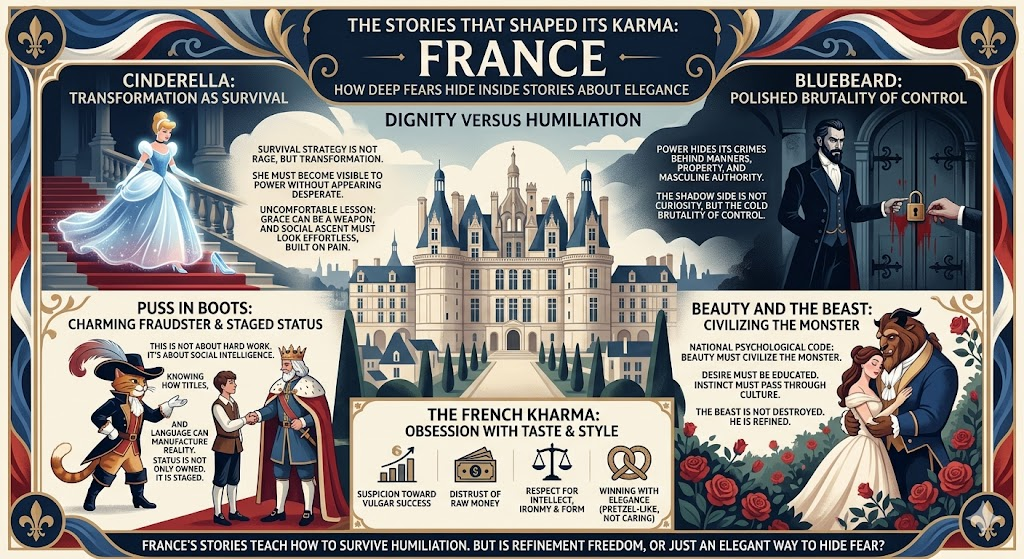
The Stories That Shaped Its Karma: France
Sometimes a nation hides its deepest fears inside stories about elegance.
France likes to imagine itself as the land of reason, beauty, taste, rebellion, and refinement. But beneath the polished surface, its old stories whisper a sharper conflict: dignity versus humiliation. The French imagination is obsessed with one question: how do you remain noble in a world that constantly tries to make you small?
- Take Cinderella, in the version shaped by Charles Perrault. On the surface, it is a story about goodness rewarded. But look closer. Cinderella does not overthrow the system. She enters it beautifully. Her survival strategy is not rage, but transformation. She must become visible to power without appearing desperate for it. The uncomfortable lesson is clear: in France, grace can be a weapon, and social ascent must look effortless, even when it is built on pain.
- Then there is Bluebeard, one of the darkest French tales. A wealthy husband, a forbidden room, murdered wives, and a woman punished for curiosity. Officially, it warns against disobedience. Psychologically, it reveals something colder: power often hides its crimes behind manners, property, and masculine authority. The shadow side is not curiosity. The shadow side is the polished brutality of control.
- And then comes Puss in Boots, the charming fraudster who turns a poor miller’s son into a nobleman through tricks, lies, performance, and perfect timing. This is not a tale about hard work. It is about social intelligence. About knowing how titles, appearances, and language can manufacture reality. France has always understood this too well: status is not only owned. It is staged.
The master key, however, may be Beauty and the Beast. It looks like a romance, but underneath it is a national psychological code: beauty must civilize the monster. Desire must be educated. Instinct must pass through culture before it becomes acceptable. The Beast is not destroyed. He is refined.
Sounds familiar, doesn’t it? The French suspicion toward vulgar success. The obsession with taste. The distrust of raw money. The respect for intellect, style, language, irony, and form. In France, it is not enough to win. One must win with elegance, preferably while pretending not to care too much.
Modern France still carries this script. Power is challenged, but also admired. Money is necessary, but morally suspicious. Work matters, but living well matters more. Success without taste looks almost obscene.
France’s old stories do not simply teach children to dream. They teach them to survive humiliation through beauty, language, rebellion, and style.
But here is the uncomfortable question: is refinement a form of freedom, or just a more elegant way to hide fear?