
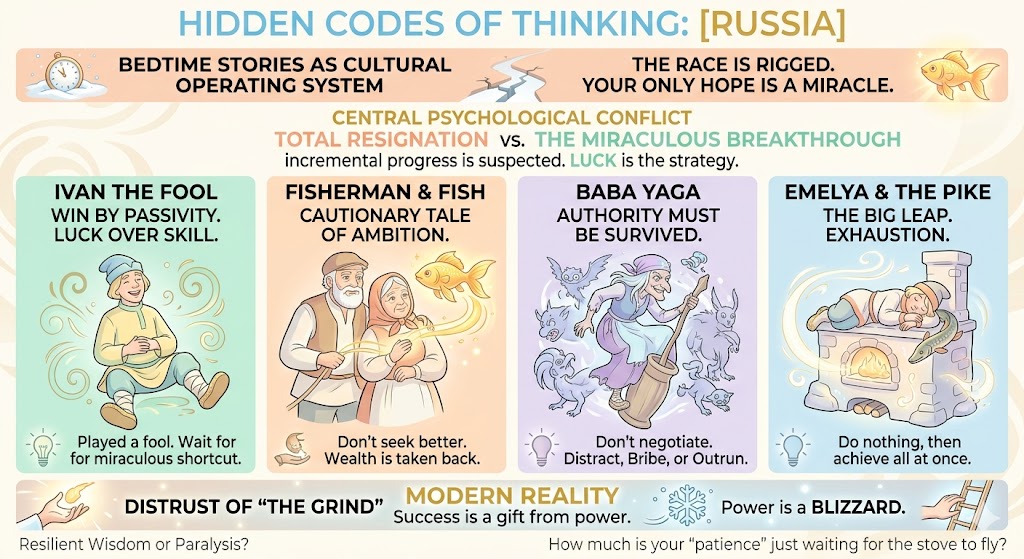
Bedtime stories are a nation’s most dangerous ideas because they are the only ones we never bother to question. While other cultures use fables to teach “slow and steady wins the race,” the Russian script suggests that the race is rigged, the track is frozen, and your only hope is a miracle you didn’t earn.
The central psychological conflict of the Russian mind is Total Resignation vs. The Miraculous Breakthrough. It is a culture that deeply suspects incremental progress. In this world, hard work is often a trap for the unimaginative, while “luck” is the only logical strategy for survival.
The Scripts of Survival
- Ivan the Fool: He is the hero who wins not by being smart or brave, but by being so remarkably passive that the universe eventually feels sorry for him. The Shadow Side: This isn’t a celebration of innocence; it’s a survival mechanism against a brutal system. If you show competence, you are given more work or more taxes. To survive, you must play the fool until the moment for a “miraculous” shortcut appears.
- The Fisherman and the Fish: An old man catches a wish-granting fish, but his wife’s ambition leads them back to a broken trough. The Shadow Side: This is a cautionary tale against the “middle class.” It teaches that seeking “better” is a dangerous hubris. It justifies a lack of initiative: why build anything if the “Goldfish” of fate will eventually take it all back?
- Baba Yaga: A cannibalistic witch who helps or eats you based on a whim. The Shadow Side: Authority is not supposed to be fair; it is supposed to be survived. You don’t negotiate with Baba Yaga; you distract her, bribe her, or outrun her. It’s a blueprint for navigating a bureaucracy that views you as fuel rather than a citizen.
The Recognition Moment
Sounds familiar, doesn’t it? That peculiar “Avos”—the national habit of hoping things will just “work out” at the last possible second without a plan. You see it in the boardroom and the kitchen: a strange pride in how much suffering one can endure, coupled with a sudden, violent burst of energy when a “miracle” is required.
The Master Key: Ilya Muromets
The ultimate key is the story of Ilya Muromets, who spends the first thirty-three years of his life unable to move, lying on the stove while the world goes on without him. Then, almost miraculously, he rises, receives strength, and becomes the great defender of the Russian land. The hidden fear here is not laziness, but powerlessness: the feeling that life may pass by while a person waits for the moment when strength finally arrives. The survival strategy is the “Sacred Awakening”: endure, remain still, absorb suffering, and then, when the hour comes, rise with impossible force.
Modern Reality
In today’s reality, this manifests as a profound distrust of “the grind.” Success isn’t seen as a ladder built of small steps, but as a “seized” opportunity or a gift from power. Power itself is viewed like a blizzard: you don’t argue with it, you just put on a heavier coat and wait for it to pass.
Is this a resilient wisdom born from an unforgiving landscape, or just a generational paralysis that mistakes survival for living?
How much of your “patience” is actually a hope that the stove will finally start flying?