The Wheel of Samsara on the Eurasian Plain: The Karma of Russia
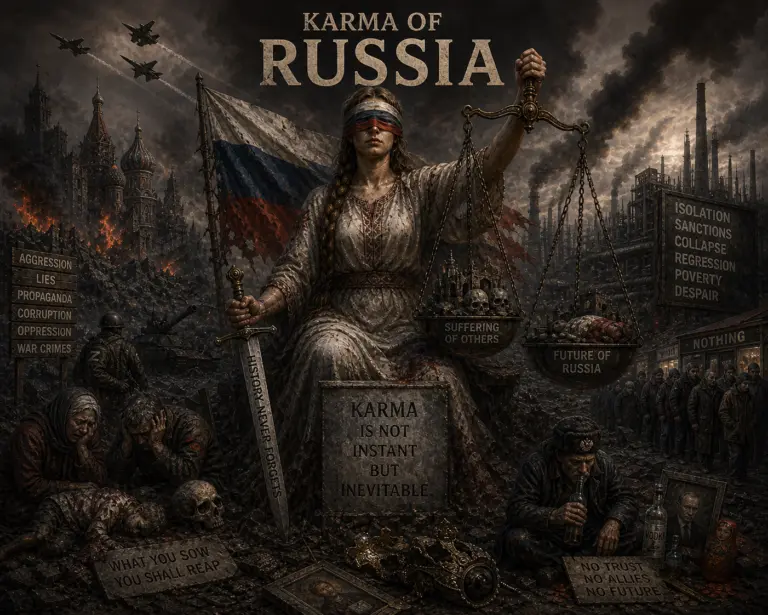
To speak of the “karma” of a nation is to transcend the standard tools of political science, economics, or conventional history. It requires an examination of the deep, repetitive grooves carved into a collective national psyche over centuries. Karma is not a mystical mechanism of cosmic punishment; it is the absolute law of cause and effect. It is the momentum of choices made, traumas unaddressed, and structural patterns so deeply ingrained that they transform history from a linear progression into a tragic, repeating loop.
Nowhere does this concept feel more visceral than in Russia. Spanning eleven time zones, eternally frozen in a state of psychological tension between East and West, Russia’s historical trajectory resembles a grand, inescapable myth. It is a cyclical epic of autocratic consolidation, brief and chaotic flirtations with liberation, and inevitable collapses back into centralized control.
Looking at Russia today, the momentum of its past actions continues to dictate its present crises. Its karma is a heavy, systemic wheel that grinds down generations, driven by an unresolved relationship with power, geography, and its own soul.
I. The Genesis of Paranoia: Geography as Destiny
To understand the Russian actions that puzzle or terrify the outside world, one must first understand the flat, terrifying vulnerability of the land itself. Unlike Great Britain protected by its channel, or the United States shielded by two massive oceans, Russia was born on the vast, uninterrupted European plain.
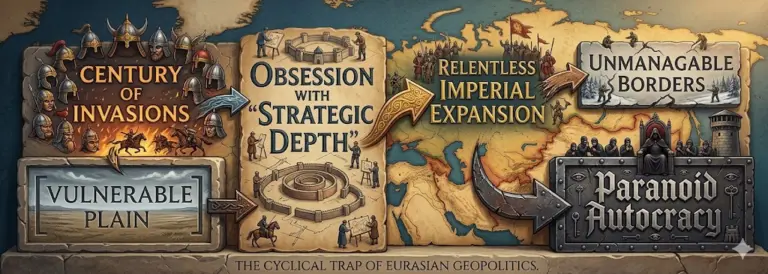
The defining trauma of the nascent Russian state occurred in the 13th century with the Mongol invasion—the “Mongol Yoke.” It did not merely destroy the prosperous, decentralized principalities of Kievan Rus; it completely rewired the political DNA of Moscow, the outpost that eventually emerged from the ashes. The Mongols taught Russia a brutal, foundational lesson: vulnerability is an invitation to total annihilation.
The response to this vulnerability became Russia’s primary karmic engine: the pursuit of security through expansion. To protect the vulnerable core, Moscow had to push its borders outward to find natural geographic barriers—the Carpathian Mountains, the Caucasus, the Urals, the Arctic.
Yet, this created a paradox. A larger empire meant longer borders to defend, which meant neighboring more potential enemies, which necessitated further expansion. This relentless cycle transformed a landlocked principality into the largest contiguous empire on earth. The heavy karmic price of this expansion was an enduring, systemic paranoia: a collective belief that the outside world is a hostile wilderness perpetually plotting Russia’s destruction.
II. The Autocratic Contract: The Sacrificial Altar of Statehood
The second pillar of Russian karma is its historical, almost religious preference for centralized, absolute power over individual liberty. While Western Europe spent centuries chipping away at the divine right of kings—gradually replacing it with social contracts rooted in individual rights—Russia developed a radically different contract.
In Russia, the people historically surrendered their personal agency to a strongman (the Tsar, the General Secretary, the President) in exchange for two things: protection from external enemies and a sense of belonging to a grand, feared global superpower.
This choice has subjected Russia to a devastating historical oscillation between iron-fisted rule and absolute collapse.
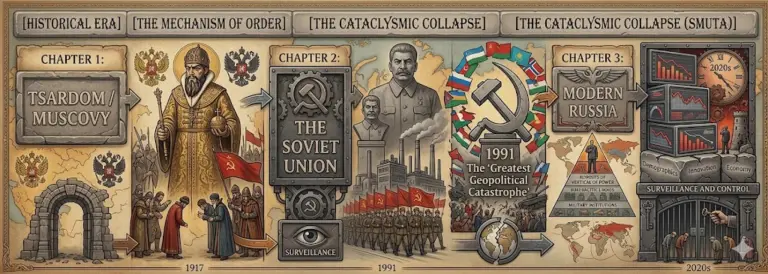
| Historical Era | The Mechanism of Order | The Cataclysmic Collapse (Smuta) |
| Tsardom / Muscovy | Ivan the Terrible & The Romanovs | The 1917 Bolshevik Revolution & Brutal Civil War |
| The Soviet Union | Stalinism & Communist Totalitarianism | The 1991 Collapse (The “Greatest Geopolitical Catastrophe”) |
| Modern Russia | The “Vertical of Power” & Neo-Imperialism | The mounting structural and economic tensions of the 2020s |
In the Russian collective memory, the worst periods of history are not the eras of ruthless tyrants, but the eras when the central authority weakened. Ivan the Terrible is romanticized because he defeated internal treachery; Joseph Stalin is venerated by many because he won the Great Patriotic War, despite murdering millions of his own citizens.
The brief periods of liberalization—the reforms of Alexander II, the provisional government of 1917, the chaotic democratization under Boris Yeltsin in the 1990s—all yielded poverty, instability, and humiliation. This has created a tragic, self-fulfilling karmic prophecy: the fear of chaos causes the population to welcome the return of an autocrat, restarting the cycle of repression that inevitably leads to the next explosion.
III. The Messianic Burden and the Sanctification of Suffering
Russia has rarely been content with simply existing as a normal nation-state; it has almost always viewed itself as an empire with a transcendent, spiritual mission.
When Constantinople fell to the Ottoman Empire in 1453, Moscow declared itself the “Third Rome”—the final, pure guardian of the Orthodox Christian faith. When Tsardom fell, this messianic impulse was secularized and exported globally as Soviet Communism; Russia was the vanguard of humanity’s utopian future. In the contemporary era, this same archetype manifests as a self-appointed bulwark defending “traditional values” against a supposedly degenerate, materialistic Western liberalism.
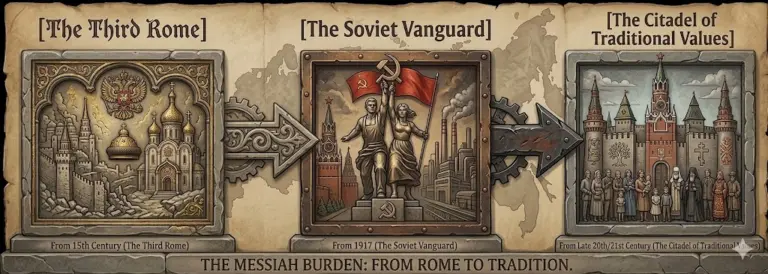
This messianic complex infuses Russian foreign policy with an existential intensity. Geopolitical disputes are rarely viewed as pragmatic disagreements over resources or borders; they are framed as cosmic battles between good and evil.
Concurrently, this complex fosters a unique culture of sacrifice. In the Russian cultural narrative, endurance is a holy virtue. The nation derives a profound, melancholy pride from how much suffering it can withstand compared to the “soft” or “decadent” societies of the West. The state counts on this capacity for infinite endurance, using it as a currency to fund its geopolitical ambitions.
IV. The Western Mirage and the Schizophrenic Soul
For over three centuries, Russia has suffered from an unresolved identity crisis, a psychological schism famously debated in the 19th century between Westernizers and Slavophiles.
- The Westernizers looked to Europe with intense longing, desiring modernization, technological advancement, and enlightenment values. They wanted Russia to be a respected member of the European family.
- The Slavophiles viewed the West as a spiritual wasteland driven by individual greed. They argued that Russia must guard its unique, communal, and mystical sobornost (spiritual unity).
This duality remains completely unresolved. Russia desires Western technology, wealth, and recognition, yet violently rejects Western political philosophy, institutional accountability, and human rights standards. It demands to be treated as a dominant global superpower, but reacts with fierce resentment when held to global norms. This unresolved tension produces a volatile mixture of an inferiority complex and a superiority complex playing out on the international stage.
V. The Modern Turning of the Wheel: The Present Crisis
The current chapter of Russian history is perhaps the most acute, dangerous expression of its accumulated karma. The profound trauma of the 1991 Soviet collapse—which stripped the nation of its empire, its economy, and its global standing overnight—set the stage for a classic Russian retributive cycle.
By tapping into deep reservoirs of historical resentment, the modern state successfully resurrected the old archetypes. It rebuilt the “Vertical of Power,” silenced domestic dissent, and embarked on aggressive revanchist campaigns to reclaim its historic buffer zones.
However, the laws of cause and effect are unyielding. The economic and social realities of the mid-2020s demonstrate the compounding interest of this karmic debt:
- The Fiscal Burden: The national economy has become dangerously hyper-militarized. By funneling massive portions of its GDP into military expenditures, the state has triggered inflation, high interest rates, and severe labor shortages.
- The Brain Drain: The tools used to achieve external state greatness—ruthless centralization and the criminalization of dissent—are actively hollowing out the nation’s future. The brightest technological, scientific, and creative minds have left the country in massive waves of emigration.
- The Sovereign Trap: To sustain its stance against the West, Russia has been forced to forfeit its historical independence, gradually slipping into the orbit of an economically dominant China as a junior partner—the exact opposite of the sovereign greatness it craves.
Conclusion: Breaking the Karmic Loop
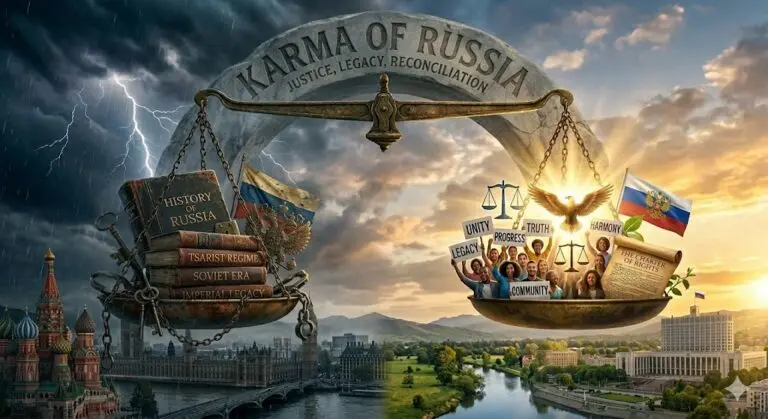
Is Russia condemned to this wheel of samsara forever? History suggests a stubborn, almost terrifying persistence of these patterns. But karma is not fatalism; it is simply momentum. The momentum can be changed, but only through a profound, collective reckoning with the past—a process of national introspection that Russia has repeatedly deferred.
For Russia to break its cycle, it must achieve two profound psychological shifts:
- Redefine Security: It must learn to feel secure within its own recognized borders without needing to subjugate or destabilize its neighbors.
- Decouple Greatness from Tyranny: The population must decouple national pride from the absolute power of a single ruler, realizing that a nation’s true strength lies in the well-being and freedom of its citizens, not the terror it inspires abroad.
Until those shifts occur, the wheel will continue to turn. The weight of the steppe remains heavy, and the soul of Russia remains caught in a storm of its own historical making, waiting for the courage to finally choose a different path.
How this analysis was written
This analysis was written as a cultural and psychological reading of Russia through geography, empire, trauma and repeated historical cycles. It looks at Russia not only as a state, but as a vast civilizational pattern shaped by vulnerable borders, centralized power, messianic ideas and the fear of collapse.
The essay focuses on several recurring codes: security through expansion, autocracy as protection from chaos, suffering as moral currency, the “Third Rome” myth, and the unresolved split between Western longing and anti-Western resentment. It does not claim to describe every Russian individual. Instead, it reads Russia as a collective story: a country caught between the desire for greatness and the recurring cost of building greatness through fear.
Sources / Further Reading:
Richard Pipes, Russia under the Old Regime; Orlando Figes, Natasha’s Dance; Geoffrey Hosking, Russia and the Russians; Stephen Kotkin, Stalin; Martin Malia, Russia under Western Eyes; Serhii Plokhy, The Gates of Europe..