Volya
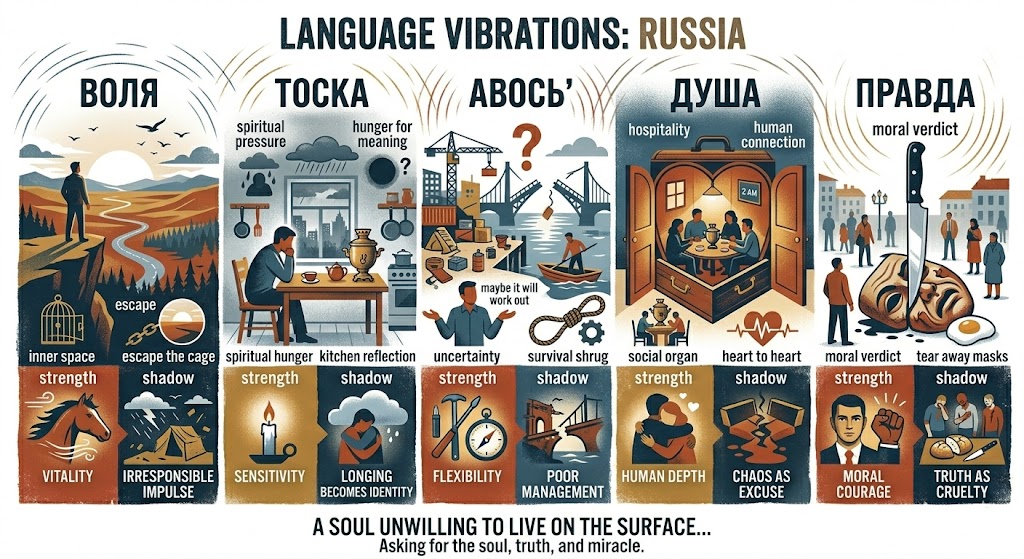
Volya is not simply freedom. It is freedom with wind, distance, danger and no one standing over your shoulder.
Behind this word lives one of Russia’s deepest psychological impulses: the desire to escape the cage, even if nobody knows what comes after the escape. Volya is not legal freedom. It is inner space. The field, the road, the forest, the sudden decision to leave, drink, fight, pray, disappear or start again.
This word carries both rebellion and loneliness. It is the feeling that a person cannot fully breathe inside too many rules. Institutions may organize life, but volya asks a more primitive question: who are you when nobody commands you?
In daily life, volya appears as suspicion toward control, emotional intensity, sudden generosity, sudden destruction, and the strange romance of acting not because it is practical, but because the soul cannot tolerate pressure anymore.
Its strength is enormous vitality. Volya gives courage, imagination, survival, refusal to be domesticated. It says that a human being is not only a citizen, worker, taxpayer or family member. A human being also needs wild space inside.
Its shadow begins when freedom loses responsibility. Then volya becomes not dignity, but impulse. Not liberation, but escape. Not courage, but the refusal to build anything stable.
From this comes:
- love of inner independence
- resistance to small control
- romantic respect for risk and extremes
- difficulty with calm, ordinary limits
Volya is Russia’s breath beyond the fence. But when breath becomes storm, it can blow down the house too.
Toska
Toska is not just sadness. It is the feeling that life owes the soul something deeper than comfort, success or polite happiness.
Behind this word stands a psychological hunger for meaning. Toska appears when the outside world is not enough: money is not enough, conversation is not enough, even love sometimes feels too small for what the soul wants.
This is not simple melancholy. It is a spiritual pressure inside ordinary life. A person may sit in a kitchen, look out the window, drink tea, say nothing, and still feel that the universe has failed to explain itself properly.
Toska shapes art, friendship, faith, drinking, poetry, confession and silence. It gives Russian emotional life its depth, but also its heaviness. It makes people suspicious of shallow cheerfulness. A smile without pain behind it can look almost unserious.
Its strength is sensitivity. Toska keeps the soul awake. It refuses to reduce life to career, shopping, entertainment and correct behavior. It asks: where is the truth, where is the wound, where is the real thing?
Its shadow begins when longing becomes identity. Then suffering becomes proof of depth, and joy starts to look vulgar. A person may begin to protect their sadness because it feels more honest than hope.
From this comes:
- emotional depth in art and speech
- distrust of superficial optimism
- attraction to confession and difficult truth
- temptation to confuse pain with wisdom
Toska is Russia’s inner weather. It can produce genius, tenderness and prayer, but it can also make happiness feel suspiciously cheap.
Avos
Avos means something like “maybe it will work out,” but inside Russian life it is much more than carelessness. It is a survival philosophy disguised as a shrug.
Behind this word stands a nervous agreement with uncertainty. When systems are unstable, rules change, plans collapse and life refuses to behave, a person learns not to trust planning too much. Avos’ says: prepare if you can, but do not worship the plan.
It lives in everyday decisions: leave it for later, somehow we will manage, someone will help, the road will open, fate will turn, the danger will pass. It is not always laziness. Sometimes it is a practical adaptation to a world where too much depends on forces outside your control.
Its strength is flexibility. Avos’ allows people to move through chaos without complete paralysis. It gives improvisation, humor, courage and the ability to survive absurd situations without breaking.
But its shadow is dangerous. Avos’ can become a national excuse for not fixing what must be fixed. A bridge, a law, a family problem, a business, a health issue, a political crisis, all can be left to “somehow.” And “somehow” is not always merciful.
From this comes:
- talent for improvisation
- tolerance of uncertainty
- weak respect for preventive planning
- hope that fate will solve what people avoid
Avos’ is the art of surviving the unpredictable. But when it replaces responsibility, fate stops being a mystery and becomes bad management.
Dusha
Dusha means soul, but in Russia it is also a social organ. It is how a person proves they are not merely functioning, but alive.
Behind this word stands the belief that the visible person is not the whole person. Job, status, money, manners, clothes, even education, all of this can be secondary. The real question is: does this person have a dusha?
Dusha appears in hospitality, intimate conversation, sudden compassion, singing, tears, moral anger, and the ability to speak heart to heart at two in the morning. It does not respect emotional small talk. It wants the hidden layer.
In relationships, dusha can create extraordinary warmth. A stranger can become close quickly if the emotional door opens. Formality may collapse into confession. People may share pain faster than they share practical details.
Its strength is human depth. Dusha protects life from becoming purely bureaucratic, commercial or technical. It says that behind every role there is a wounded, loving, contradictory creature who wants to be seen.
Its shadow begins when soul becomes an excuse for chaos. “I have a soul” may start to mean: forgive my irresponsibility, my drama, my broken promises, my emotional invasion. Depth can become a weapon against boundaries.
From this comes:
- intensity in friendship and love
- respect for sincerity over politeness
- emotional generosity
- difficulty with clean personal boundaries
Dusha is Russia’s most seductive word. It gives warmth to a cold world, but sometimes it burns the furniture to prove there is a fire.
Pravda
Pravda means truth, but in Russian culture it often sounds less like a neutral fact and more like a moral verdict.
Behind this word stands the need to tear away masks. Pravda is not always comfortable, diplomatic or soft. It wants to expose what is hidden, false, hypocritical or rotten. It is truth with teeth.
This word shapes conversations, politics, literature and family life. People may endure discomfort if they believe something “true” is being said. A harsh sentence can be respected because it sounds honest. A gentle lie may be despised because it smells like cowardice.
Its strength is moral courage. Pravda refuses to let language become only decoration. It pushes against fake harmony, official phrases, empty smiles and beautiful nonsense. It asks not what sounds pleasant, but what stands underneath.
Its shadow begins when truth becomes cruelty. A person may confuse bluntness with honesty, aggression with insight, exposure with justice. The desire to unmask can become addiction. Once everything is exposed, someone still has to build.
From this comes:
- respect for direct speech
- suspicion toward polished appearances
- moral intensity in public debate
- temptation to use truth as a weapon
Pravda is Russia’s knife for cutting through illusion. But a knife can prepare bread, or it can wound everyone at the table.
What do these words reveal about the soul of this country?
These words reveal a country that does not want to live on the surface. Russia’s language keeps asking for the soul, the truth, the open space, the hidden wound and the miracle that may still arrive at the last moment.
Its greatness and its danger come from the same source: Russia is rarely satisfied with a normal life. It wants depth, fate and meaning, even when what it needs most is a working plan.