The Persian Paradox: How the Ghost of Empire and Divine Obsession Locked Iran in a 2026 Time Lo
Every nation cuts a deal with its own history, but Iran signed its contract in blood, poetry, and oil. To understand Iran today, in 2026, you have to look past the standard news headlines about centrifuges and drone shipments. You have to look at the psychological contract between the Iranian citizen and the state.
That contract is built on a heavy, unspoken agreement: “Give up your personal autonomy, your modern freedoms, and your right to experiment with the future, and in return, we will protect your hyper-fragile pride from a hostile world and guarantee your place in a cosmic, divine drama.”
This deal didn’t appear out of nowhere. It is the direct result of a historical pendulum that has swung for millennia between two extremes: the intoxicating highs of global empire and the devastating lows of foreign humiliation and domestic tyranny. Iranians gave up on boring, stable civic development because their history taught them that survival requires either total dominance or absolute, martyrdom-infused resistance.
1. The Internal Demon: The Imperial Hangover and the Culture of Martyrdom
Iran’s historical ledger is a brutal mix of aggressive imperial expansion and catastrophic collective traumas. The country carries the DNA of an ancient superpower alongside the deep scars of an exploited victim. This duality has warped into a modern geopolitical psychosis.
Five key historical events define this karmic weight:
- The Muslim Conquest of Persia (633–654 AD): The collapse of the Sasanian Empire wasn’t just a political regime change; it was a total civilizational reset. A proud, distinct Zoroastrian superpower was absorbed into the Arab Caliphate. This created a permanent, dual identity crisis: the desire to be the cultural center of the world, clashing with the trauma of forced assimilation. Iran eventually “hijacked” Islamic history by championing Shia Islam, turning defeat into a permanent badge of spiritual superiority.
- The Safavid Forced Conversion (1501): Shah Ismail I established the Safavid Empire and forced a predominantly Sunni population to convert to Shia Islam at the point of a sword. Sunni scholars were executed, mosques were destroyed, and state-sponsored cursing of early Islamic figures became the norm. This brutal enforcement of religious homogeneity laid the foundational infrastructure for the modern theological police state.
- The Anglo-Soviet Invasion (1941): Despite declaring neutrality during World War II, Iran was invaded and occupied by Great Britain and the Soviet Union to secure oil fields and supply routes. The Shah was unceremoniously exiled by foreign powers. This cemented a profound, cynical truth in the national psyche: international laws are a joke, big powers will always violate your sovereignty, and weakness invites immediate destruction.
- The CIA-MI6 Coup / Operation Ajax (1953): When the democratically elected Prime Minister Mohammad Mosaddegh nationalized Iranian oil, Western intelligence orchestrated his overthrow to reinstall the absolute monarchy of the Shah. By crushing a legitimate, secular democratic experiment, the West accidentally created the perfect greenhouse for radical Islam. It proved to the population that democracy was a Western trap, paving the way for 1979.
- The Iran-Iraq War (1980–1988): Triggered by Saddam Hussein’s invasion but fueled by the Islamic Republic’s desire to export its revolution, this war cost nearly a million lives. The state utilized “human wave” tactics, sending teenagers with plastic “keys to heaven” to clear minefields. This meat-grinder era solidified Ashura (the culture of martyrdom and holy suffering) as the ultimate state ideology.
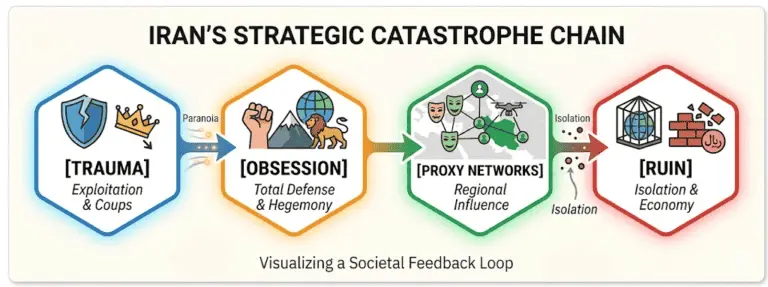
Today, this bloody history has turned into a crippling national neurosis. Iran’s rulers act out their imperial fantasies by funding proxy militias across the Middle East, viewing themselves as regional puppet masters. But this aggressive posture has triggered a massive karmic blowback. The obsession with resisting external enemies has turned the state into an internal occupying army.
The modern Iranian lives in a state of permanent psychological paralysis. The elite are so terrified of looking weak to the outside world that they treat their own youth as foreign insurgents, crushing domestic protests with absolute brutality.
2. National Fixation: The Elegant Art of Deception
The ultimate визитная карточка (calling card) of Iranian culture is Ta’arof (تعارف). To outsiders, it is celebrated as an exquisite system of hospitality, extreme politeness, and cultural refinement. It’s the ritual where a taxi driver refuses your money three times before accepting it, or a host insists that their house belongs to you.
But in the harsh light of 2026, Ta’arof has been driven to a dysfunctional extreme, morphing into a national coping mechanism of social insincerity and institutionalized double lives.
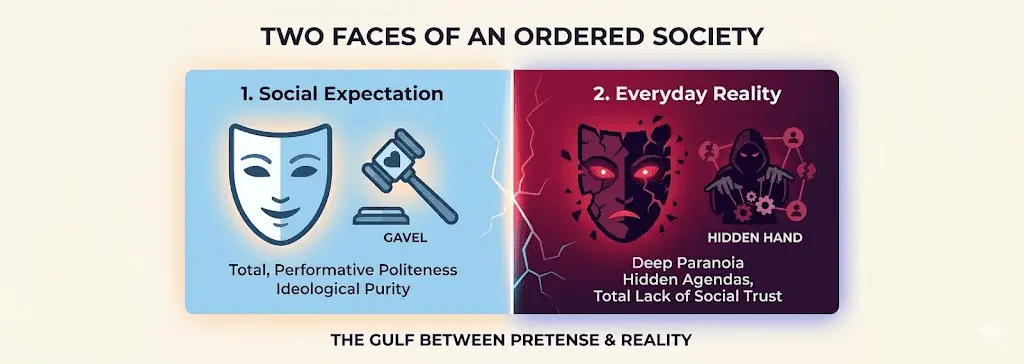
In everyday Iranian life, this fixation means that nobody can say what they actually mean, and nobody can trust what they hear. It creates an environment where passive-aggressive compliance replaces honest negotiation. In business and technology, it destroys efficiency. You cannot run a agile tech startup or implement data-driven economic reforms when managers spend 80% of a meeting trading poetic compliments and hiding critical failures to “save face.”
By turning deception into an art form, society has built a world where everyone pretends to be a pious supporter of the state in public, only to drink homemade wine and watch banned satellite TV in private. Progress is jammed because the culture rewards the facade of harmony over the messy, honest friction required for innovation.
3. Anatomy of National Duplicity
The gap between what Iran pretends to be and what Iran actually is has grown into a yawning chasm. The society is effectively split into two parallel universes: the official revolutionary theater and the underground reality of the 2020s.
| The Beautiful Myth / The Facade | The Brutal Truth / The Reality |
| The Holy Islamic Utopia: The state brands itself as a morally pure, corruption-free society built on divine justice, modesty, and spiritual resistance against Western decadence. | The Crisis of Faith and Vice: Many observers describe modern Iran as a society where official religious identity and private social reality increasingly diverge. |
| Champions of the Oppressed: The regime claims to be the global vanguard protecting the world’s dispossessed, anti-colonial forces, and marginalized peoples. | Domestic Apartheid: The system systematically oppresses its own ethnic minorities (Kurds, Baluchis), treats women as second-class legal entities, and ruthlessly executes political dissidents at a staggering rate. |
| Scientific and Technological Independence: State media boasts of domestic technological triumphs, medical breakthroughs, and satellite launches achieved under total sanctions. | The Grand Brain Drain: Anyone with a working brain cell and an engineering degree is actively trying to flee. Iran suffers from a catastrophic flight of human capital, leaving industries managed by ideologically loyal incompetents. |
| Egalitarian Revolutionary Asceticism: The ruling class champions the simple, pious lifestyle of early Islamic leaders, praising the “barefoot masses.” | The “Aghazadeh” Reality: The children of the regime elite (Aghazadehs) flaunt immense, unexplained wealth, driving luxury European sports cars through Tehran and posting photos from their lavish vacations in Western capitals. |
4. The Fear That Paralyses the System
In a system built on ideological compliance and historical paranoia, the worst thing you can do is stand out, take ownership, or try to fix a broken gear. The entire culture is optimized to deflect blame.
The diagram below illustrates exactly what happens when an individual tries to break the mold:
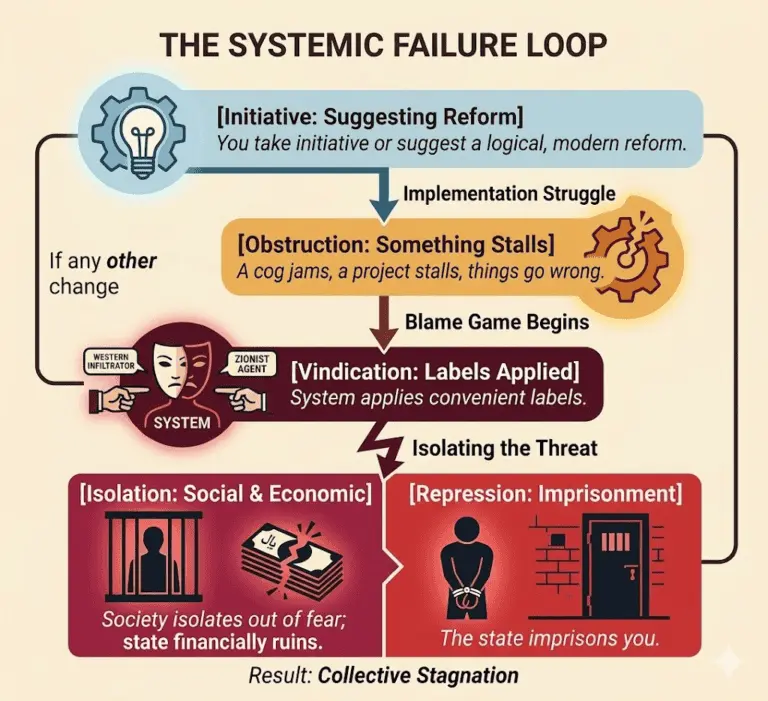
This collective fear creates absolute administrative gridlock. Because any deviation from the hardline ideological script can be interpreted as treason, nobody from mid-level managers to top-tier ministers wants to make a real decision. If an innovative economic policy fails, it’s not labeled a mistake; it’s labeled economic sabotage or a foreign conspiracy.
As a result, the entire nation operates on a survival strategy of malicious compliance: do exactly what the archaic rules say, collect your paycheck, and let the ship sink slowly, as long as you aren’t blamed for the iceberg.
5. The Trap of Past Glory
Iran is culturally drunk on its own history. When a modern Iranian state official or standard nationalist wants to justify why the country deserves to be a global player despite having a crumbling currency and an isolated passport, they inevitably pull out the same old trunk of historical treasures:
“We gave the world the Cyrus Cylinder, the first declaration of human rights! We are the land of Avicenna, Khayyam, and Hafez! We have thousands of years of continuous civilization while the West was still living in mud huts!”
This reliance on ancient cultural capital is a profound trap. The formula of “past civilizational greatness + oil wealth” is completely useless in the global landscape of 2026.
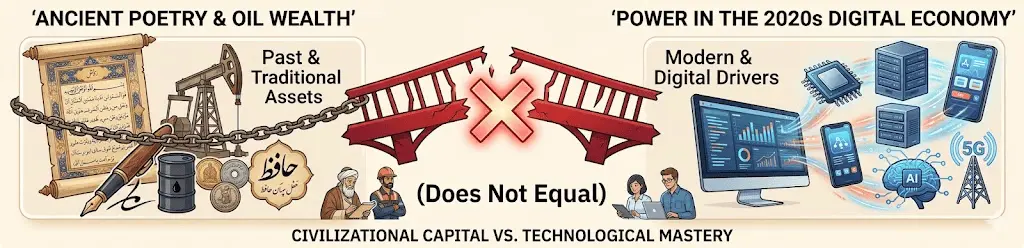
The world has moved on to a landscape dominated by semiconductor supply chains, artificial intelligence, green energy transitions, and transparent financial networks. You cannot run a modern economy on the memory of Cyrus the Great or the poetic prose of the Shahnameh. By treating their history as a comfortable mattress to sleep on rather than a launchpad, the nation has allowed its infrastructure to decay while living in a nostalgic fantasy world.
6. Diagnosis: The Karma of Slow Inertia
Iran will not collapse tomorrow morning. The Western fantasy of a sudden, cinematic revolution that fixes everything overnight ignores the dark reality of how authoritarian inertia works.
Iran manages to finance its long, grinding stagnation through a sophisticated, highly adaptive ecosystem of survival:
- The Sanctions-Proof Shadow Economy: Decades of isolation have created a parallel financial universe. Through systemic smuggling networks, oil sales to Asian markets via dark tanker fleets, and a heavily controlled domestic manufacturing sector, the regime generates just enough cash to keep the state apparatus paid and fed.
- The Praetorian Guard Security Architecture: The Islamic Revolutionary Guard Corps (IRGC) is not just a military branch; it is a multi-billion-dollar corporate conglomerate that controls real estate, telecommunications, construction, and black-market trade. The people holding the guns are also the people holding the bank accounts. They have zero incentive to allow the system to change because they own the system.
The heaviest, most tragic karmic lesson that Iran stubbornly refuses to learn is that true sovereignty cannot be built on external confrontation and internal terror.
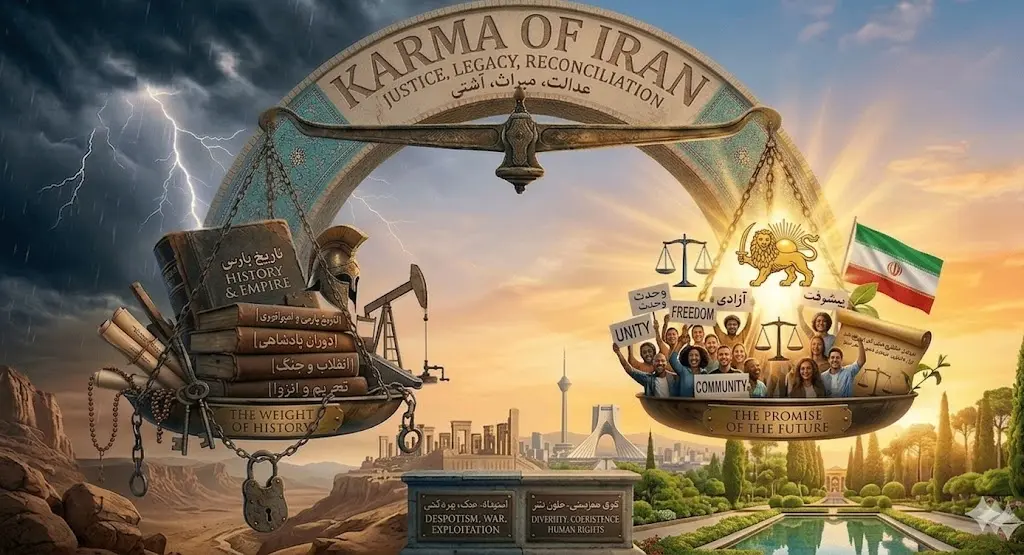
The nation has spent nearly half a century convinced that if it just builds one more missile, funds one more proxy network, or locks up one more generation of young activists, it will finally achieve the security and respect it craves. It is a tragic, closed loop: the more the state fights its imagined and real external demons, the more it destroys the actual soul of its people from within. Until the culture realizes that its greatest enemy isn’t across the ocean, but rather the mirror reflecting its own unhealed historical traumas, Iran will remain trapped in a gilded, poetic cage of its own making.
How this analysis was written
This analysis was written as a cultural and psychological reading of Iran through empire, religion, foreign intervention, revolution, oil, martyrdom and modern authoritarian survival. It looks at Iran not only as a state, but as a civilization caught between ancient pride, poetic intelligence, historical humiliation and the political machinery of the Islamic Republic.
The essay focuses on several recurring codes: imperial memory, Shia martyrdom, Ta’arof as social performance, distrust of foreign powers, the split between public obedience and private life, and the trap of using past greatness as a substitute for future-building. It does not claim to describe every Iranian individual. Instead, it reads Iran as a collective story: a country where dignity, resistance and beauty are constantly forced to negotiate with fear, control and historical trauma.
Sources / Further Reading:
Ervand Abrahamian, A History of Modern Iran; Nikki R. Keddie, Modern Iran: Roots and Results of Revolution; Abbas Amanat, Iran: A Modern History; Homa Katouzian, The Persians; Michael Axworthy, Revolutionary Iran; Said Amir Arjomand, The Turban for the Crown.