The Stories That Shaped Its Karma: Iran
Sometimes a nation hides its deepest fears not in its laws, but in the stories it tells its children.
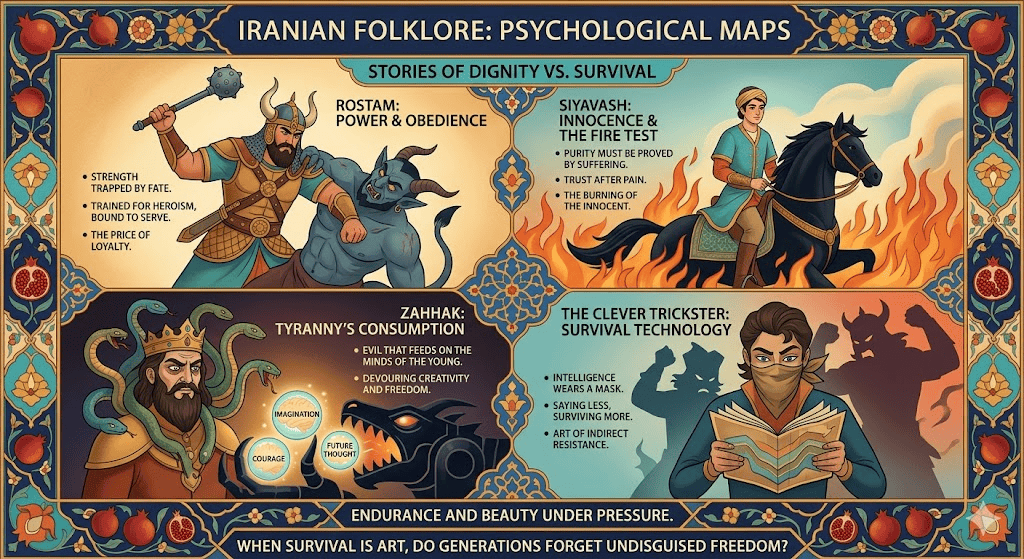
Iran’s old tales are not soft bedtime decorations. They are psychological maps. Again and again, they return to the same conflict: dignity versus survival. How do you remain noble when power is brutal? How do you stay human when history keeps asking you to bend, wait, disguise yourself, or lose everything?
Take Rostam, the giant hero of the Shahnameh. On the surface, he is strength itself: the warrior who defeats monsters, rescues kings, and carries the weight of a civilization on his shoulders. But the shadow side is darker. Rostam is not free. He is powerful, yet trapped by loyalty, kings, fate, and masculine honor. Iran’s great hero teaches a painful lesson: strength does not always protect you from obedience.
Then there is Siyavash, the innocent prince who passes through fire to prove his purity. It is a beautiful image, almost cinematic. But underneath it lies an uncomfortable national habit: the belief that innocence must suffer before it is believed. You are not trusted because you speak the truth. You must burn and survive before society grants you moral value.
And then comes Zahhak, the tyrant with snakes growing from his shoulders, fed by human brains. It is grotesque, but brutally precise. Evil in this story is not just violence. It is a system that feeds daily on the minds of the young. The shadow lesson is simple: tyranny does not only kill bodies. It eats imagination, courage, and future thought.
Iranian folklore also loves the clever survivor: the trickster, the patient one, the person who says less than they know. This is not cowardice. It is a survival technology. When direct confrontation is too dangerous, intelligence learns to wear a mask.
The master key is probably Siyavash. His story contains the hidden wound: the fear that truth alone is not enough. You must prove yourself through pain. You must remain elegant while being tested. You must carry humiliation without becoming small.
Sounds familiar, doesn’t it? The careful speech. The coded humor. The respect for poetry as a safe place for dangerous truth. The suspicion toward raw power. The talent for endurance, beauty, negotiation, and indirect resistance.
In modern life, this script can appear in attitudes toward authority, success, money, and work. Ambition is admired, but open ambition can feel risky. Wealth is desired, but too much visibility invites judgment. Talent must often be wrapped in modesty, irony, or patience.
Iran’s old stories do not simply glorify suffering. They teach refinement under pressure.
But here is the haunting question: when survival becomes an art form, how many generations forget what freedom feels like without disguise?