
Language Vibrations: Words That Do Not Translate, But Shape Iran’s Fate
TA’AROF
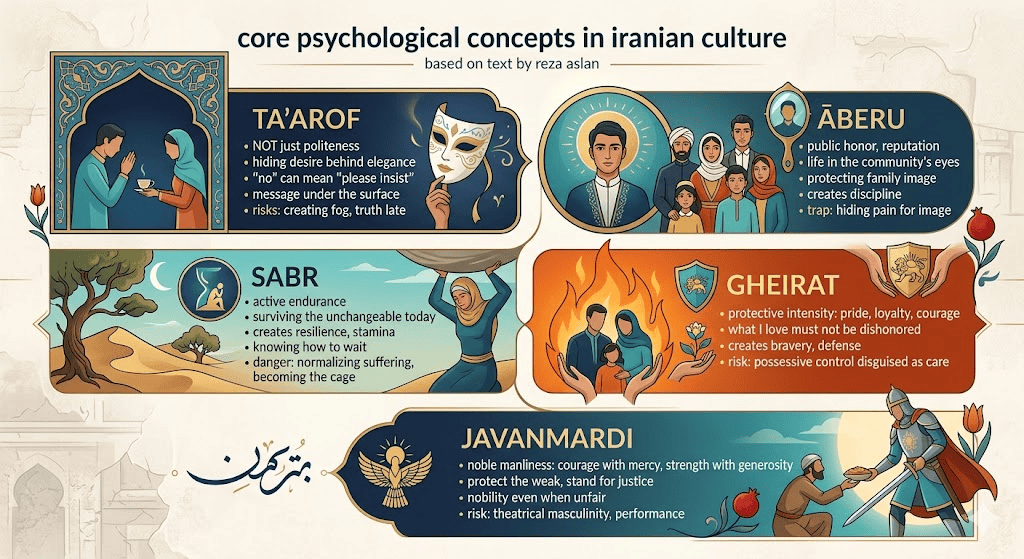
Ta’arof is not politeness. It is the art of hiding desire behind elegance, pride behind humility, and power behind courtesy.
Inside this word lives one of Iran’s deepest social instincts: never show too much directly. Desire must be wrapped. Need must be disguised. Even generosity has to perform a small dance before it becomes real.
Ta’arof teaches people to read the invisible. A simple “no” may mean “please insist.” A gift may not be a gift. A refusal may not be refusal. A compliment may carry status, debt, affection or control. The spoken sentence is only the surface. The real message lives underneath.
This makes Iranian communication highly refined. People learn nuance, timing, emotional intelligence and social grace. A blunt person can look almost childish in this world, as if he has entered a chess game and started throwing stones.
But the shadow begins when sincerity becomes too expensive. Ta’arof can protect dignity, but it can also create fog. People may spend so much energy preserving form that truth arrives late, weak or not at all.
From this comes:
- the culture of indirect communication
- the ability to sense hidden meanings
- the fear of appearing rude, needy or too simple
- the danger of emotional ambiguity
Ta’arof is Iran’s social perfume. Beautiful, subtle, intoxicating, and sometimes used to cover the smell of conflict.
ĀBERU
Āberu is public honor, reputation, the face a person carries in the eyes of others. In Iran, a person does not only live inside the self. A person lives in the gaze of the community.
Behind this word stands a powerful psychological mechanism: life is not only about what you do, but about how your dignity is seen. One wrong public humiliation can feel heavier than a private failure.
Āberu shapes family life, marriage, money, work, politics and silence. People protect not only their own image, but the image of parents, children, relatives, even the dead. Reputation is not private property. It is a family inheritance.
Its strength is obvious. Āberu creates discipline. It stops people from acting carelessly. It teaches restraint, elegance, self-control and responsibility before others.
But its trap is cruel. When reputation becomes more important than truth, people learn to hide pain. A family may protect its image instead of protecting its wounded members. A society may fear scandal more than injustice.
From this comes:
- strong concern for dignity and public image
- pressure to avoid shame at almost any cost
- loyalty to family reputation
- silence around uncomfortable truths
Āberu gives people a face. But sometimes the face becomes a mask that cannot be removed.
SABR
Sabr means patience, but not passive patience. It is the discipline of surviving what cannot be changed today.
This word carries the psychology of endurance. Iran has known pressure, invasion, empire, revolution, sanctions, surveillance, disappointment and waiting. Sabr becomes more than a virtue. It becomes a survival technology.
Sabr teaches the soul to slow down before it breaks. It says: not everything can be solved by force, not every door opens when you kick it, not every pain ends when you complain.
Its strength is deep. It creates resilience, spiritual stamina and the ability to live through uncertainty without collapsing. A culture with sabr knows how to wait, how to adapt, how to keep dignity under pressure.
But patience has a dark twin. Sometimes sabr becomes a beautiful name for delay. People tolerate what should be confronted. They turn endurance into habit. They survive so well that survival itself becomes the cage.
From this comes:
- emotional stamina under pressure
- respect for self-control
- ability to live with uncertainty
- danger of normalizing suffering
Sabr is noble when it protects the soul. It becomes dangerous when it teaches people to decorate their prison.
GHEIRAT
Gheirat is protective intensity: pride, loyalty, jealousy, courage, moral fire. It says: what I love must not be dishonored.
This word holds a very old emotional code. A person is not just an individual. A person belongs to a circle: family, beloved, homeland, faith, memory, name. Gheirat rises when that circle feels threatened.
In its strong form, gheirat creates bravery. It is the force that makes someone defend the weak, protect the family, stand up for dignity, refuse humiliation. It is emotional muscle.
But gheirat can easily become possessive. The same fire that protects can control. The same pride that defends honor can punish freedom. When love becomes ownership, gheirat stops being noble and starts becoming dangerous.
This is why the word is so psychologically charged. It contains both courage and suspicion. Both devotion and domination. Both protection and fear.
From this comes:
- strong loyalty to family and loved ones
- sensitivity to insult and humiliation
- courage in defending what is sacred
- risk of control disguised as care
Gheirat is the fire of honor. It warms the house, but if no one watches it, it can burn the house down.
JAVANMARDI
Javanmardi is noble manliness, but not in the shallow muscular sense. It is generosity with courage, strength with mercy, pride with moral duty.
Inside this word lives an old Iranian dream: the strong person should not be a bully. The strong person should be magnanimous. He should protect, give, forgive, help, stand for justice and not count every coin like a small soul.
Javanmardi is a code of dignity. It says that power without generosity is ugly. Wealth without honor is poor. Courage without ethics is just noise.
This concept gives Iranian culture one of its most attractive ideals: the person who remains noble even when life becomes unfair. The one who does not humiliate the weak. The one who gives without turning generosity into advertising.
But the shadow is performance. Javanmardi can turn into a theatrical masculinity, where honor must be displayed, generosity must be noticed, and moral superiority becomes another costume.
From this comes:
- admiration for generosity and moral courage
- contempt for pettiness
- the ideal of protecting the weaker person
- danger of heroic self-image and social performance
Javanmardi is Iran’s dream of noble strength. Its tragedy begins when nobility becomes a role instead of a character.
What do these words reveal about the soul of this country?
These words reveal a culture obsessed with dignity: how to keep it, how to perform it, how to protect it, how to survive when it is threatened.
Iranian language does not describe a simple inner life. It describes a theater of honor, patience, beauty, restraint and hidden fire. Iran’s soul does not shout first. It watches, measures, waits, smiles politely, protects its face, then remembers everything.