
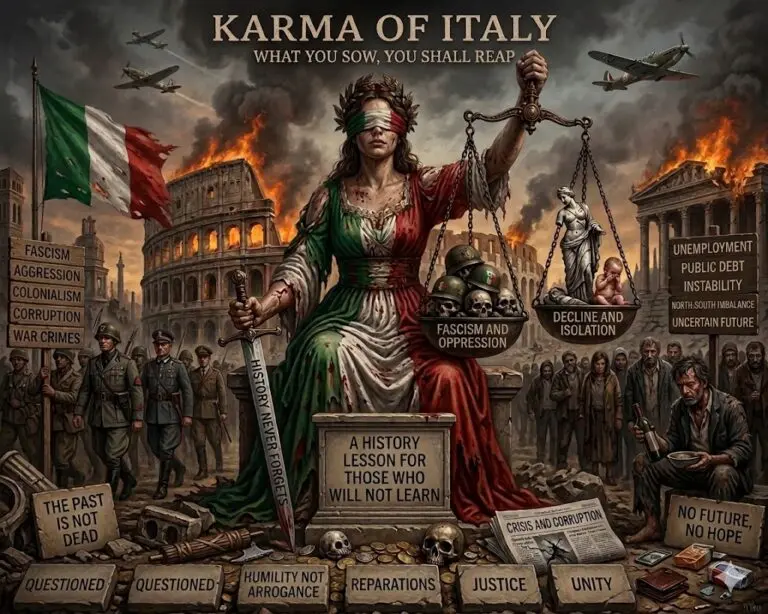
The Karma of Italy: A Nation Caught Between Its Gods and Its Ghosts
To understand Italy is to understand the physics of a pendulum. No other nation on Earth swings so violently between the sublime and the chaotic, between absolute genius and maddening dysfunction. It is a country that has spent millennia building the foundations of Western civilization, only to spend centuries navigating the structural cracks of its own making.
If we look at Italy not just through the lens of history, economics, or art, but through the metaphysical concept of karma—the law of action and inevitable, echoing consequence—we uncover a profound cosmic ledger. Italy’s karma is unique: it is a nation perpetually paying the debt of its own historic greatness, while simultaneously reaping the sweet, chaotic rewards of its refusal to be tamed by modernity. It is a land of beautiful penance and exquisite survival.
1. The Imperial Hangover: The Cosmic Debt of the Caesars
Italy’s primary karmic condition is that it is haunted by its own ancestors. Walk down any cobblestone street in Rome, Florence, or Naples, and you are walking on layers of unmatched human achievement. The Roman Empire exported law, engineering, architecture, and language across the known world.
But such a monumental past comes with a heavy karmic price: the burden of structural inheritance.
When a nation’s past is so overwhelmingly magnificent, the present can feel like an afterthought, or worse, a decline. Italy has become the world’s living museum, a reality that creates a fascinating creative paralysis in the public sphere.
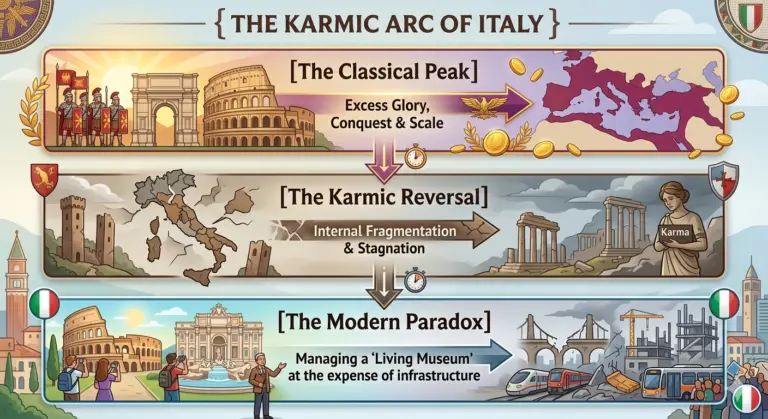
Consider the pragmatic nightmare of modern Italian infrastructure. It is remarkably difficult to build a modern subway line in Rome or expand a highway in Tuscany when every shovel stroke hits a centurion’s villa, an Etruscan tomb, or a Renaissance foundation. The ancestors built for eternity, leaving the modern Italian to figure out how to fix the plumbing without upsetting UNESCO.
Thus, the country is structurally locked in a preservation mindset. The karma manifests as an inability to easily innovate at scale. Italy is globally revered for historic innovation, yet it frequently struggles with bureaucratic and systemic modernization. The weight of the stone blocks the path of the digital.
2. The Sacred and the Profane: The Vatican and the Guilt-Absolution Cycle
You cannot analyze Italy’s karma without stepping into the shadow of the dome of St. Peter’s. For nearly two millennia, Italy has hosted the spiritual epicenter of the Western world. This has injected a highly complex karmic knot into the national psyche: the proximity of the divine alongside the deeply fallible.
Historically, the Church in Italy was not just a spiritual guide; it was a territorial landlord, a political kingmaker, and an atmospheric tax collector. This cohabitation created a fascinating psychological coping mechanism in the Italian people: the split between public piety and private skepticism.
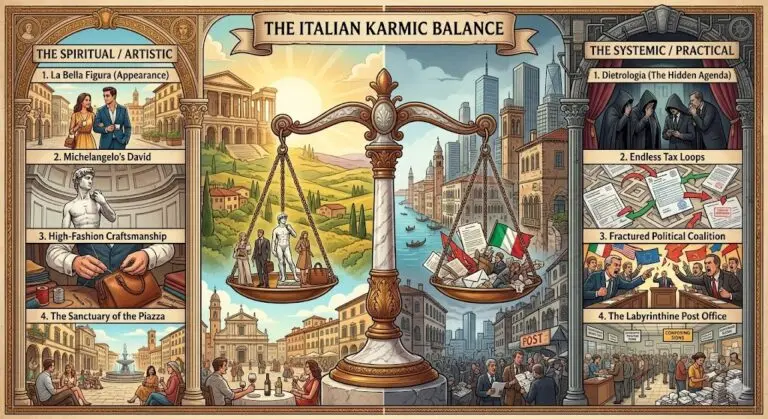
This duality birthed the cultural concept of La Bella Figura—literally “the beautiful figure,” or the art of presenting oneself flawlessly to the world. It is a defensive mechanism against existential scrutiny. If the world is chaotic, corrupt, or spiritually heavy, one must at least ensure that the presentation of life—the clothes, the manners, the food, the architecture—is immaculately beautiful.
The karma of hosting the papacy is a culture that intimately understands human weakness. It is a society that doesn’t expect its systems or its leaders to be perfect, because it has seen centuries of popes, princes, and politicians fall short. Absolution is always just around the corner, which makes for a deeply forgiving culture, but an incredibly frustrating civil landscape.
3. L’Arte di Arrangiarsi: The Bureaucratic Labyrinth
There is a brilliant, uniquely Italian phrase: l’arte di arrangiarsi—the art of getting by, or the ability to find a creative, often improvised way around an impossible problem. It is a survival mechanism born out of a deeply entrenched karmic cycle: the historical, multi-generational distrust of the State.
For centuries following the fall of Rome, Italy was not a unified country. It was a fragmented patchwork of maritime republics, duchies, papal states, and foreign occupiers (Spanish, French, Austrian, Bourbon). The state was rarely an ally; it was an invading army, a tax collector, or a distant monarch. Consequently, the Italian people developed a profound reliance on the self, the family, and the local village (campanilsmo—loyalty to the local bell tower), rather than the central government.
“In Italy, the laws are made to be broken, or at least, gracefully bent to accommodate human reality.”
The karma of this historical fragmentation is the modern Italian bureaucracy—a labyrinth so dense, slow, and redundant it borders on Kafkaesque performance art. Because citizens historically sought loopholes to survive foreign rulers, the modern state created more laws to close those loopholes. In response, the citizens found cleverer, more elegant loopholes.
Today, this cycle yields a society that is brilliantly functional on a micro-level (family-owned luxury brands, niche engineering firms, local gastronomy) but notoriously gridlocked on a macro-level (national political coalitions, judicial timelines, large corporate scaling). The country’s political instability—having experienced dozens of governments since World War II—is the direct cosmic echo of a people who fundamentally believe that prime ministers come and go, but the family dinner remains sacred.
4. The Sensory Ledger: La Dolce Vita as a Universal Recompense
If Italy’s political and economic karma sounds punishing, the universe balances the ledger with unparalleled generosity in the physical realm. Italy enjoys what can only be described as a “sensory surplus.” This is the reward side of the karmic equation.
The Italian dedication to la dolce vita (the sweet life) and il dolce far niente (the sweetness of doing nothing) is not mere laziness or hedonism; it is an active, defensive philosophical stance. It is the understanding that human existence is fragile, regimes are temporary, and therefore, the present moment must be honored with absolute devotion.
- The Volcanic Soil: The destructive tectonic karma of Vesuvius, Campi Flegrei, and Etna is balanced by the fact that their volcanic ash yields the most fertile ground on earth for tomatoes, grapes, lemons, and olives. The earth threatens to destroy life, but first, it makes it taste spectacular.
- The Democratic Stage of the Piazza: The Italian town square is an architectural masterpiece designed not for cars, but for human eyes. It forces community. You cannot easily isolate yourself in Italy; the built environment demands that you walk out, look your neighbor in the eye, argue, embrace, and participate in the human comedy.
- The Obsession with Craft: Because mass production requires a level of sterile, predictable organization that alienates the Italian soul, Italy excels at the artisanal. The world turns to Italy for Ferrari, Pagani, Brunello di Montalcino, and hand-stitched leather because these things require an intense, borderline obsessive emotional investment in the object being created.
The world envies Italy because Italy remembers what it means to be a human being in an increasingly mechanized, digitized world. The sensory rewards of Italy are the universe’s way of paying interest on centuries of systemic suffering.
5. The Demographic Winter and the Landscape of Memory
In the modern era, Italy is navigating its most challenging karmic crisis yet: a quiet, devastating demographic winter. The country faces one of the oldest average populations in the world and a critically low birth rate.
This is the modern manifestation of its socio-economic karma. In a society where young people face chronic underemployment, a lack of institutional meritocracy, and a corporate system that historically favors seniority and legacy over fresh talent (often referred to in Italy as the system of i baroni), the youth are making a quiet choice. They are either emigrating to Northern Europe and North America—a massive “brain drain”—or delaying starting families indefinitely.
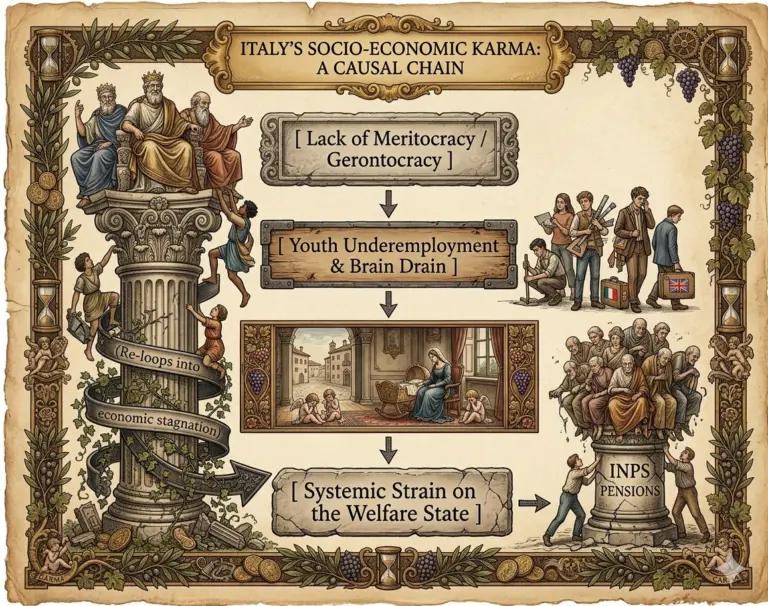
This is the heavy price Italy is paying for its systemic stubbornness. The culture fiercely protects the old ways, old money, and old structures, making it incredibly difficult for the young to build new foundations. The country that famously worships the image of the Bambino (the Christ child) in its art has created an economic landscape where having an actual child feels like a financial impossibility for many of its citizens.
6. The Eternal Return: Italy’s Ultimate Metaphysical Lesson
What, then, is the ultimate takeaway from the Karma of Italy?
Italy is history’s greatest masterclass in the concept of the Eternal Return. It is a nation that has died, been buried, and been reborn a dozen times over. It collapsed with Rome, shattered into warring factions in the Middle Ages, ignited the entire Western world with the intellectual explosion of the Renaissance, withered under foreign empires, unified through blood in the 19th-century Risorgimento, fell into the dark abyss of Fascism, and rose again as a global industrial powerhouse in the mid-20th century.
Italy’s karma teaches the rest of the world three profound truths:
- Chaos and Creativity are Twin Siblings: The exact same lack of rigid, sterile order that causes political and bureaucratic frustration is the fertile soil required for artistic, culinary, and design genius. Without the chaos, there is no spark.
- Resilience is Local, Not Central: When macro-systems, empires, and national governments fail—as they inevitably do—human-scale connections are what endure. The family unit, the local baker, the regional identity, and the neighborhood community are the ultimate safety nets.
- Quality of Life is a Non-Negotiable Metric: True wealth is not found merely in raw GDP growth, stock market highs, or corporate efficiency. It is measured by the time taken to enjoy an espresso, the preservation of historic beauty, the health of the elderly, and the unhurried warmth of human interaction.
Italy will likely never run with the hyper-efficient, sterile clockwork of Northern Europe, nor will it ever possess the relentless, growth-at-all-costs velocity of Silicon Valley. To demand that of Italy is to completely misunderstand its cosmic purpose. Italy exists to remind the world that life is meant to be lived, tasted, and felt deeply—even if you have to wait in an absurd line at the local municipality to do it. Its karma is a beautiful, deeply flawed, eternal masterpiece.
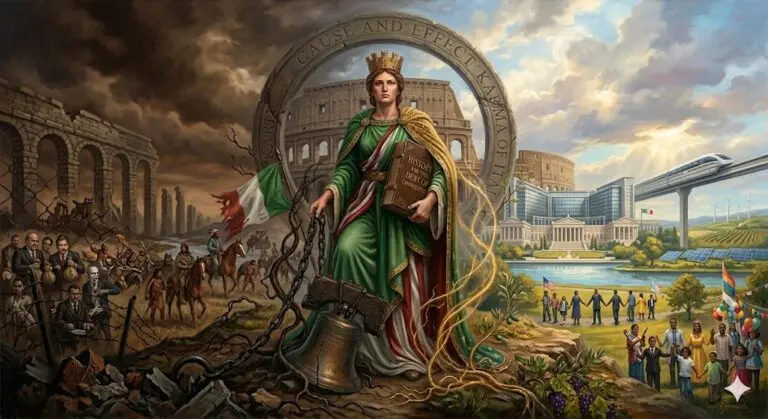
How this analysis was written
This analysis was written as a cultural and psychological reading of Italy through its history, social rituals, religious inheritance and everyday strategies of survival. It looks at Italy not only as a country of art, food and beauty, but as a civilization still negotiating with the weight of Rome, the shadow of the Vatican, the memory of fragmentation and the stubborn genius of local life.
The essay focuses on several recurring codes: la bella figura as social self-protection, l’arte di arrangiarsi as creative survival, bureaucracy as a legacy of mistrust, and la dolce vita as a philosophical refusal to let disorder destroy pleasure. It does not claim to describe every Italian individual. Instead, it reads Italy as a collective story: a nation where beauty, chaos, memory and improvisation are not contradictions, but part of the same cultural engine.
Sources / Further Reading:
John Foot, Modern Italy; Christopher Duggan, The Force of Destiny: A History of Italy Since 1796; David Gilmour, The Pursuit of Italy; Luigi Barzini, The Italians; Paul Ginsborg, A History of Contemporary Italy; Robert D. Putnam, Making Democracy Work.