
Furbizia
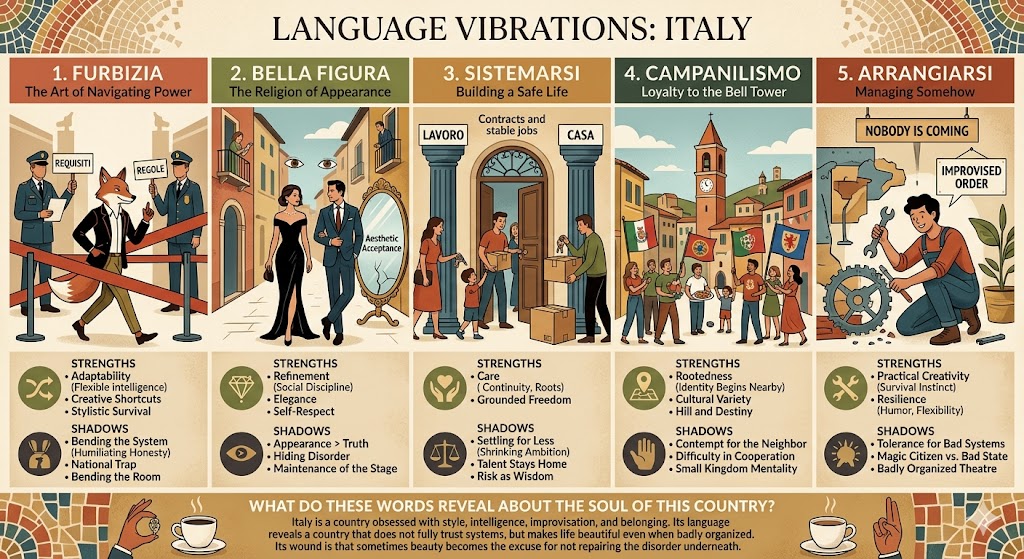
Furbizia is the Italian art of not meeting power head-on, but slipping around it with a smile.
Behind this word lives a very old psychological instinct: life is not always fair, authority is not always clean, rules are not always made for justice. So intelligence becomes flexible. Morality becomes situational. Survival learns to wear perfume.
Furbizia is not simple cleverness. It is cleverness with street temperature. It knows when to speak, when to stay silent, when to ask a cousin, when to call a friend, when to wait until the official rule becomes negotiable.
In daily life, it can look charming: the quick solution, the elegant shortcut, the ability to survive chaos without losing style. In politics, it becomes more dangerous: the belief that systems are not to be trusted, only navigated.
Its strength is adaptability. Italy has survived invasions, bureaucracy, weak institutions, strong families, fragile governments and theatrical public life partly because people learned not to be rigid.
Its shadow begins when intelligence stops serving life and starts humiliating honesty. Furbizia becomes a national trap when the smartest person in the room is not the most capable, but the one who knows how to bend the room.
From this comes:
- admiration for quick intelligence
- suspicion toward formal rules
- patience with small corruption
- the belief that innocence is often stupidity
Furbizia is Italy’s survival instinct, polished into a social skill. Beautiful when it protects life. Poisonous when it replaces trust.
Bella figura
Bella figura is not vanity. It is the social religion of appearing composed, worthy and aesthetically acceptable before the eyes of others.
Behind this expression stands a deep Italian fear: to be seen badly. Not only to fail, but to fail without grace. Not only to be poor, but to look poor. Not only to suffer, but to suffer without form.
Bella figura governs clothes, speech, posture, table manners, public behavior, business meetings, family ceremonies and even emotional collapse. One may be anxious, broke, furious or disappointed, but the surface must not collapse too easily. The world is watching, even when nobody is watching.
This gives Italian life its famous visual intelligence. Beauty is not decoration here. Beauty is social discipline. The street, the shoes, the coffee cup, the gesture of the hand, the way a person enters a room, all of this becomes a language of dignity.
The strength of bella figura is refinement. It teaches people not to dump their chaos on others. It protects elegance, restraint and self-respect.
Its shadow begins when appearance becomes more important than truth. Then problems are hidden, families perform happiness, institutions perform competence, and everyone becomes slightly tired from maintaining the stage.
From this comes:
- sensitivity to reputation
- instinctive respect for style and form
- fear of public embarrassment
- the habit of hiding disorder behind beauty
Bella figura is Italy’s pact with the mirror. It says: even if life is messy, do not let ugliness win too easily.
Sistemarsi
Sistemarsi means to get settled, but inside Italian culture it carries the emotional weight of building a safe life before life becomes too risky.
Behind this word stands a national anxiety about uncertainty. To sistemarsi is not only to find a job or a house. It is to arrange existence so that the future stops behaving like an enemy.
The word carries family pressure, economic caution, social expectation and private longing. A person must sistemarsi with work, with marriage, with housing, with documents, with status, with a place in the world. It is a word full of keys, contracts, kitchens, relatives and quiet fear.
In a country where beauty is ancient but opportunity often feels narrow, sistemarsi becomes almost sacred. It is the dream of stability in a land that has taught people not to trust promises too much.
Its strength is care. It values continuity. It respects the need for roots. It understands that freedom without a base can become panic.
Its shadow begins when settling down becomes settling for less. Then ambition shrinks, youth waits too long, talent stays near home, and the fear of risk starts calling itself wisdom.
From this comes:
- strong attachment to family support
- caution toward financial risk
- delayed independence for many young people
- desire for security before personal reinvention
Sistemarsi is Italy’s quiet prayer against chaos. It wants life to become a home, but sometimes it turns the home into a beautiful cage.
Campanilismo
Campanilismo is loyalty to the bell tower, the local place, the small homeland before the abstract nation.
Behind this word stands one of Italy’s deepest truths: identity begins nearby. The town, the region, the dialect, the food, the square, the football club, the local saints, the grandmother’s recipe, the street where everyone knows your story.
Italy is a country, yes. But psychologically, it is also a mosaic of emotional republics. The local world is not small. It is intimate, proud, suspicious and fiercely alive.
Campanilismo gives Italy its astonishing cultural variety. Every region defends its taste, rhythm, accent and memory as if civilization itself depends on it. In a way, it does.
Its strength is rootedness. People know where they come from. Place is not just geography, it is character. A hill, a city, a coastline, a dialect can become a destiny.
Its shadow begins when love of place becomes contempt for the neighbor. Then the national project weakens, cooperation becomes difficult, and every village secretly believes it is the center of the universe. Sometimes beautifully. Sometimes absurdly.
From this comes:
- strong regional identity
- pride in local traditions
- distrust of distant authority
- difficulty building unified national confidence
Campanilismo is Italy’s genius and its fragmentation. The country is powerful because every corner has a soul, and fragile because every soul wants its own kingdom.
Arrangiarsi
Arrangiarsi means to manage somehow, to make do, to find a way when the system does not help you.
This word contains one of the most Italian forms of courage: not heroic courage, not loud courage, but practical courage. The courage of the person who says, “Fine, nobody is coming. I will solve it myself.”
Arrangiarsi lives in broken plans, delayed offices, family emergencies, unpaid invoices, train strikes, small businesses, old apartments, impossible bureaucracy and last-minute miracles. It is the everyday talent for improvising order out of disorder.
This is why Italy can look chaotic from outside and still function in strange, human ways. The system may be slow, but the person is alive. The rule may be stupid, but someone knows a workaround. The plan may collapse, but lunch will still happen.
Its strength is resilience. Arrangiarsi keeps people moving. It protects humor, flexibility and personal competence when official structures fail.
Its shadow begins when people stop demanding better systems because they have become too good at surviving bad ones. Then improvisation becomes destiny. The citizen becomes a magician, and the state remains a badly organized theatre.
From this comes:
- practical creativity
- tolerance for disorder
- dependence on personal networks
- low expectations from institutions
Arrangiarsi is Italy’s private engine. It proves that life can continue without perfect systems, but it also explains why perfect systems are so rarely demanded with enough fury.
What do these words reveal about the soul of this country?
Italy is not ruled by simplicity. It is ruled by negotiation between beauty and disorder, family and freedom, elegance and survival, local pride and national fatigue.
Its language reveals a country that does not fully trust systems, so it perfects style, intelligence, improvisation and belonging. Italy’s genius is that it can make life beautiful even when life is badly organized. Its wound is that sometimes beauty becomes the excuse for not repairing the disorder underneath.