
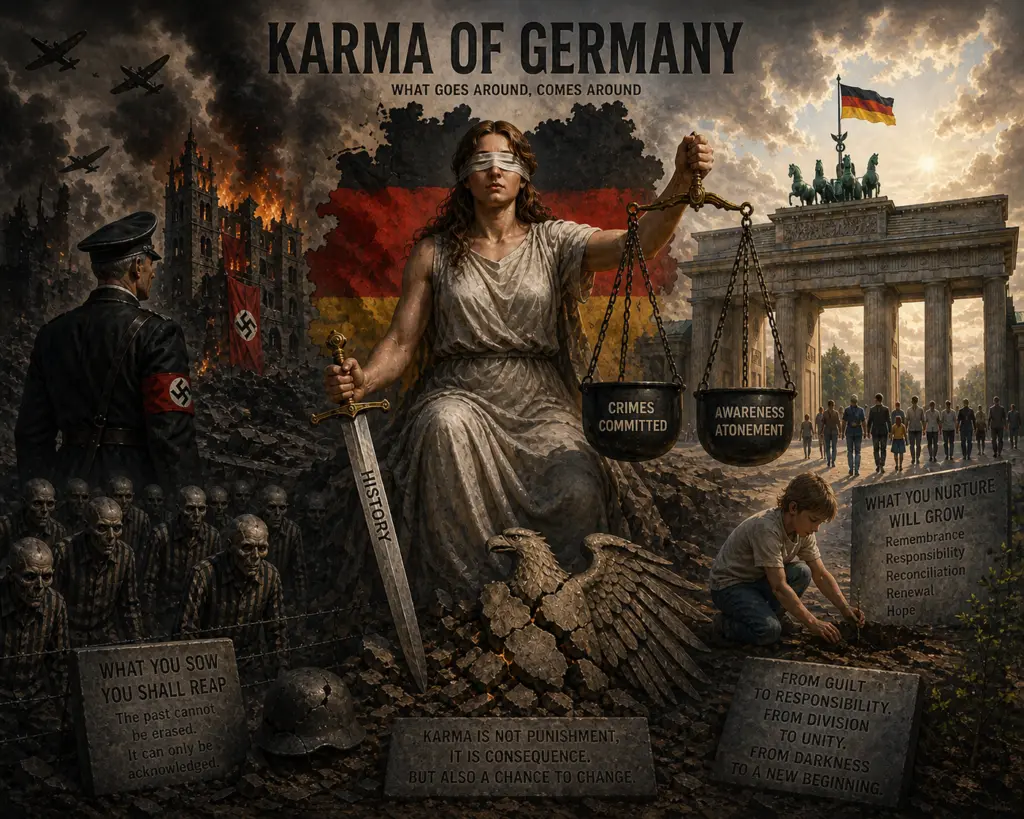
Germany’s Karmic Trap: The High Cost of the “Never Again” Illusion
Every nation has a ghost that runs the country from behind the curtain. For Germany, that ghost is a paradox. It is a society that has spent decades conducting a masterclass in public repentance, yet today, in 2026, it finds itself psychologically paralyzed, economically stagnant, and structurally stuck in the past.
To understand modern Germany, one must look past the pristine highways and the orderly train stations. The true psychological contract between the German citizen and the state is simple: “Give up your individual agency, absolute spontaneity, and messy initiatives, and in return, the state will guarantee a perfectly calculated, risk-free, predictable life.”
This contract wasn’t born out of thin air. It was forged in the absolute ruins of 1945. Having twice blown up the world and completely destroyed itself, the German collective subconscious made a desperate deal: if we stop moving, stop taking risks, and simply follow the process, we can never be dangerous again. But in a fast-moving, digitized global economy, this hyper-fixation on safety has mutated into a quiet, orderly trap.
1. The Main Inner Demon: The Burden of the Aggressor
Germany’s historical ledger is heavy, marked not just by internal shifts, but by its role as an existential threat to global stability. The country’s modern identity is directly shaped by five catastrophic milestones of aggression and trauma:
- 1904–1908: The Herero and Namaqua Genocide. Long before the world wars, the German Empire systematically exterminated over 60,000 Herero and 10,000 Nama people in German South West Africa (modern-day Namibia), pioneering the brutal use of concentration camps and forced starvation.
- 1914–1918: The First World War. Driven by aggressive militarism and geopolitical hubris, Germany pushed Europe into an industrial-scale slaughter, resulting in over 20 million deaths and the total destabilization of the continent.
- 1939–1945: The Second World War and the Holocaust. The ultimate expression of state-sponsored evil. The Nazi regime unleashed a war of total annihilation, murdering six million Jews and engineering the deaths of over 70 million people globally.
- 1945–1989: The Trauma of the Amputation. The total collapse resulted in the nation being sliced in half by the Iron Curtain. For over forty years, Germans lived as geopolitical pawns, deeply internalizing the idea that independent national action is inherently radioactive.
The Modern Psychosis
How does this bloody ledger manifest today? It has generated an acute paralysis of responsibility. Because historical German initiative brought nothing but catastrophe to the world, modern Germany has developed a profound allergy to leadership.
When the world demands rapid, decisive geopolitical or structural action, Germany defaults to endless committee meetings, bureaucratic stalling, and an obsession with consensus. The country is terrified of its own shadow. It hides behind rules, paperwork, and international frameworks not out of pure efficiency, but out of a deep-seated fear that if it acts boldly, it might accidentally become the villain again. The result is a collective numbness—a system that prefers a slow, predictable decline over a bold, risky leap forward.
2. National Fixation in Everyday Life: The Cult of Ordnung
The ultimate German pride is Ordnung (Order). The famous idiom says: “Ordnung muss sein” (There must be order). In theory, it means reliability, efficiency, and fairness. In the reality of 2026, it has been driven to a level of bureaucratic absurdity that actively strangulates daily life.
Step into a standard German public office or try to open a business, and you enter a time capsule from 1995. While the rest of the world runs on instant digital infrastructure, Germany remains deeply wedded to the Faxgerät (fax machine) and physical, stamped paper (Formulare).
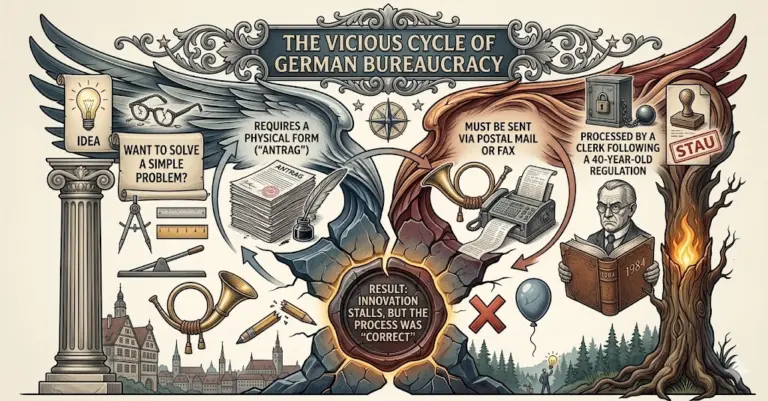
Why? Because a digital process is fluid; it can change rapidly and requires individual trust. A physical piece of paper, stamped by three different departments, provides absolute bureaucratic cover. No one can be blamed if the rules were followed exactly. This obsession with avoiding mistakes has created a culture where it is better to do nothing efficiently than to do something new with a margin of error. Innovation is sacrificed on the altar of predictability.
3. Anatomy of National Doublethink
The facade Germany presents to the world is one of unparalleled moral clarity, environmental leadership, and progressive values. The interior reality, however, is rife with convenient compromises.
| The Beautiful Facade (The Myth) | The Uncomfortable Reality (The Fact) |
| “We are the champions of green energy and the climate transition (Energiewende).” | Germany shut down its nuclear plants, tore down ancient forests to mine lignite (dirty brown coal), and remains heavily reliant on fossil fuels to keep its heavy industry from collapsing. |
| “We have fully processed our past and stand for absolute moral integrity.” | For decades, Germany gladly funded its economic miracle by outsourcing its national security to the US, its cheap energy to authoritarian Russia, and its export market to China, willfully ignoring the ethical red flags. |
| “We are an ultra-efficient, high-tech industrial superpower.” | The country’s digital infrastructure is notoriously lagging. High-speed internet drops in rural areas, mobile connectivity is spotty, and paying with a debit card in a Berlin restaurant is still treated like a minor miracle. |
4. The Fear That Paralyses the System
The driving force of German institutional life is not the desire to win, but the absolute terror of failing or being outside the norm. This collective anxiety creates a impenetrable barrier against any real reform.
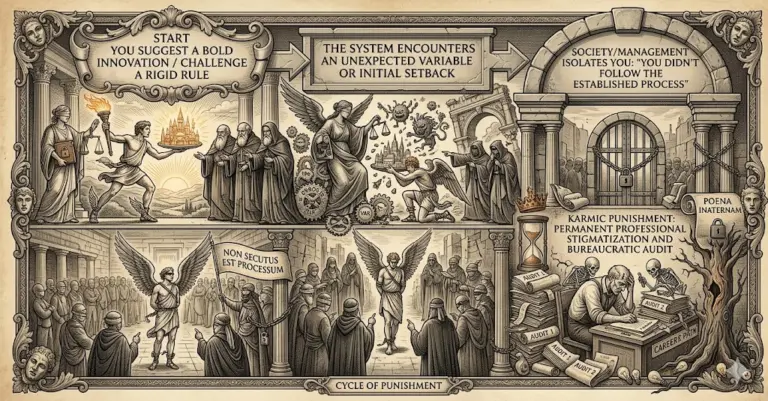
In Silicon Valley, failure is a badge of honor—a lesson learned. In Germany, failure is a legal and social liability. If a manager tries an unorthodox strategy and it fails, they aren’t just critiqued; they are culturally excommunicated for violating the Prozess. Therefore, from the lowest clerk to the corporate board member, the safest career move is always to say “No” to change.
5. The Trap of Past Glory
Germany is currently attempting to coast on the fumes of its mid-20th-century achievements. The entire economy is built on a magnificent, yet aging, industrial foundation: combustion engine cars, heavy chemical engineering, and specialized machinery.
For decades, the stamp “Made in Germany” was an unassailable gold standard. But the world has shifted from hardware to software, from mechanical engineering to artificial intelligence and digital platforms. Germany didn’t miss the train; it looked at the train, demanded a safety certificate for the tracks, realized the paperwork wasn’t filed in triplicate, and decided to walk.
The old formula—selling high-quality mechanical goods to expanding global markets while enjoying cheap manufacturing inputs—is fundamentally broken. You cannot fix a software-driven world with a sturdier piece of steel, yet the national psyche refuses to abandon the comfort of its old industrial identity.
6. Diagnosis: The Karma of Slow Inertia
Germany will not collapse in a dramatic, catastrophic flash. Its accumulated wealth, massive institutional reserves, and deep-seated social discipline will allow it to finance its own stagnation for a very long time. It will simply get a little slower, a little grayer, and increasingly irrelevant on the global stage.
The ultimate, unlearned karmic lesson for Germany is this: You cannot achieve absolute safety, and the absolute elimination of risk is itself the greatest risk of all.
By trying to build a society so tightly regulated that no mistake can ever happen, Germany has built a cage. The nation is trapped in a loop of its own history—so terrified of its past capacity for destructive momentum that it has chosen slow, orderly inertia as its permanent hiding place. Until the culture realizes that true responsibility requires courage, vulnerability, and the willingness to step into the unpredictable unknown, it will remain a hostage to its own meticulously organized ghosts.
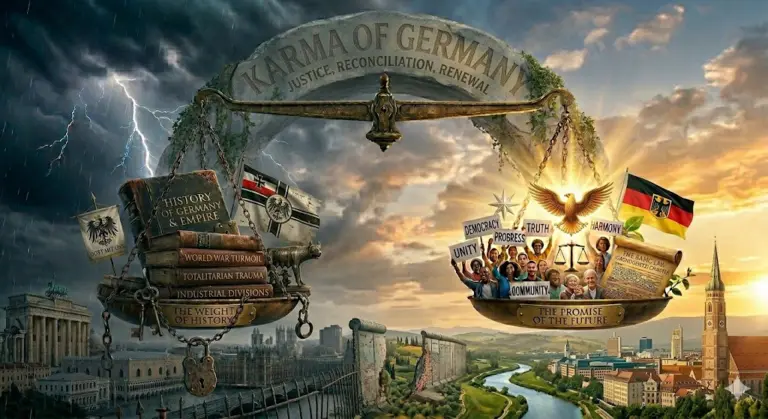
How this analysis was written
This analysis was written as a cultural and psychological reading of Germany’s modern national character through history, collective memory and everyday social patterns. It looks at Germany not only as an economy or political system, but as a country shaped by the trauma of aggression, defeat, division and postwar moral reconstruction.
The essay focuses on several recurring codes: Ordnung as a need for control, bureaucracy as protection from blame, historical guilt as a fear of leadership, and industrial pride as a possible trap in a digital world. It does not claim to describe every German individual. Instead, it reads Germany as a collective story: a nation trying to prevent chaos so completely that it may have built a new form of paralysis.
Sources / Further Reading:
Norbert Elias, The Germans; Mary Fulbrook, A Concise History of Germany; Aleida Assmann, Der lange Schatten der Vergangenheit; Ian Kershaw, To Hell and Back: Europe 1914–1949; Timothy Garton Ash, In Europe’s Name: Germany and the Divided Continent.
2 worldwide wars in 30 years ??? Germany is too active and gready