
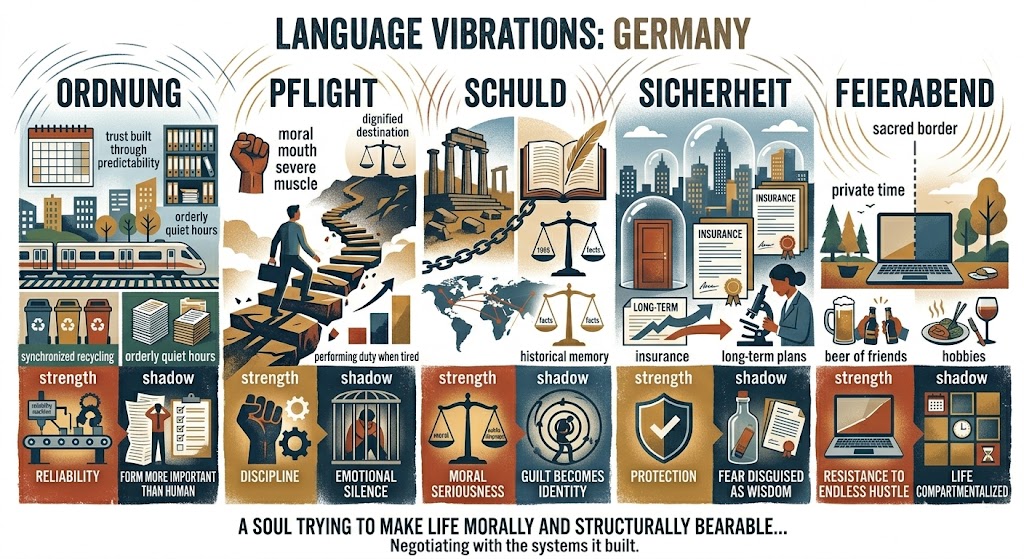
Ordnung
Order in Germany is not just neatness. It is the moral belief that life becomes safer when chaos is forced to stand in line.
Behind this word stands a deep psychological mechanism: the fear that disorder is never innocent. A small mess can become a large collapse. A missed rule can become a public problem. A vague plan can become a collective failure.
Ordnung lives in the calendar, the archive, the train timetable, the recycling bins, the tax form, the apartment contract, the quiet hours in the building. It is not only about control. It is about trust. If everyone follows the structure, strangers can live together without needing to love each other.
Its strength is obvious: reliability. Germany became powerful not by charming the world, but by making things work. The machine, the office, the invoice, the legal document, the production line, the public system. Ordnung gives society a spine.
But its shadow begins when order becomes more sacred than life itself. Then the form becomes more important than the human being. A person in difficulty may first be asked whether they filled out the correct paper.
From this comes:
- deep respect for systems
- discomfort with improvisation
- trust built through predictability
- fear of uncontrolled emotion
Ordnung is Germany’s shield against chaos. But sometimes the shield is so heavy that even joy must apply for permission.
Pflicht
Pflicht means duty, but in Germany it is not a small polite word. It is the inner court where a person judges themselves before anyone else does.
This word carries a severe moral muscle. It says: do what must be done, even if you are tired, bored, offended or not inspired. Feelings may be real, but they are not always relevant.
Pflicht shapes work, family, politics and money. You pay, you show up, you prepare, you finish. You do not simply follow your mood, because mood is considered an unstable ruler. A serious person is not the one who feels deeply, but the one who remains dependable when feelings change.
Its strength is discipline. A society built on Pflicht can survive pressure, rebuild after disaster and keep institutions alive without constant theatrical enthusiasm. It does not need to be excited every morning to function.
Its shadow appears when duty becomes emotional silence. People may perform responsibility so perfectly that they forget to ask whether they are still alive inside it. The sentence “I had no choice” can become a hiding place.
From this comes:
- reliability as a moral value
- shame around irresponsibility
- suspicion toward easy pleasure
- the quiet heroism of endurance
Pflicht gives Germany seriousness. But seriousness can become a prison when the soul is always standing at attention.
Schuld
Schuld means guilt, but also debt. That double gravity is one of Germany’s deepest psychological codes.
This word suggests that what is owed is not only financial. It can be moral, historical, personal, almost spiritual. To owe is to be marked. To be guilty is to carry a balance that must somehow be addressed.
Schuld shapes the national imagination with unusual force. It makes memory feel like a civic obligation, not just a private feeling. It gives German public life a constant awareness of responsibility, consequence and the danger of looking away.
In money, Schuld carries caution. Debt is not just a tool, it can feel like a moral stain. In politics, it produces a culture that fears reckless rhetoric, uncontrolled power and historical amnesia. Germany knows that language can become architecture, then law, then violence.
The strength of Schuld is moral seriousness. It prevents cheap innocence. It teaches that actions have weight, that history does not disappear because people are tired of discussing it.
Its shadow begins when guilt becomes identity. Then responsibility stops being action and becomes a permanent posture. A country can become so afraid of moral error that it starts confusing caution with wisdom.
From this comes:
- intense historical memory
- suspicion toward grand political gestures
- moral seriousness around public language
- discomfort with unpaid obligations, personal or collective
Schuld is Germany’s wound and its warning system. It keeps the country awake, but sometimes too awake to dream freely.
Sicherheit
Sicherheit means security, safety, certainty. In Germany, it is not a luxury. It is almost a national love language.
Behind this word stands the desire to reduce danger before danger arrives. Insurance, savings, rules, qualifications, stable contracts, technical standards, long-term planning. The German mind often respects the person who prevents the crisis more than the person who dramatically solves it.
Sicherheit enters money through caution, work through contracts, family through planning, politics through regulation. It is the opposite of romantic chaos. A good life is not necessarily a spectacular life. It is a life that does not suddenly fall apart.
Its strength is protection. It creates durable systems, serious engineering, strong social expectations and a culture where risk is not automatically worshipped as courage. Sicherheit says: not every leap is freedom, some leaps are stupidity with good branding.
But the shadow is fear disguised as wisdom. When security becomes too central, every new idea looks irresponsible before it has a chance to prove itself. The future is asked to provide documents before entering the room.
From this comes:
- preference for planning over gamble
- respect for qualifications and guarantees
- anxiety around instability
- slow but solid decision-making
Sicherheit protects Germany from foolishness. But it can also protect it from surprise, invention and the strange happiness of not knowing everything in advance.
Feierabend
Feierabend is the end of the working day, but psychologically it is much more than “after work.” It is the sacred border where productivity must stop knocking.
This word reveals a culture that takes work seriously, but also wants work to know its place. The day has a structure, and the person has a right to return to themselves. Feierabend is not laziness. It is a controlled rebellion against endless availability.
In daily life, it protects private time, beer with friends, dinner, quiet, hobbies, family, the small rituals of normal life. It says that dignity is not only found in performance. Dignity also lives in closing the laptop.
Its strength is balance. Germany does not always romanticize burnout. It understands that a worker who never stops is not heroic, just badly managed. Feierabend gives the individual a boundary against the machine.
Its shadow begins when life becomes too compartmentalized. Emotion here, work there, friendship in this slot, rest in that slot. Even freedom can become scheduled.
From this comes:
- respect for personal time
- resistance to chaotic work culture
- clear separation between duty and private life
- irritation when others disturb agreed boundaries
Feierabend is Germany’s quiet answer to the cult of endless hustle. It says: the machine may be excellent, but it does not own the evening.
What do these words reveal about the soul of this country?
Germany’s language reveals a soul trying to make life morally and structurally bearable: order against chaos, duty against weakness, guilt against forgetting, security against collapse, private time against the machine.
This is a country that does not fully trust spontaneity, history or human nature. So it builds systems, and then spends its life negotiating with the systems it built.