The Ghost of the Empire and the Price of Siesta: The Cultural Diagnosis of Spain
Spain in 2026 is an absolute paradox wrapped in a tourism brochure. To the outsider, it looks like a sun-drenched paradise of endless summers, vibrant plazas, and a laid-back lifestyle that the rest of the stressed-out world desperately envies. But if you scratch this beautiful veneer, you find a society trapped in a deep, invisible paralysis.
Every country has a social contract, an unspoken deal between the citizen and the state. In Spain, that contract is built on a grand collective illusion: “Give us stability, safety nets, and the right to be left alone to enjoy life, and we will agree never to look too closely at the skeletons in our historical closet.”
This contract was signed in blood and fear. It is the direct hangover of a century that tore the country apart, culminating in a brutal civil war and four decades of a suffocating fascist dictatorship. To survive without killing each other again, Spaniards made a pact of amnesia. But history doesn’t just vanish because you refuse to talk about it. It mutates into karma. Today, Spain’s unspoken deal has created a nation that is deeply risk-averse, economically stagnant, and psychologically trapped between a bloody imperial past it cannot process and a modern world it is afraid to fully embrace.
1. The Main Internal Demon: The Imperial Hangover and the Pact of Oblivion
Spain’s modern psychosis is not an accident; it is the logical consequence of centuries spent as both a global aggressor and a self-destructive family. The country is haunted by two distinct sets of ghosts: the victims of its global empire and the ghosts of its own brothers murdered on home soil.
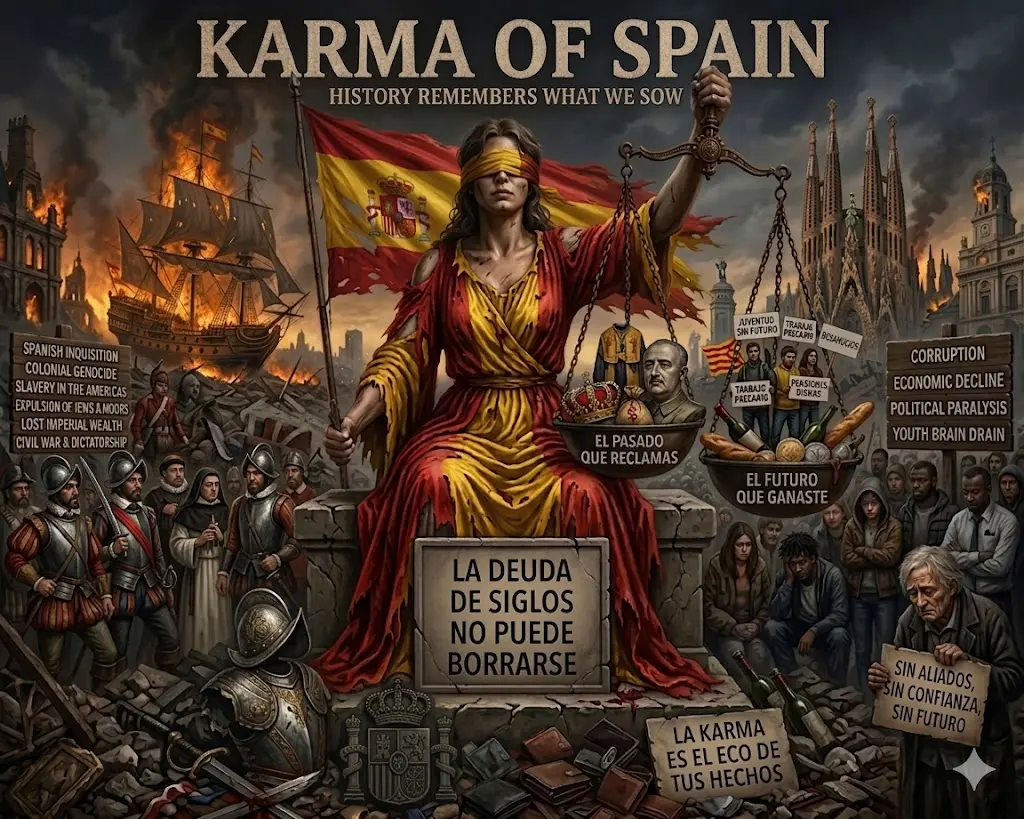
To understand why Spain in 2026 feels so stuck, we have to look at five critical historical traumas that forged its collective psyche:
- 1492–1700s: The Destruction of the New World and the Colonial Genocide. Spain didn’t just discover America; it liquidated entire civilizations. Through the encomienda system, forced labor, and systematic violence, the Spanish Empire caused the death of tens of millions of indigenous people in Central and South America. The gold and silver shipped back to Madrid didn’t build a sustainable economy; it funded religious wars and created a cultural mindset that wealth is something you extract or inherit, not something you build through innovation and hard work.
- 1478–1834: The Spanish Inquisition. For over three centuries, the Spanish state and church ran a brutal apparatus of ideological cleansing. Torture, public executions (autos-da-fé), and the expulsion of Jewish and Muslim populations systematically destroyed the country’s intellectual and entrepreneurial middle class. It hardwired a terrifying lesson into the Spanish DNA: Compliance is survival. Dissent, original thinking, or standing out will destroy you.
- 1936–1939: The Spanish Civil War. A brutal conflict where neighbors slaughtered neighbors, resulting in an estimated 500,000 deaths. It wasn’t just a war; it was an ideological laboratory where fascism, communism, and anarchism tore the country’s social fabric to shreds. The trauma was so deep that it shattered internal trust for generations.
- 1939–1975: The Franco Dictatorship. For 36 years, General Francisco Franco put Spain in a deep freeze. Intellectuals fled, political opposition was brutally suppressed, and over 114,000 people vanished into unmarked mass graves—making Spain second only to Cambodia in the number of missing persons worldwide. The state enforced a rigid, hyper-conservative, and highly bureaucratic hierarchy.
- 1977: El Pacto de Olvido (The Pact of Oblivion). When Franco died, Spain transitioned to democracy by making a conscious choice: they passed an Amnesty Law that legally forbade prosecuting any crimes of the dictatorship. They chose stability over justice. They literally buried the truth.
The Modern Karma: Collective Paralysis
How does this bloody ledger manifest in 2026? It shows up as a profound paralysis of national will. Because Spain never properly processed its colonial atrocities or its internal fascist trauma, the society suffers from a severe cultural bipolarity.
On one hand, any attempt to discuss national identity or patriotism triggers an immediate defense mechanism; the flag and the idea of “Spain” are still heavily weaponized by the right or feared as fascist by the left. On the other hand, the centuries of the Inquisition and Francoism have left a deep-seated fear of authority, paired with an ironic dependence on it. Spaniards deeply distrust their politicians, yet they crave the safety of the state. The result is a society that prefers stagnation over the risk of conflict, where uncomfortable truths are swept under the rug, and where the collective response to systemic crisis is a collective shrug.
2. National Fixation in Everyday Life: The Absurdity of the Opositor
The ultimate pride of Spanish culture is its focus on quality of life, family, and leisure—the legendary disfrutar de la vida. Spaniards love to contrast their warm, social, human-centric lifestyle with the cold, workaholic, robotic existence of Northern Europeans or Americans.
However, in 2026, this beautiful focus on life balance has been driven to a pathological extreme: the total financial and professional castration of the youth through the cult of the Funcionario (Civil Servant).
In Spain, the ultimate career dream for millions of university graduates is not to start a tech company, invent a new product, or climb the corporate ladder. It is to become an opositor—someone who spends 2 to 5 years of their prime youth locked in a room, memorizing thousands of pages of outdated legal codes, just to pass a brutal national exam (oposición).
The prize? A guaranteed, un-fireable job as a mid-level bureaucrat, a schoolteacher, or a tax clerk making a modest but safe €1,500 to €2,500 a month until retirement.
This fixation kills the nation’s future. Young, brilliant minds waste their most creative years memorizing medieval administrative laws instead of building businesses. Risk is viewed not as an opportunity, but as a mental illness. In everyday life, this manifests as a crushing bureaucratic nightmare. Trying to open a business, get a digital nomad visa, or resolve a tax issue in Spain involves navigating an agonizing labyrinth of red tape managed by unmotivated, un-fireable state workers who view the citizen as an annoying interruption to their breakfast break. The pride of “living life” has mutated into a collective surrender to low-level economic mediocrity just to avoid the ghost of insecurity.
3. Anatomy of National Duplicity
Spain is a master at building progressive, hyper-modern facades to distract from a highly conservative, rigid structural reality.
| The Beautiful Myth / The Facade | The Bitter Truth / The Reality (2026) |
| “Spain is a hyper-progressive, feminist, and LGBTQ+-friendly paradise of tolerance.” Spain was an early adopter of gay marriage and prides itself on passing cutting-edge social laws. | The society remains deeply divided, tribal, and economically exploitative. Beneath the progressive laws lies a reality where youth unemployment hovers around 25-30% (the highest in the EU), forcing a generation to live with their parents until age 30+. Furthermore, structural racism and xenophobia are rampant in agricultural sectors (like Almería), where illegal migrants harvest Europe’s vegetables in slave-like conditions. |
| “We are an eco-friendly, green leader championing the European energy transition.” Madrid and Barcelona boast about solar grids, bike lanes, and banning combustion engines. | Spain’s economic model relies heavily on environmental destruction. The country is turning into a desert due to climate change, yet mega-farms and illegal water extraction for intensive agriculture (to export cheap strawberries and pork) are draining the nation’s vital aquifers, like the dying Doñana National Park. |
| “We have a modern, decentralized, and harmonious democratic state.” Spain presents itself as a successful model of regional autonomy and cultural diversity. | The territorial crisis is a ticking time bomb managed by judicial warfare. The ghost of Catalan independence and Basque separatism is met not with deep political synthesis, but with rigid constitutional dogmatism, deep-seated regional resentment, and a political class that uses territorial division to polarize voters for cheap electoral gains. |
4. The Main Fear Paralyzing the System
The monster that keeps Spanish society awake at night is Insecurity and the Fear of Falling Out of the Tribe. In a country with historically volatile politics and a weak job market, standing out, making a mistake, or challenging the established order is seen as social and economic suicide.
Here is what happens when someone tries to break the mold in the Spanish system:
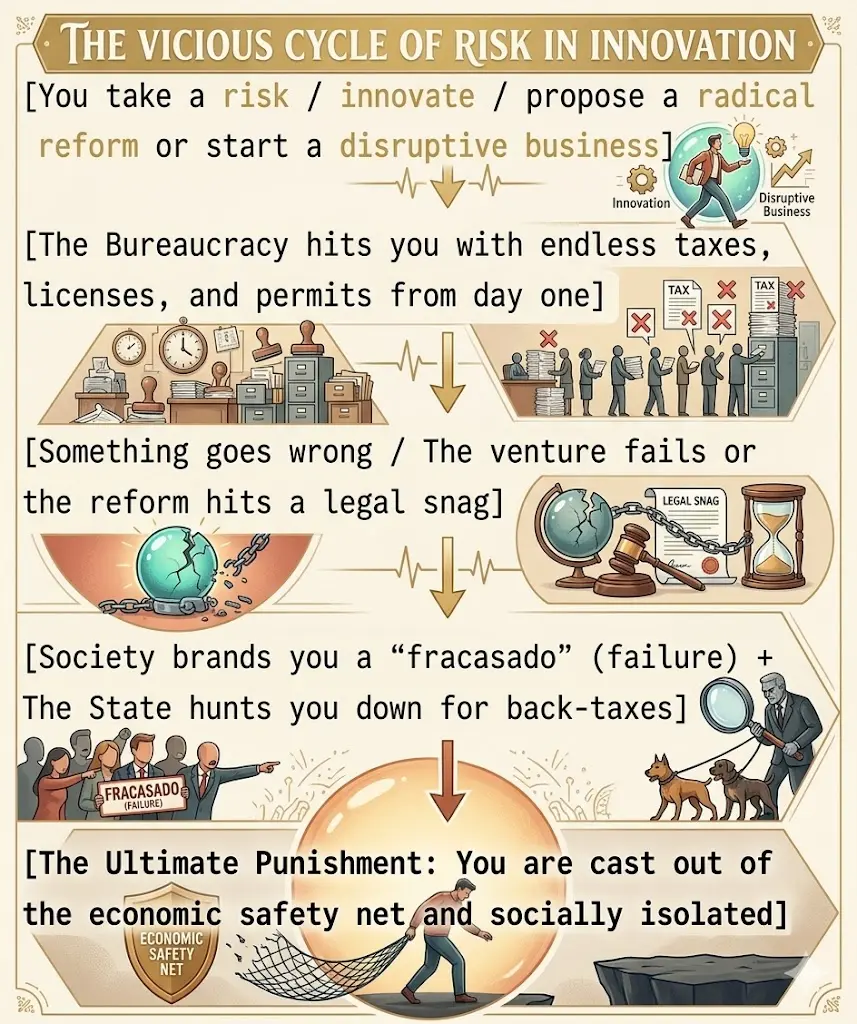
Because of this brutal loop, nobody wants to stick their neck out. Managers in Spanish corporations don’t reward initiative; they reward face-time (calentar la silla) and obedience. Politicians don’t pass structural reforms; they pass short-term band-aids to secure the next election. The system is designed to protect those who are already inside the castle (pensioners and civil servants) while completely sacrificing the young and entrepreneurial.
5. The Trap of Past Merits
Spain in 2026 is essentially living off its inheritance and its geography. Its entire economic survival strategy can be summed up in three words: Sun, Sand, and Sangria.
During the 1960s and 1970s, Spain mastered the art of mass tourism and cheap real estate development. It became “the playground of Europe.” Later, it used billions in EU structural funds to build world-class infrastructure—high-speed trains (AVE) and incredible highways.
Today, Spain tries to run a 21st-century economy using this exact same mid-20th-century formula. The country has become an economic monoculture dependent on low-value services. Millions of jobs are tied to hospitality, waiter culture, and real estate speculation.
The formula is completely broken for the 2020s because:
- It creates an economy of low wages, precarious temporary contracts, and zero technological sovereignty.
- Climate change is turning the Iberian Peninsula into a furnace, threatening the very tourism and agriculture Spain relies on.
- Flying in millions of tourists to drink cheap beer while locals are priced out of their own rental markets in Madrid, Barcelona, and Malaga is causing severe social unrest.
Spain is treating its incredible history, culture, and geography not as a launchpad for future innovation, but as a retirement fund it is rapidly draining.
6. Diagnosis: The Karma of Slow Inertia
Spain is not going to collapse tomorrow. It will not experience a dramatic financial apocalypse or a sudden revolution. Why? Because its stagnation is perfectly funded.
Spain is kept on life support by the European Central Bank and a massive influx of northern European money. It functions as the ultimate resort and retirement community for wealthier nations. The older generation owns their apartments, enjoys comfortable state pensions, and forms a powerful voting bloc that blocks any real change. The younger generation, paralyzed by the fear of systemic failure, chooses to adapt rather than revolt—they work gig-economy jobs, live with roommates or parents well into their thirties, and channel their frustrations into festivals, football, and socializing.
The Ultimate Karmic Lesson:
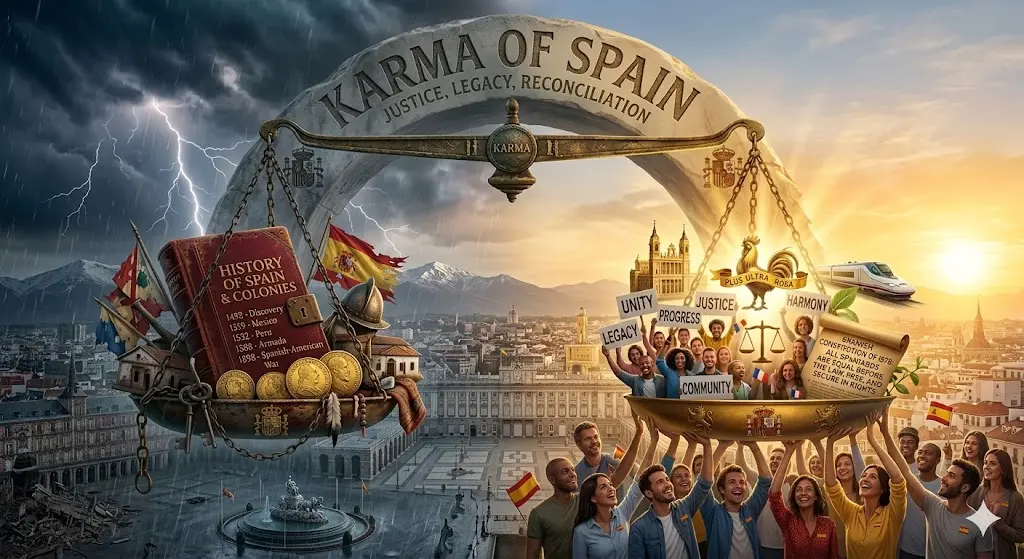
Spain’s deepest historical lesson, which it passionately refuses to learn, is that you cannot build a prosperous future by hiding from your past and avoiding all risk.
By burying the trauma of the dictatorship under the Pact of Oblivion, Spain learned to fear deep political and structural transformation. By relying on colonial gold in the past and tourism gold today, it forgot how to build an economy based on merit, risk, and innovation. Until Spain digs up its literal and figurative ghosts, stops worshiping the safety of the bureaucratic desk, and dares to reinvent its economic identity, it will remain a beautiful, sun-drenched museum—a nation running in place, perfectly content with slow, comfortable, and elegant decay.
How this analysis was written
This analysis was written as a cultural and psychological reading of Spain through its imperial past, civil war trauma, dictatorship, regional fractures, bureaucracy, tourism economy and deep attachment to stability. It looks at Spain not only as a beautiful Mediterranean country, but as a society shaped by unfinished historical grief, inherited fear of conflict and the temptation to choose comfort over transformation.
The essay focuses on several recurring codes: the legacy of empire, the Spanish Inquisition, the Civil War, Francoism, the Pact of Oblivion, regional identity, the culture of the funcionario, tourism dependence, youth insecurity and the fear of social rupture. It does not claim to describe every Spanish individual. Instead, it reads Spain as a collective myth under pressure: a nation rich in beauty, memory and human warmth, but still negotiating with the ghosts it has not fully buried.
Sources / Further Reading:
Paul Preston, The Spanish Holocaust; Giles Tremlett, Ghosts of Spain; Helen Graham, The Spanish Civil War; Stanley G. Payne, The Franco Regime; Henry Kamen, The Spanish Inquisition; Raymond Carr, Spain: A History; Sebastian Balfour, The End of the Spanish Empire, 1898–1923; Michael Reid, Spain: The Trials and Triumphs of a Modern European Country; Javier Cercas, The Anatomy of a Moment; OECD and Eurostat reports on Spain’s labour market, youth unemployment, tourism economy and demographic trends.