
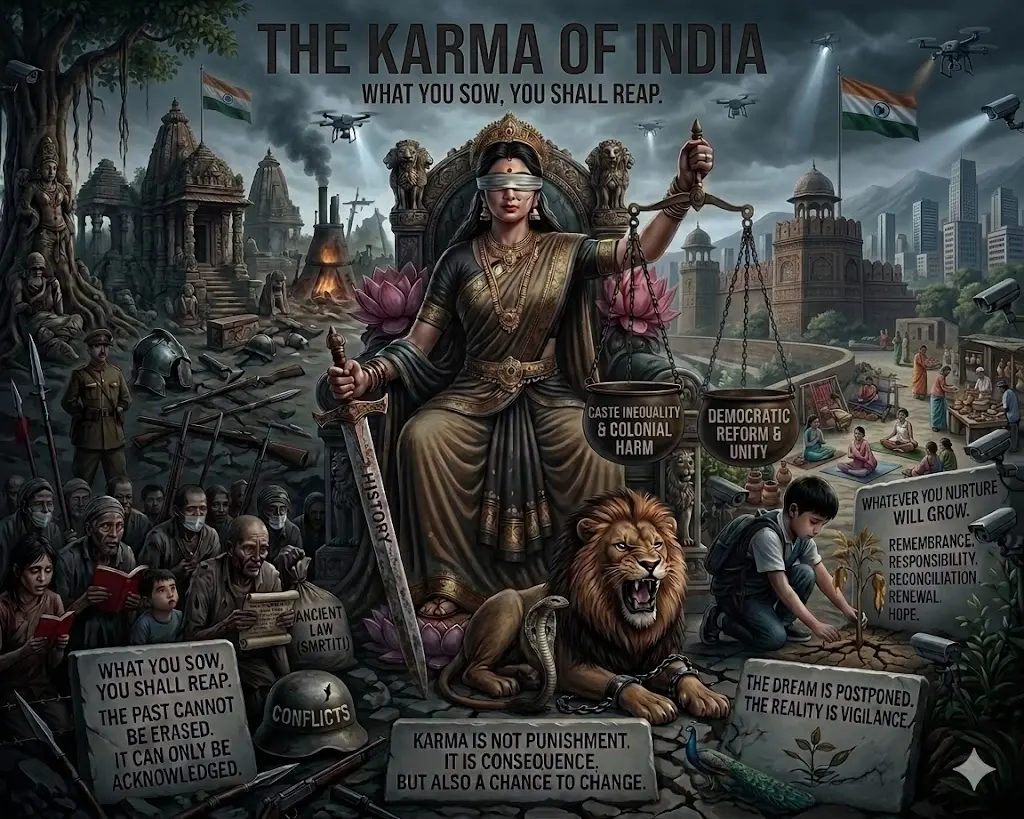
The Phantom Empire: Inside the Karmic Trap of Modern India
Every nation likes to think it is the author of its own destiny. But if you strip away the tourism brochures, the tech-billionaire PR, and the grand geopolitical speeches, you are left with a deeper, colder machinery: the law of cause and effect. Call it history, call it social psychology, or call it karma—nations eventually become prisoners of the choices they never resolved.
Today, India stands as a soaring paradox. It builds lunar landers and runs global tech giants, yet its streets still carry the weight of an unresolved past. To understand why India in 2026 feels both unstoppable and deeply paralyzed, we have to look past the economic charts and peer into its psychological contract—the unwritten, unspoken deal between the citizen and the state.
In India, that contract is built on a grand illusion of protective hierarchy. For millennia, the collective survival strategy was simple: trade individual agency for the safety of the group (caste, community, family). The state, whether British, Mughal, or modern democratic, was always an aloof deity—something to be feared, appeased, or bypassed, but never truly trusted. The citizens agreed to manage their own survival through insular networks, while the state promised to protect the overarching cultural fortress. The tragedy of this contract is that it rewards compliance over initiative and turns every public space into a battleground for scarce resources.
1. The Heavy Baggage: Five Knots in the Karmic Rope
India often frames its historical identity purely around victimization—a peaceful civilization repeatedly crushed by foreign boots. While the trauma of invasion is real, this view creates a convenient blind spot. It ignores how India’s own systemic cruelties and aggressive regional choices have built the psychological walls that trap its society today.
- The Institutionalized Apartheid (The Caste System): For nearly three thousand years, Indian civilization perfected a brutal, self-replicating social architecture. This wasn’t just a mild class divide; it was a rigid, religiously sanctioned denial of basic humanity to millions of Dalits (untouchables). By treating a massive chunk of its own population as spiritually and physically polluting, the society hardwired a deep contempt for manual labor and human dignity. Today, this manifests as a complete lack of civic empathy—why care about public infrastructure or the poverty of others if they are inherently destined for that state?
- The Direct Action Day and Partition (1946–1947): The birth of modern India was baptized in a frenzy of neighbor-on-neighbor violence. Events like the Direct Action Day in Calcutta (1946) sparked a chain reaction of mutual slaughter that claimed over a million lives and displaced fifteen million. Instead of mourning this as a collective failure of coexistence, the political elite weaponized the trauma. The ghost of Partition was never laid to rest; it was kept alive to ensure that the primary lens of civic identity remains religious anxiety.
- The Annexation of Hyderabad and Goa (1948, 1961): While championing anti-colonialism and peace on the world stage, the young Indian state quickly showed it could play the role of an aggressive, expansionist power. Operation Polo (1948) saw the military annexation of Hyderabad, resulting in the largely forgotten mass casualties of tens of thousands of Muslims. The forced taking of Goa from the Portuguese in 1961 cemented a worldview that military dominance beats international diplomacy. This built a regional bully complex that still poisons India’s relationships with every single one of its neighbors today.
- The Crushing of the Northeast and Kashmir (1950s–Present): Through the Armed Forces Special Powers Act (AFSPA), India turned its own peripheral regions into permanent internal colonies. For decades, the state used systematic military force, extrajudicial killings, and the suspension of civil liberties to keep populations in places like Nagaland, Mizoram, and Kashmir in line. The message to the populace was clear: unity is non-negotiable, and the state will use the exact same iron fist as the British Empire to enforce it.
- The Anti-Sikh Pogroms (1984): Following the assassination of Prime Minister Indira Gandhi, the capital city witnessed a terrifying display of organized state complicity. For three days, thousands of innocent Sikhs were hunted down, necklaced with burning tires, and murdered while the police stood down or actively guided the mobs. This was the moment the rule of law permanently broke in the modern Indian psyche. It proved that the state would happily unleash majoritarian violence whenever it suited the ruling class, leaving a legacy of institutionalized impunity.
The Modern Psychosis: The Siege Mentality
How do these historical scars affect the nation in 2026? They manifest as a chronic, defensive siege mentality. Because the nation’s identity is anchored in past humiliations and unacknowledged internal violence, society operates in a state of permanent hyper-vigilance. Any criticism—whether from a foreign journalist, a local activist, or an international rating agency—is treated as a conspiracy to destabilize the country. This creates a collective paranoia that paralyzes self-reflection. Instead of fixing real flaws, energy is wasted hunting down internal scapegoats and traitors.
2. National Fixation: The Comedy and Tragedy of Jugaad
If you ask any Indian what makes their culture uniquely resilient, they will proudly point to Jugaad. It is the ultimate national badge of honor. Roughly translated, it means a clever, low-cost hack—fixing a broken engine with a rubber band, or routing electricity through a neighbor’s fence. It is celebrated in business schools as “frugal innovation.”
In reality, Jugaad is a structural sickness masquerading as a virtue.
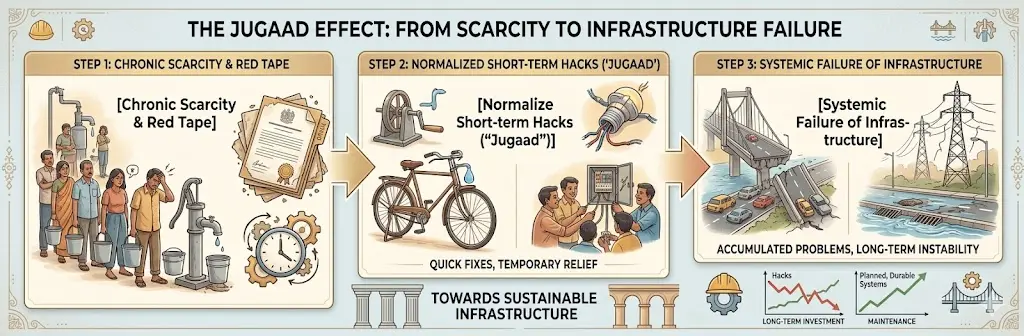
Jugaad is born out of a profound despair. It is the realization that the formal system is so broken, corrupt, and buried under red tape that following the rules is a form of social suicide. So, everyone hacks the system.
Look at everyday life in any major Indian metropolis today. Instead of building proper drainage systems, cities rely on Jugaad pumps that fail every monsoon, turning tech hubs like Bengaluru into rivers. Instead of enforcing traffic laws, drivers employ a chaotic choreography of cutting corners, driving down wrong lanes, and bribing officers—treating a basic commute as a high-stakes gamble.
Because everyone is busy finding a personal shortcut, there is zero collective pressure on the government to build permanent, high-quality infrastructure. Jugaad keeps the nation trapped in a loop of low expectations. It celebrates surviving a broken environment rather than demanding a functioning one.
3. Anatomy of National Duplicity: Myth vs. Reality
To maintain its self-esteem, Indian society has constructed an elaborate facade of moral superiority. This creates a severe case of national cognitive dissonance, where the image projected to the world is flatly contradicted by the reality on the ground.
| The Beautiful Myth / The Facade | The Brutal Truth of the 2020s |
| “Vasudhaiva Kutumbakam” (The World is One Family): India positions itself as the moral voice of the Global South, a peaceful civilization that exports yoga, spirituality, and universal brotherhood. | Furious Internal Tribalism: On home soil, social media and mainstream news are filled with toxic communal polarization. Religious minorities are systematically marginalized, and mixed-faith couples face harassment from vigilante groups. |
| The Land of the Divine Feminine: The culture worships powerful goddesses (Durga, Lakshmi) and proudly boasts about its deep respect for motherhood and women. | A Public Space Hostile to Women: India remains one of the most dangerous places in the world for women. Sexual violence is endemic, and the systemic victim-blaming by police, politicians, and judiciaries exposes a deeply entrenched misogyny. |
| The “Digital India” Superpower: The country celebrates its world-class digital payment infrastructure (UPI) and its army of software engineers driving global tech. | A Desperate Shortage of Real Jobs: The tech boom is an isolated island. Beneath the digital veneer lies a massive crisis of jobless growth. Millions of highly qualified engineers and graduates compete for low-end manual government clerk positions. |
| The World’s Largest Democracy: A proud celebration of a vibrant multi-party system, free elections, and a fiercely independent spirit. | An Electoral Autocracy: The institutional machinery—the courts, the investigative agencies, and the media—has been thoroughly hollowed out. Dissent is treated as anti-national behavior, and tax raids are used as political weapons to silence critics. |
4. The Fear That Paralyzes the System
In a culture that spent centuries under colonial rule, feudal landlords, and bureaucratic tyranny, fear is the primary tool of management. In India, the ultimate terror is not failure; it is social ostracization and loss of status.
The system values predictability and hierarchy above all else. This collective fear acts as a massive emergency brake on any real reform or creative risk. The following chain reaction illustrates what happens when an individual tries to buck the trend:
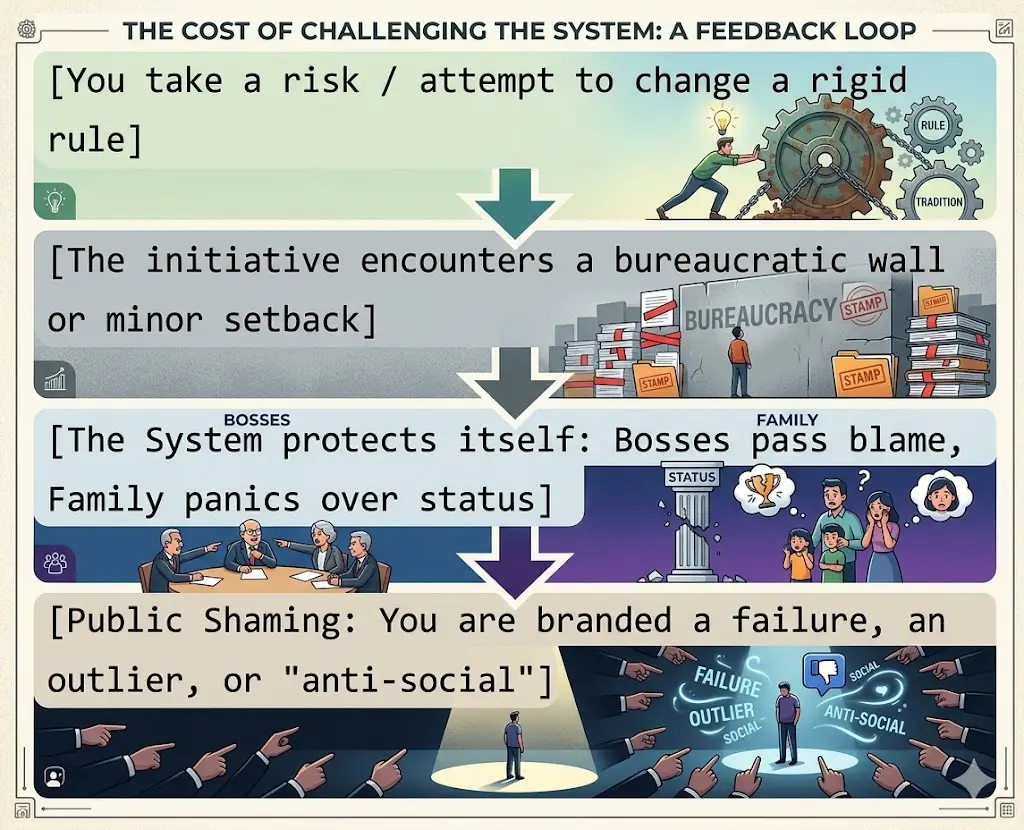
Because of this cycle, nobody wants to be the one holding the line. A bureaucrat will let a vital file sit on his desk for months because making a decision requires taking responsibility, and taking responsibility carries risk. A middle manager will stifle an innovative idea from a subordinate because it disrupts the established hierarchy. The safe path is always to nod, defer to seniority, and let the problem become someone else’s burden.
5. The Trap of Past Glories
India is deeply addicted to its own rearview mirror. When confronted with its current socio-economic challenges, the standard cultural defense is to point to ancient achievements: “We invented the zero! We had universities like Nalanda when Europe was in the Dark Ages! We accounted for a quarter of global GDP in the 17th century!”
This is the classic trap of historical rent-seeking.
Borrowing glory from ancestors you did nothing to earn is the ultimate symptom of a stagnant present.
The formula of relying on vast numbers of cheap, English-speaking labor—which drove the IT boom of the late 1990s and 2000s—is hitting a brick wall. In the era of automation, artificial intelligence, and advanced manufacturing, simply being “cheap and numerous” is no longer a competitive advantage.
The education system, which values rote memorization over critical thinking, continues to pump out millions of degrees that are effectively useless in the modern economy. By pretending that ancient heritage compensates for modern structural deficits, India is bringing a sword from the bronze age to a cyber warfare fight.
6. Diagnosis: The Karma of Slow Inertia
India is too vast, too resilient, and too chaotic to experience a sudden, dramatic collapse. It will not face a spectacular economic implosion. Instead, it finances its stagnation through a massive internal market, a wealthy and desperate diaspora that pumps home billions in remittances, and a state apparatus that has mastered the art of managing poverty rather than eradicating it.
The true karmic curse of India is its glacial inertia—the ability to tolerate immense suffering, injustice, and inefficiency without ever reaching a breaking point. The elite have successfully decoupled their lives from the state; they live in gated communities, send their children abroad, and use private healthcare, leaving the rest of the population to navigate a broken world.
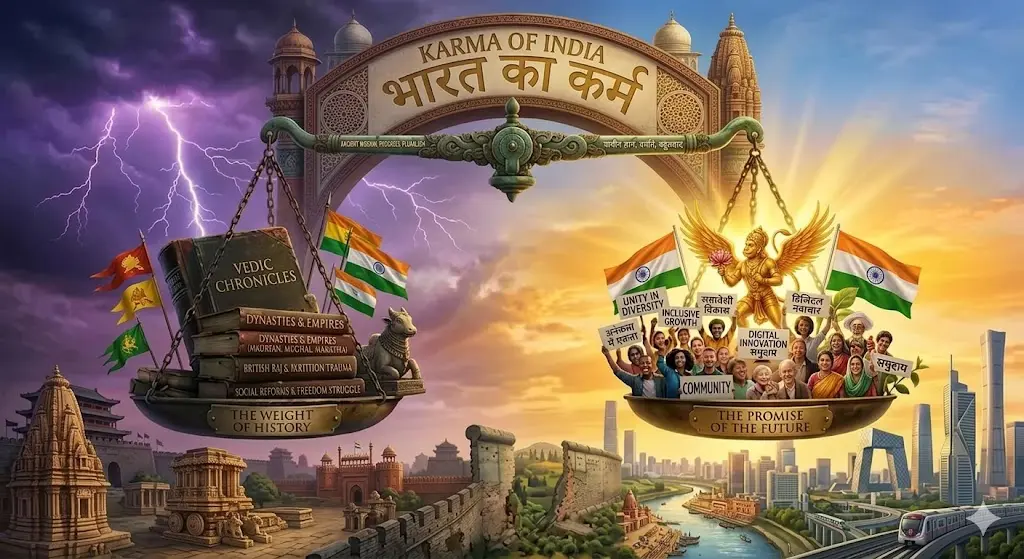
The ultimate karmic lesson that India refuses to learn is that a nation cannot achieve true greatness while leaving the majority of its people behind. You cannot build a superpower on a foundation of systemic inequality, religious distraction, and institutional distrust. Until the culture stops mistaking survival for progress, and until it begins to value individual human dignity over collective tribal pride, it will keep running in place—always arriving, but never quite reaching the destination.e dark.
How this analysis was written
How this analysis was written
This essay was written as a cultural-psychological interpretation, not as a neutral historical summary. It connects major historical ruptures, social hierarchies, political traumas and everyday survival patterns to explore how India’s collective mindset has been shaped over time.
The analysis draws on historical studies of caste, Partition, colonial rule, post-independence state violence, democratic backsliding, youth employment, digital modernization and informal problem-solving cultures such as jugaad. The aim is not to reduce India to a single stereotype, but to identify recurring psychological patterns: hierarchy, resilience, improvisation, status anxiety, religious polarization, institutional distrust and the tension between civilizational pride and unfinished social reform.
Sources / Further Reading:
B. R. Ambedkar, Annihilation of CasteRamachandra Guha, India After Gandhi: The History of the World’s Largest DemocracySunil Khilnani, The Idea of IndiaChristophe Jaffrelot, India’s Silent Revolution: The Rise of the Lower Castes in North IndiaAshis Nandy, The Intimate Enemy: Loss and Recovery of Self Under ColonialismSudhir Kakar, The Indians: Portrait of a PeopleAmartya Sen, The Argumentative IndianPankaj Mishra, From the Ruins of EmpireKatherine Boo, Behind the Beautiful ForeversEncyclopaedia Britannica, entries on the caste system, Dalits, Direct Action Day and the Partition of IndiaHuman Rights Watch, reports on the Armed Forces Special Powers Act, Kashmir and civil liberties in IndiaNanavati Commission Report on the 1984 anti-Sikh violenceInternational Labour Organization, India Employment Report 2024: Youth Employment, Education and SkillsFreedom House, Freedom in the World: IndiaV-Dem Institute, Democracy Report 2026International Monetary Fund, analysis of India’s Unified Payments Interface and digital payment system