
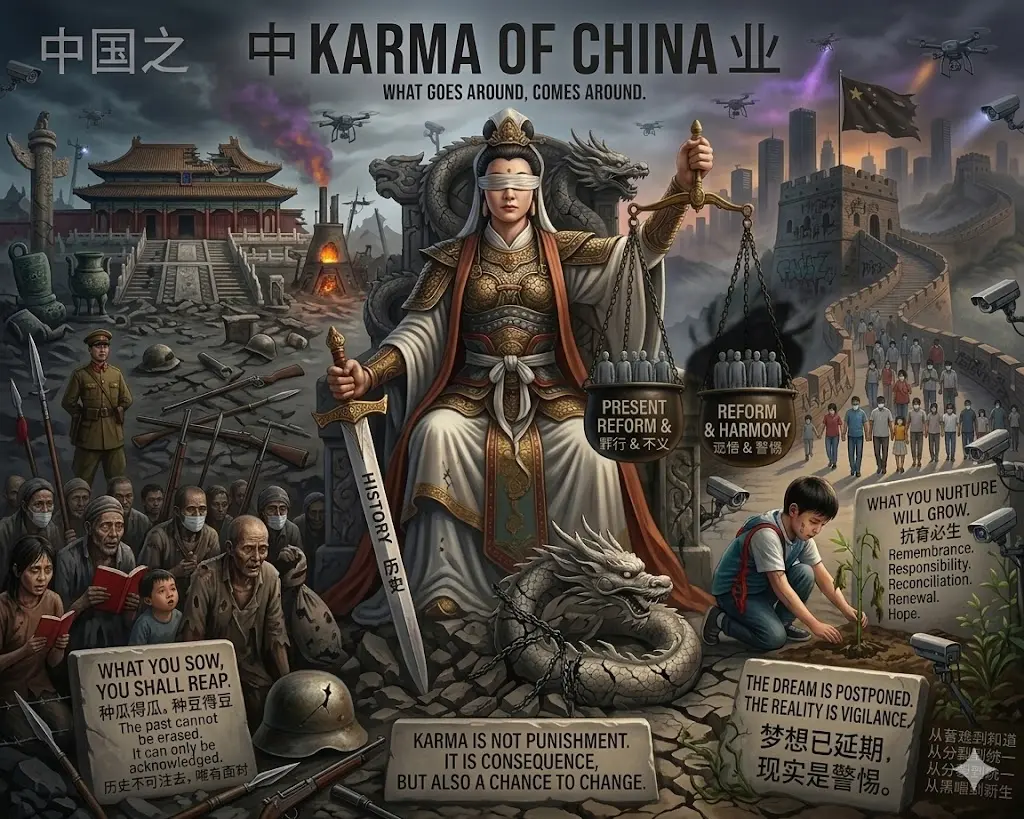
The Architecture of the Anthill: How China’s Historical Karma Built the Ultimate Psychological Cage
Every society has a ghost in its machine, but China’s ghost is a giant, centuries-old algorithm written in blood, paranoia, and the desperate collective need for a quiet life. To look at China in 2026 is to look at a hyper-modern sci-fi state built on top of a psychological fortress. On the outside: facial recognition, high-speed rail, and digital currencies. On the inside: a trauma-driven survival blueprint that has remained virtually unchanged since the First Emperor buried scholars alive in 210 BCE.
To understand the Chinese collective psyche today, you have to understand the fundamental, unspoken social contract that keeps 1.4 billion people pulling in the same direction:
The Social Contract: “You give up your voice, your political agency, your historical memory, and your right to misbehave. In exchange, the state guarantees that tomorrow will not look like the cultural and economic apocalypses of the 20th century, and that nobody will invade you again.”
It is the ultimate transaction: absolute obedience for absolute predictability. But this contract was not signed out of love for the state; it was signed out of an ancient, bone-deep terror of chaos (luan). The tragedy of modern China is that the very tools it used to escape its past nightmares have mutated into a psychological cage that leaves the nation brilliant, wealthy, exhausted, and profoundly paralyzed.
1. The Main Inner Demon: The Multi-Headed Beast of Paranoia
China’s modern karma is driven by two alternating forces: a deep trauma from being victimized by others, and the terrifying memory of what happens when the state loses its grip and turns its violence inward or onto its neighbors. This historical baggage is not ancient history—it directly shapes how Beijing and its citizens view the world in 2026.
The Five Scars of Chinese Consciousness
- The Century of Humiliation (1839–1949): The foundational trauma. It began with the Opium Wars, where Western powers hooked the population on drugs to force open markets, and culminated in the brutal Japanese invasion of the 1930s and 40s (such as the Rape of Nanjing in 1937, where over 200,000 civilians were slaughtered). The Karma: A permanent geopolitical chip on the shoulder. The world is viewed as a zero-sum jungle where you are either the predator or the prey. There is no such thing as altruism in global politics; everything is a conspiracy to keep China down.
- The Conquest and Erasure of Xinjiang and Tibet (1949–Present): Under the guise of liberating these regions from feudalism, China annexed vast territories, systematically dismantling local religious, cultural, and linguistic identities. In recent years, this culminated in the internment of over a million Uyghurs in “re-education” camps. The Karma: A crushing, permanent anxiety over territorial integrity. The state must spend billions on internal surveillance because it knows that empire-building through force requires eternal force to maintain.
- The Great Leap Forward (1958–1962): Mao Zedong’s catastrophic attempt to industrialize overnight through sheer willpower and bad math. The state requisitioned grain from starving peasants to export it and prove the “success” of the system, resulting in the largest man-made famine in human history. Between 30 and 45 million people starved to death in silence. The Karma: A visceral, generational obsession with food security, material hoarding, and a profound cynicism regarding state ideological promises.
- The Cultural Revolution (1966–1976): A decade where the state weaponized children against their parents and students against their teachers. Society was cannibalized in a frenzy of ideological purity; neighbors denounced neighbors, and historical artifacts were smashed. The Karma: The complete destruction of social trust outside the immediate family unit. If the state can turn your own child into your executioner, you learn never to trust anyone with your real thoughts.
- The Tiananmen Square Massacre (June 4, 1989): When the youth of China asked for political reform, openness, and an end to corruption, the state responded with tanks and live ammunition in the heart of the capital, killing hundreds, if not thousands, of its own students.
The Karma: The violent sealing of the political vacuum. It proved that the system would rather kill its own future than compromise on absolute control.
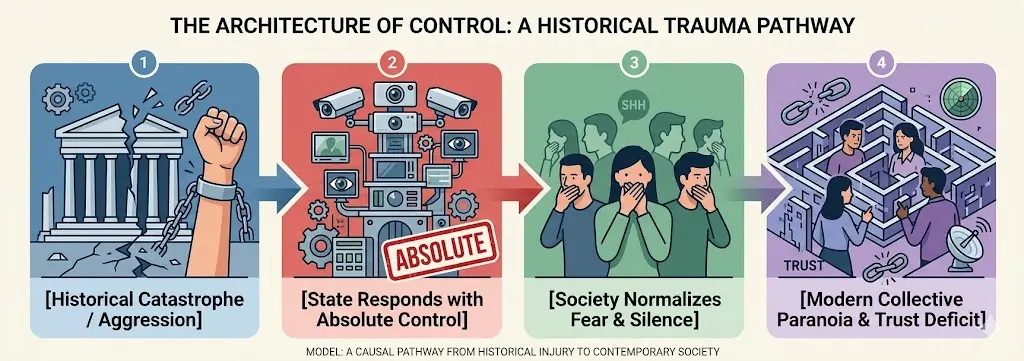
Today, this bloody matrix manifests as a unique psychological paralysis. The average citizen knows that the line between order and total madness is paper-thin. Therefore, any critique of the system is viewed not as a desire for improvement, but as a dangerous loose thread that could unravel the whole tapestry. The nation is trapped in a state of high-functioning PTSD: hyper-vigilant against external threats, fiercely nationalistic, yet internally terrified of its own shadow.
2. National Fixation in Everyday Life: The Absurdity of Hyper-Competition (Neijuan)
The trait most celebrated by China—and envied by the West—is its legendary capacity for hard work, resilience, and discipline. This is a culture that built the Great Wall and pulled 800 million people out of poverty in a matter of decades. But by 2026, this virtue has been driven off a cliff and into a psychological meat grinder known as Neijuan (内卷) or “Involution.”
Involution is competition turned inward into a meaningless, exhausting spiral. It is a race to the top where the finish line keeps moving backward.
The Modern Reality: The “996” Grind and Burnout
Consider the life of a typical 20-something white-collar worker in Shenzhen or Shanghai. They grew up under the brutal pressure of the Gaokao (the university entrance exam where a single point can determine whether you become a tech executive or a delivery driver). They survived that, only to enter a corporate market governed by the infamous “996” schedule (9 AM to 9 PM, 6 days a week).
- Employees stay at their desks until 10 PM not because they have work to do, but because leaving before the boss makes them look uncommitted.
- Parents spend their entire life savings on extracurricular English and coding tutors for toddlers, simply so their child isn’t left behind in a preschool market that is already saturated.
This is not productivity; it is a collective panic attack. Because the system offers only one acceptable version of success (wealth and status approved by the collective), everyone runs on the same treadmill at maximum speed. The progress it generates is increasingly marginal, while the psychological toll is devastating. It has created a generation so burned out that a counter-culture of Tangping (躺平 – “lying flat”) and Bailan (摆烂 – “let it rot”) has emerged—young people actively choosing to do the bare minimum because they realize the game is rigged.
3. Anatomy of National Doublethink
In China, what is said and what is lived exist in two entirely parallel universes. The state projects an image of harmonious, confident, and morally superior socialist civilization, while the reality underneath is raw, hyper-capitalist survivalism.
| The Beautiful Myth / The Facade | The Bitter Truth / The Reality (2020s) |
| “The Harmonious Society & Collective Spirit” The claim that Chinese culture is inherently communal, selfless, and uniquely focused on the common good, unlike the selfish, individualistic West. | The Chronic Trust Deficit Decades of political betrayal have made society deeply atomized. People will routinely ignore a stranger bleeding out on the street out of fear of being scammed or sued by the victim (a phenomenon so common it required specific “Good Samaritan” laws to fix). |
| “Anti-Imperialist Champion of the Global South” China presents itself as a peaceful power that never invades other countries, respects sovereignty, and stands against Western bullying. | Economic Imperialism & Coercion Through the Belt and Road Initiative, China secures strategic infrastructure (ports, mines) from developing nations via debt traps. Meanwhile, it uses aggressive economic boycotts against any country (from Lithuania to Australia) that dares question its policies. |
| “The Workers’ and Peasants’ Socialist Paradise” An ideological claim that the Communist Party operates for the welfare of the proletariat and stands against capitalist exploitation. | Hyper-Capitalist Inequality with No Safety Net China possesses one of the highest numbers of billionaires alongside 600 million people living on an income of less than $140 a month. There are no independent labor unions; striking workers or labor rights lawyers are routinely jailed by the “Socialist” state. |
4. The Main Fear Paralysis System
If you want to know why a country with 1.4 billion brilliant minds struggles to produce radical cultural breakthroughs or disruptive political ideas, you have to look at the risk-reward ratio embedded in the culture. In China, initiative is a dangerous liability.
The system is designed to reward compliance and brutally punish divergence. This creates a cultural feedback loop where everyone—from the lowest village bureaucrat to the CEO of a multi-billion-dollar tech company—is incentivized to wait for orders from the top rather than solve a problem themselves.
The Innovation and Initiative Death Spiral
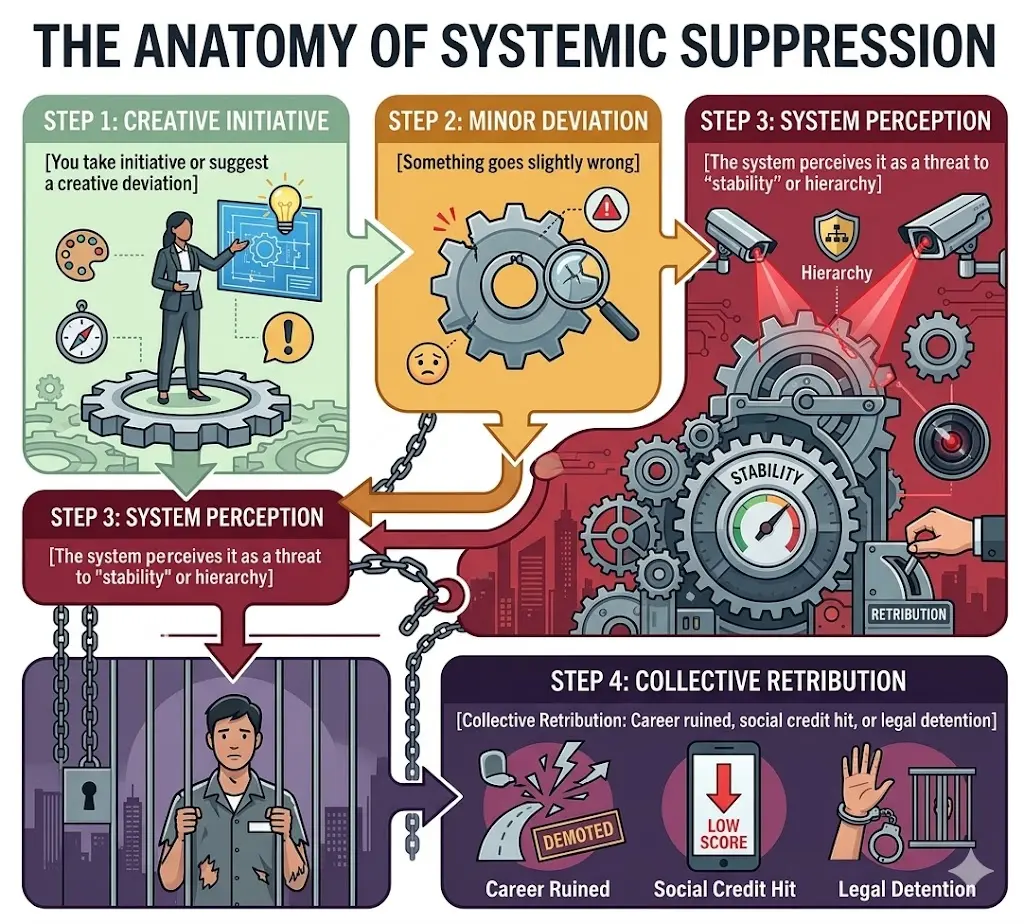
Because the penalties for failing outside the prescribed boxes are total, the smart play is always to mimic, copy, and conform. This creates a society that can optimize, scale, and build existing technologies at terrifying speed, but panics when faced with open-ended, creative problem-solving. Everyone is playing defense.
5. The Trap of Past Merits: The “Five Thousand Years” Extortion
China’s favorite geopolitical argument is its age. No diplomatic meeting or state-run documentary passes without a reminder that China possesses “5,000 years of unbroken history.” The economic miracle of the 1990s and 2000s—where China became the “Factory of the World” through cheap labor, massive infrastructure investment, and rapid urbanization—is treated as the natural restoration of its historical throne.
But this old formula has hit a brick wall in the mid-2020s:
- The Demographic Collapse: The legacy of the brutal One-Child Policy (1979–2015)—where millions of forced abortions and sterilizations were carried out—has caught up. China is now aging faster than any society in history. It is running out of young workers to fuel its factories.
- The Diminishing Returns of Concrete: You can only build so many ghost cities, empty high-speed rail lines, and twelve-lane highways before the debt becomes toxic. The real estate market, which once drove 30% of the GDP, is an exhausted balloon.
- The Chilling Effect on Tech: By cracking down on its own domestic tech giants (like Alibaba and Tencent) to ensure they don’t become more powerful than the Party, the state effectively neutered its own engines of future growth.
You cannot bully your way into the high-tech, AI-driven economy of 2026 using the authoritarian, heavy-industrial playbook of 1996. The state wants the fruits of creative genius but refuses to grant the freedom of thought required to grow them.
6. Diagnosis: The Karma of Heavy Inertia
China is not going to collapse tomorrow. The Western punditry that has spent the last thirty years predicting the imminent “fall of Beijing” fundamentally misunderstands the depth of Chinese resilience. The system finances its current stagnation through an unmatched capacity of its population to absorb pain, sacrifice comforts, and tolerate immense pressure for the sake of national pride.
The real karmic curse of China is not collapse; it is stagnation and the loneliness of the anthill.
The heaviest lesson that the nation refuses to learn is that true stability comes from trust, not from total surveillance; and greatness is measured by the freedom of a society to think, not its capacity to conform. By choosing to treat its own people as units of economic output and potential security threats rather than autonomous citizens, the system has locked itself into a cycle of permanent anxiety.
As long as the nation remains terrified of its own historical ghosts, it will continue to march in perfect, glittering, high-tech formation—rich, powerful, and deeply afraid of the dark.
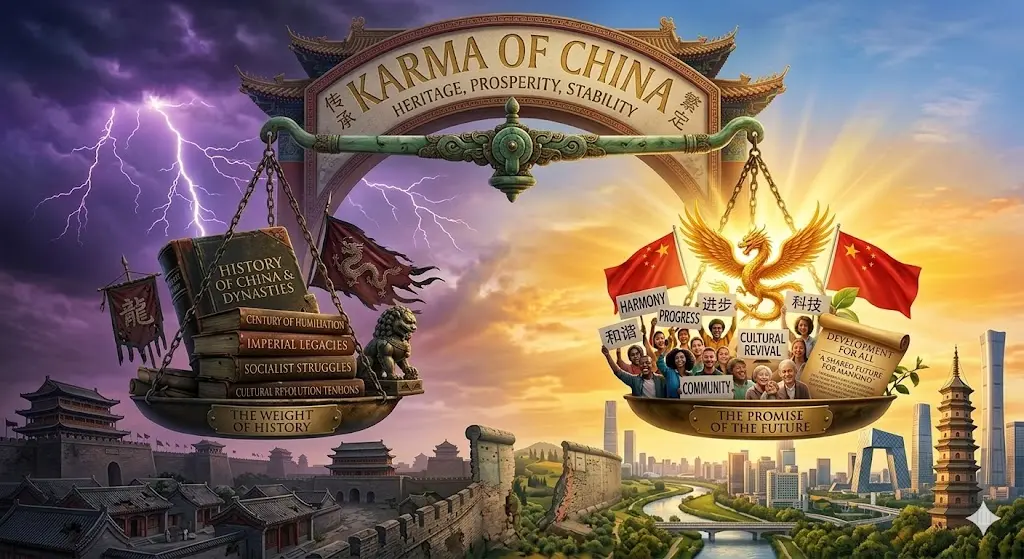
How this analysis was written
This analysis was written as a cultural and psychological interpretation, not as a neutral political report or a prediction of China’s future.
It draws on Chinese history, modern political memory, social behavior, demographic trends, work culture, and recurring national narratives. The goal was not to describe every aspect of China, but to identify the deep psychological patterns that continue to shape its collective behavior: fear of chaos, obsession with stability, historical humiliation, competitive pressure, distrust, discipline, endurance and the search for control.
Historical references were used as symbolic and psychological anchors. The article does not claim that all Chinese people think alike, nor does it reduce a civilization of more than a billion people to one fixed character. It looks instead at repeated patterns that appear in institutions, public narratives, family expectations, political culture and everyday survival strategies.
The word “karma” is used here in a historical and psychological sense: as the accumulated consequence of choices, traumas, silences and unresolved collective fears.
Sources / Further Reading:
Julia Lovell, The Opium War: Drugs, Dreams and the Making of ChinaAlison A. Kaufman, The “Century of Humiliation” and China’s National NarrativesRana Mitter, China’s Good War: How World War II Is Shaping a New NationalismFrank Dikötter, Mao’s Great Famine: The History of China’s Most Devastating CatastropheRoderick MacFarquhar and Michael Schoenhals, Mao’s Last RevolutionLouisa Lim, The People’s Republic of Amnesia: Tiananmen RevisitedAmnesty International, People’s Republic of China: Preliminary Findings on Killings of Unarmed CiviliansUN Human Rights Office, Assessment of Human Rights Concerns in the Xinjiang Uyghur Autonomous RegionCarl Minzner, End of an Era: How China’s Authoritarian Revival Is Undermining Its RiseChina Perspectives, The 996 Working Pattern in Chinese Internet FirmsRhodium Group, China’s Demographic Future Is NowRAND Corporation, China’s Aging Population and the Implications for Its Future